search

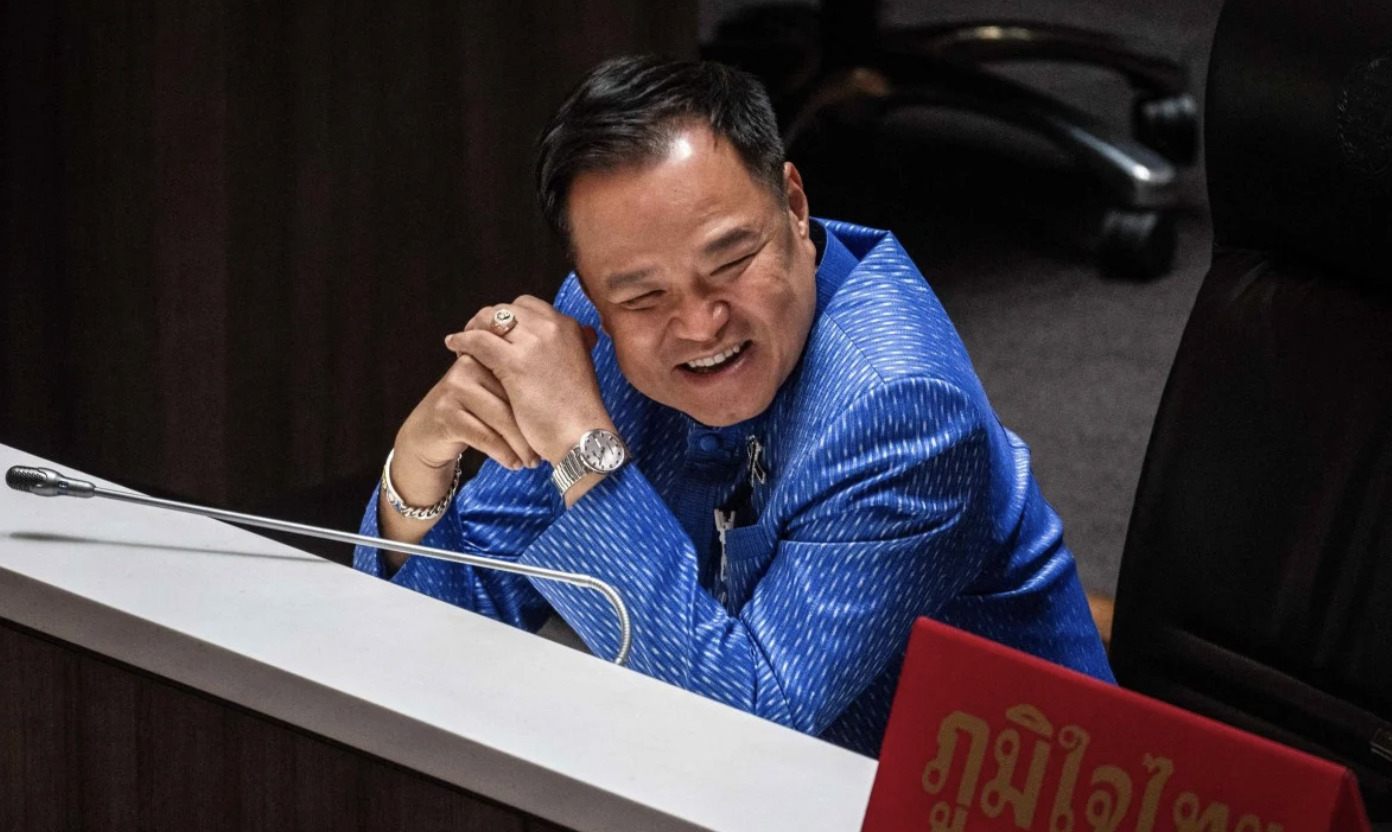
Anutin Charnvirakul elected Thailand's new prime minister. Credit: AFP
Twin Crisis Tests Conservative Rule in Thailand
30 June 2026/6 Minutes of Reading
Confronting Twin Crisis
When the Bhumjaithai Party (BJT) returned to power following the February 2026 elections, it rode on the back of conservative support triggered by the country’s border dispute with Cambodia. However, less than a month after the formation of the new BJT-led coalition government, this localised security crisis was eclipsed by the outbreak of the Iran war in West Asia.
The conflict swiftly disrupted global energy markets and maritime trade routes, presenting an immediate threat to Thailand’s economic stability. Consequently, the new administration was forced to shift its focus from containing a regional crisis to managing a global one.
Prime Minister Anutin Charnvirakul has got his work cut out for him. He inherited an economy that has been caught in a low-growth equilibrium since the Covid-19 pandemic. Its current projected GDP growth is the second lowest in Southeast Asia, and the rise in global energy prices has forced it to run current account deficits in spite of generating export revenues that would have been trade surpluses in normal times.
As a net importer of oil, Thailand is exceptionally vulnerable to energy shocks. It imports roughly 50% of its crude oil – accounting for around 6% of its GDP – and relies on imported liquified natural gas (LNG),which contributes 27% to its total gas supply needed for 66% of its domestic power output.
At the same time, the cost of sourcing alternative LNG cargo has risen by an estimated 125%—all while the Thai baht has depreciated by 5.3% and headline inflation is hovering at 2.9%. The labour market, though likely to improve from the expansion in agriculture and services, will nonetheless experience a 0.94% rise in the unemployment rate compared to the same period last year.
The government has since approved a US$5.4b stimulus package to mitigate stagflation risk and inflationary pressures. But consumer subsidy schemes do not come cheap. The cabinet’s approved borrowing of more than US$6.13b to finance these programmes is expected to raise public debt to 68% of its GDP by the third quarter of this year—just 2% shy of its official ceiling.
The Iran War has hit Thailand’s consumer confidence harder than anywhere else in Asia. While export-led growth remains high at 23.1%, total exports and purchasing power are expected to soften as higher imports of capital goods and raw materials continue to push the country’s trade deficit to its widest level on record since 1991. These economic pressures are likely to have significant political consequences for the newly elected government.
Stress Testing Thailand’s Leadership
The BJT’s electoral victory marks the first time a conservative party had won a general election in this century, which is noteworthy given that all seven of Thailand’s general elections from 2005 to 2023 had been won by counter-hegemonic parties which opposed or at least in some way criticised the royalist political order.
Nearly all the elected civilian governments during this period were either blocked from power or removed by a coup.
The BJT is ostensibly insulated from royalist interference, but we might expect it to suffer from a protracted crisis.
First, the party relies heavily on the continuous distribution of state patronage to maintain provincial loyalty. If the crisis dries up the government budget, the party can no longer count on its material promises to placate the coalition’s various factions. This may cause its network of local brokers and voters to split and disintegrate.
By continuing a hardline stance against Cambodia, the government has essentially inherited a two-front crisis that directly undermines its own economic goals.
In its election manifesto, the BJT vowed to continue its “half-half plus” programme of co-payment subsidies, introduce new tax exemption/redemption schemes for ageing workers, and even construct a wall between Thailand and Cambodia.
How the government is going to finance these programmes is now up in the air as they require substantial public funding at a time when increasing levels of public and consumer debt are likely to constrain the government’s ability to quickly mobilise fiscal resources to implement them.
The rent-seeking imperatives of baan yai (big house) coalitions will also be a challenge to consider in light of the shrinking economic pie.
Indeed, the imperatives of policymaking often do not sit well with patronage politics. As we recall, Thailand from the interwar to the post-World War II period was a “bureaucratic polity”–a regime characterised by the elevation of civilian and military elements above societal forces. This arrangement encouraged the formation of and competition between bureaucratic factions that often turned fratricidal.
Under the BJT, rent-seekers may again clash with technocrats to disrupt the policy apparatus—as they did, for instance, under the Chatichai Choonhavan government of 1988 to 1991. Or they may ally with external cliques or business cronies to form opaque partnerships that partly contributed to the worst effects of the 1997 Asian Financial Crisis.
Second, the BJT lacks a core ideology, which is crucial for containing factionalism.
In Thailand, party leaders are always vulnerable to defections by politicians within their own ranks who feel they might have better prospects elsewhere. Prime ministers are always under the threat of policy blackmail by coalition partners for the same reason.
This is worrying because many elected governments in Thailand have ended in this way, if not because of a coup. This risk is likely going to persist under the BJT given that, while the ruling coalition is 292-member strong, it is in reality split across 15 to 16 parties.
Many of these parties compete for the same voter base, and any shortfall in internal discipline would drastically increase the effective number of veto players in parliament, leading to fragmented control over policy.
Third, the parliamentary opposition will not go easy on the BJT. It consists of the reformist People’s Party (PP), the junta-splinter Klatham Party (KP) and the former ruling Democrat Party (DP). This coalition, while likely to be fragmented, is unusually broad, comprising the radical progressives, middle-class liberals and traditional conservatives. Their combined total is a solid 207 seats.
Notably, the PP topped the separate party-list vote in 215 constituencies compared to the BJT’s 56 in the last election. It also swept all 33 seats in Bangkok—a social constituency known historically for its conservatism. This indicates that substantial pockets of non-BJT support remain intact.
The KP, on the other hand, has begun to rapidly consolidate its party organisation, positioning itself as the BJT’s direct challenger in the northern, central plains, northeast and southern constituencies. The DP is the oldest party in Thailand and is the ideological rival of the BJT.
Combined, any government missteps will likely be fiercely scrutinised.
Saving Graces
So far, the BJT has avoided the public backlash that has struck its neighbours elsewhere in the region, such as Indonesia, where disgruntled fishermen in Central Java led demonstrations over their grim trawling prospects, and the Philippines, where transportation drivers in Manila took to the streets to protest against gas prices that have more than doubled since the outbreak of the war.
There are at least three factors underpinning the BJT’s capacity to weather the crisis. The first is that the party appears to enjoy substantial support within the royalist establishment, which wields the totality of discursive, financial, judicial and coercive power in the country. This gives the party a high level of state legitimation.
By receiving the King’s blessing, the BJT appears less vulnerable to removal by a military coup or via the increasingly common mechanism of a “judicial coup” orchestrated by the National Anti-Corruption Commission, the Constitutional Court, and the Election Commission. Furthermore, its inviting privy councillors to ministerial meetings underscores its close relationship with the palace.
In this way, the BJT is subject to few of the normal constraints of Thai governments.
The second is that the party seems to be responding to the crisis with calculated personnel appointments. Unlike the patronage cabinets of previous crisis-inflicted governments, the current cabinet is technocratic: five of its seven deputy prime ministers have backgrounds in academia, civil service and the professions. The other two are placed as strategic powerbrokers to maintain political peace.
Three popular ministers were also retained from the first Anutin cabinet. The current energy minister is a trailblazer known for his “death ground” approach to public governance, while the prime minister himself was the much-praised health minister during the pandemic. For the most part, this is a highly qualified team that enjoys the support of the public.
The third is that the BJT indirectly controls the Senate. This is crucial because in a bicameral system, all bills proposed by the Lower House must be reviewed and passed by the Upper House. Securing the Senate’s cooperation ensures the swift passage of emergency decrees. Furthermore, this control gives the party broad latitude over policy and constitutional reform, which it can leverage to pre-empt meaningful political change or even to strengthen the post-coup power structure.
High Stakes
The BJT administration is currently sitting at a crucial inflection point as it seeks fuller consolidation of its position within the country’s powerful royalist establishment. Elite relations remain fluid, which means that frequent cabinet reshuffles are expected given that the BJT has no outright majority and must divide its party quotas in order to avoid a fallout with its coalition partners.
At the same time, we may expect rival elites to capitalise on mass grievances to mobilise pressure on the government. The probability of mass-level actions will increase as the crisis prolongs further. Based on current trends, however, the country’s ongoing transition from a military autocracy to a civilian-led “proxy regime” seems likely to continue.
The views expressed are those of the authors and do not necessarily reflect those of STRAT.O.SPHERE CONSULTING PTE LTD.
This article is published under a Creative Commons Licence. Republications minimally require: 1) credit authors and their institutions, and; 2) credit to STRAT.O.SPHERE CONSULTING PTE LTD and include a link back to either our home page or the article’s URL.