search


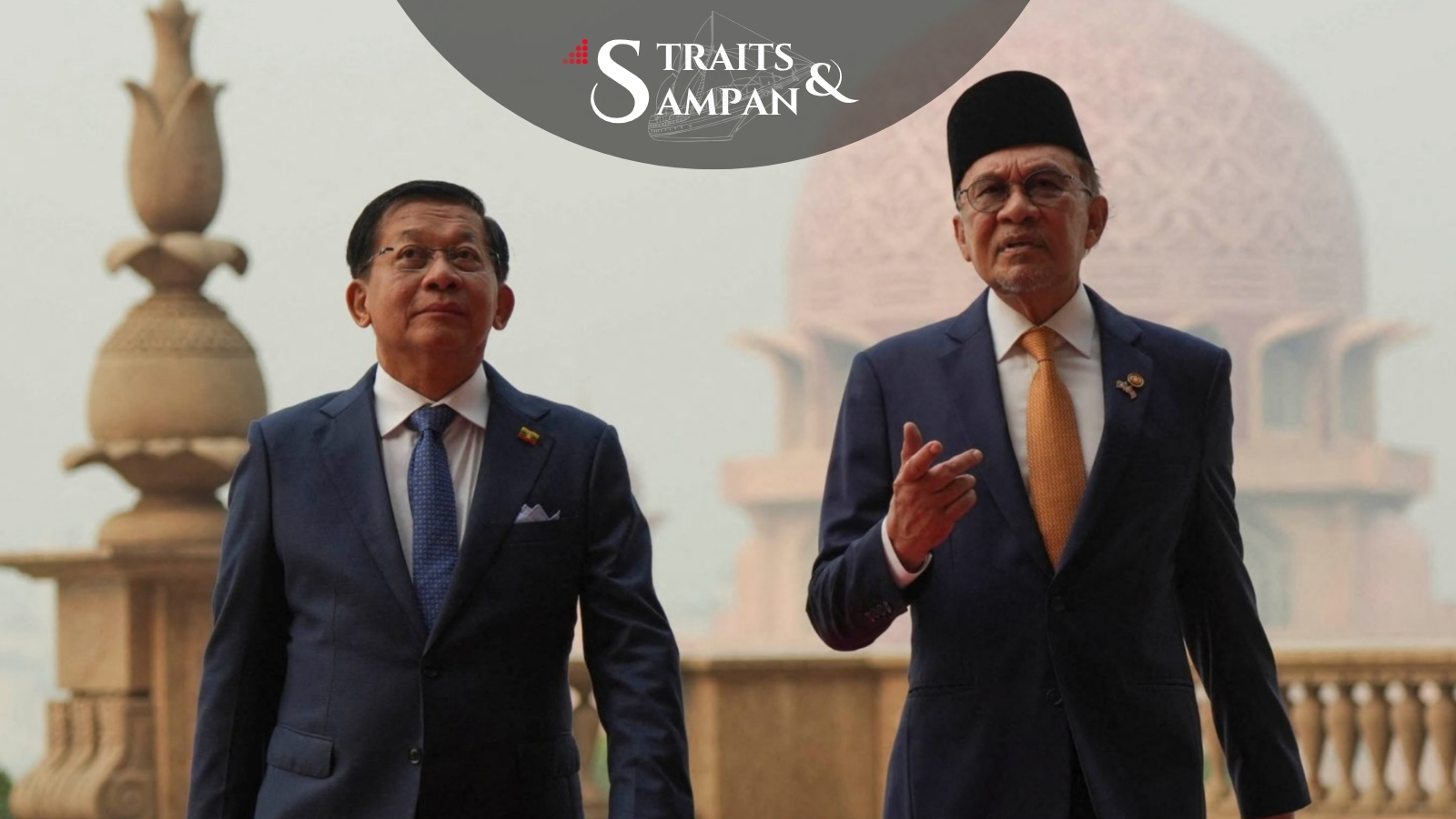
Prime Minister Anwar Ibrahim and Burmese President Min Aung Hlaing in Putrajaya, 8 October 2026. The transboundary haze from Indonesia is visible in the background. Credit: Reuters
From Palestine to Myanmar
21 October 2026/5 Minutes of Reading
Stark Contrast
As I explored in the first part of this series, “Ahead of GE16, Who Needs Whom?”, Malaysia’s electoral landscape is currently defined by a fractured electorate, where coalition fluidity reigns at the state level and the domestic alliances binding the federal government remain fundamentally uneasy.
Against this deeply fragmented backdrop, Malaysia’s foreign policy under Prime Minister Anwar Ibrahim reveals an increasingly important feature of the political contest ahead of the 16th General Election (GE16).
Public sentiment over international crises has become a potent political resource, allowing Anwar to reinforce his leadership credentials, respond to domestic grievances and appeal to constituencies whose electoral interests do not necessarily align.
The stark contrast between the government’s approach to Palestine and Myanmar is particularly revealing of this strategy.
Anwar has positioned himself prominently and unequivocally in defence of Palestinian rights on the global stage. Conversely, however, the same government has pursued the repatriation of Myanmar nationals amid a troubling and growing anti-Rohingya sentiment in Malaysia.
These dual positions emerge from vastly different diplomatic and domestic circumstances, but both carry distinct political connotations for the incumbent administration.
In the first case, it shows the government responds directly to powerful domestic demands for international solidarity; in the other, it demonstrates its capitulation to populist demands for tighter immigration control.
By balancing global Islamic leadership on Gaza with hardline domestic policy on Myanmar, Anwar is seen as attempting to consolidate opposing sources of political legitimacy at one.
The central question, then, is whether Anwar can convert these competing public sentiments into tangible electoral support without critically weakening the reformist identity of Parti Keadilan Rakyat (PKR), his political platform.
The inherent difficulty of this balancing act, however, is that the audiences he seeks to satisfy harbour different expectations and expressions of broad support for his leadership on global issues do not necessarily translate into votes for his party at the ballot box.
Foreign Policy as an Electoral Resource
To understand this dynamic, Robert Putnam’s theory of two-level games is instructive: it explains how governments negotiate internationally while simultaneously responding to pressing domestic political constraints.
However, the Malaysian case also illustrates something altogether more proactive. Latest developments show us how political leaders can actively weaponise international issues to influence domestic perceptions of their leadership.
Anwar operates within a fragmented political landscape where Malay-Muslim political legitimacy remains strongly contested, while PKR’s traditional multiracial and reformist supporters are increasingly concerned about the sluggish pace of institutional change.
In an environment where the electorate is highly polarised and political alliances are transactional, foreign policy provides a unique opportunity to respond to both audiences without directly confronting every thorny domestic disagreement. It gives Anwar a common cause that unites people and lifts him above messy domestic politics.
The utility of this strategy is well-documented in Malaysian political academia. Research published by the ISEAS-Yusof Ishak Institute has demonstrated how successive Malaysian governments have historically used the Palestinian struggle to reinforce Islamic political legitimacy at home.
Building on this trajectory, a more recent study examines Anwar’s specific Gaza rhetoric through the conceptual framework of civilisational populism, arguing that his articulation of Muslim solidarity also functions to respond to domestic challenges from conservative Islamist opponents.
The reasoning behind this strategy is straightforward. High-profile international advocacy enables Anwar to demonstrate unyielding conviction, moral authority, and statesmanship, which are all the qualities that can significantly strengthen his public standing even when domestic policy remains heavily contested and bogged down by coalition friction.
Palestine and the Malay-Muslim Vote
Anwar’s fervent support for Palestine cannot reasonably be explained entirely through the lens of cynical electoral calculations.
His deep engagement with Islamic political causes and the Palestinian struggle stretches back decades, long before he assumed the premiership. Nevertheless, his current position as prime minister undeniably gives that longstanding commitment a very different political function.
By championing the Palestinian cause on international platforms, Anwar effectively neutralises one of the primary avenues of attack from ethno-religious opposition parties.
For instance, it becomes exceedingly difficult for conservative opponents to paint him as purely “secular” or sufficiently “pro-Western” when he is internationally recognised for condemning Western hypocrisy regarding the crisis in Gaza.
Yet, there is also an important and often overlooked distinction between gaining political legitimacy and gaining actual votes. Palestine is a uniquely unifying issue in Malaysia because it already commands massive support across all party lines.
Anwar’s advocacy may undeniably strengthen his personal leadership image, but its ultimate electoral value depends on whether voters associate that image with PKR rather than simply approving of Malaysia’s overarching national position.
History and voting patterns suggest that Malay-Muslim voters who traditionally back conservative or nationalist opposition parties are highly unlikely to cross the aisle to vote for Pakatan Harapan (PH) solely based on a shared foreign policy stance.
While they may applaud Anwar the statesman, their electoral choices are ultimately driven by domestic identity politics and localised socioeconomic concerns.
Relying on foreign policy credentials will not be enough to secure crucial electoral majorities, especially when local economic anxieties, such as the rising cost of living, inflation and subsidy rationalisations dominate the electorate’s immediate daily issues.
The Myanmar Paradox and the Reformist Dilemma
While the Palestinian issue is actively leveraged to court the conservative majority, the government’s handling of Myanmar nationals exposes a different, far more pragmatic facet of its electoral strategy.
The systemic repatriation of individuals to a conflict-torn Myanmar directly contradicts the fundamental human rights principles that PKR and its progressive allies have historically championed.
However, this policy is executed against the backdrop of rising anti-Rohingya sentiment and broader xenophobia within the Malaysian electorate. The discourse surrounding migrants and refugees has become increasingly weaponised by political opportunists to exploit nationalist anxieties.
By tightening immigration controls and facilitating these repatriations, such approach signals the act of bowing to a populist approach through prioritising immediate political appeasement over international human rights norms.
This presents a complex balancing act for PKR’s more urban, progressive base. Although vocal supporters expect the coalition to uphold a firm moral stance on refugee rights and Naypyidaw’s junta, some nonetheless harbour support for the government’s current policy towards the Rohingya.
Indeed, some within the urban electorate may quietly accept the government’s tighter immigration controls as a necessary, pragmatic response to current domestic economic and social anxieties.
The political calculation here appears to be one of measured risk. The government seemingly calculates that despite this progressive faction – which is influential in the discourse but may not be as electorally dominant – it may have limited viable alternatives.
The prevailing anxiety over the prospect of an ultra-conversative government post-GE16 keeps much of the multiracial electorate tethered to Anwar’s coalition, mitigating the immediate fallout from these ideological compromises.
Still, assuming this base will turn out unconditionally carries more subtle electoral vulnerabilities. As these voters evaluate the cautious pace of institutional reforms, the primary threat is not a mass defection to the opposition but rather creeping political fatigue.
A depressed voter turnout driven by disillusionment and apathy in marginal, mixed-demographic constituencies could prove fatal for the ruling coalition when GE16 arrives.
The Limits of Sentimental Politics
Relying on public sentiment generated by foreign crises is ultimately a high-risk, low-yield strategy for securing long-term electoral dominance.
Anwar’s navigation of these international issues undoubtedly showcases his prowess as a global diplomat and his political awareness of Malaysia’s domestic vulnerabilities. However, the translation of international grandstanding into domestic electoral capital remains a fundamentally inefficient mechanism and can also be short-sighted.
While strong, resonant stances on global issues provide temporary buffers against opposition attacks and offer a brief respite from internal coalition tensions, they cannot replace the fundamental importance of domestic governance.
Malaysian voters may cheer for a leader who stands up for the oppressed abroad, but they cast their ballots based on the material realities they face at home.
The true test for Anwar Ibrahim, then, is not whether he can continue to eloquently articulate Malaysia’s stance on the global stage, but whether he can decisively pivot from managing competing public sentiments to delivering substantive domestic policies.
Without that critical transition, neither the international praise he wins on Palestine nor the pragmatic trade-offs made on Myanmar will translate into the votes required to sustain his administration at home.
The views expressed are those of the authors and do not necessarily reflect those of STRAT.O.SPHERE CONSULTING PTE LTD. This article is published under a Creative Commons Licence.
Republications minimally require: 1) credit authors and their institutions, and; 2) credit to STRAT.O.SPHERE CONSULTING PTE LTD and include a link back to either our home page or the article’s URL.