search


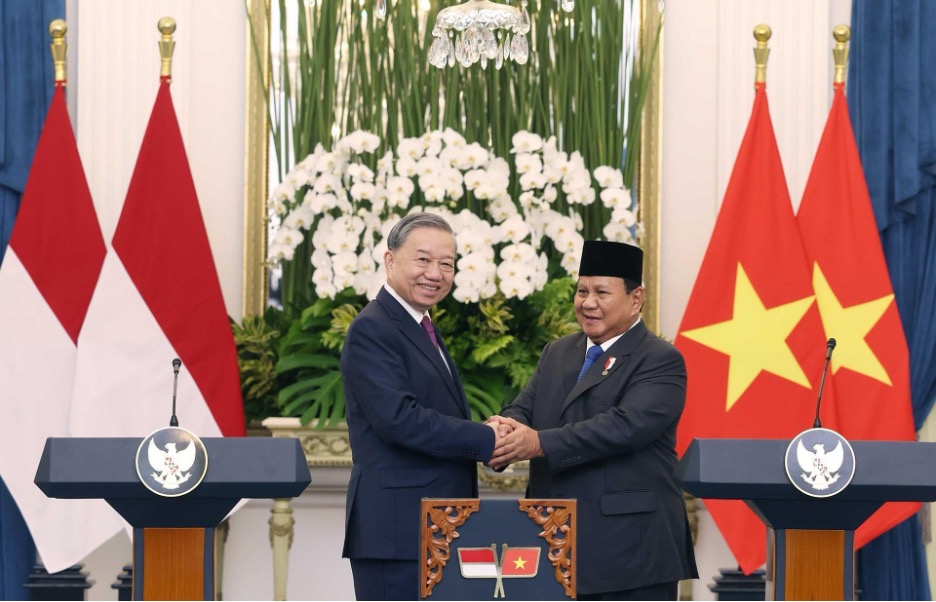
Presidents Prabowo Subianto and To Lam, the latter of which is also Vietnam’s Communist Party General Secretary, shook hands during a press conference at the Merdeka Palace in Jakarta, Indonesia, 10 March 2025. Credit: (Reuters/Ajeng Dinar Ulfiana)
Pragmatists in Chief
22 October 2026/5 Minutes of Reading
Introduction
In Southeast Asia’s diplomatic culture, the head of state diplomacy is a primary element that should not be dismissed.
In recent years, examples from Indonesia and Vietnam have demonstrated how head of state diplomacy is more effective, fast and progressive than diplomatic processes spearheaded by foreign ministers.
Consider President Prabowo Subianto of Indonesia. In his first two years in office, he has made around 54 foreign visits to 28 countries, surpassing any Indonesian leader in modern history. Dino Patti Djalal, the country’s celebrated diplomat and former deputy foreign minister, even pointed out how Prabowo’s travels exceed the United Nations secretary general’s.
On a similar vein, though less frequently, is Vietnam’s President and General Secretary To Lam, who visited 16 countries in his first year in office, more extensively than any of his predecessors did.
But frequency should not be a benchmark for success and effectiveness. There is a need to examine whether the head of state diplomacy, in the cases of Indonesia and Vietnam, truly delivers concrete results for both nations.
Understanding Foreign Policy Processes
The rules and institutions governing foreign policy shape how both leaders approach head of state diplomacy.
Indonesia’s multiparty democratic system gives Prabowo considerable executive authority, especially given his big coalition and limited opposition in Dewan Perwakilan Rakyat (House of Representatives – DPR).
However, his move to centralise foreign policy process on the president’s office, often with limited involvement from Kementerian Luar Negeri (Foreign Ministry – Kemenlu), risks weakening institutional coordination and parliamentary scrutiny.
In Vietnam, To Lam’s dual role as both president and general secretary of Dan Cong san Viet Nam (Communist Party of Vietnam – CPV) has made him the most powerful leader in the post-Doi Moi era, giving him considerable power over the formulation of the country’s foreign policy.
Yet, unlike Prabowo, To Lam has made efforts to strengthen institutional involvement. In January 2025, the CPV adopted two resolutions placing international integration and foreign affairs among the central pillars of national development, reinforcing their strategic importance.
Despite these institutional differences, both leaders have emphasised on strategic autonomy.
Prabowo upholds Indonesia’s bebas aktif (independent and active) principle, upholding the non-alignment principle and adopting the “good neighbour policy”. Meanwhile, To Lam promotes Vietnam’s bamboo diplomacy, which underscores flexibility and independence in preserving sovereignty.
These principles provide both leaders with a framework for engaging major powers, while their respective political and institutional arrangements shape how that diplomacy is conducted.
Effectiveness
Both have used foreign policy to achieve their top agenda, which is domestic economic growth.
For Indonesia, the government must pursue several milestones in order to achieve Prabowo’s 8% economic growth target by 2029.
One of them is the conclusion of the Indonesia-European Union Comprehensive Economic Partnership Agreement (IEU-CEPA). After negotiations stalled for a decade, an agreement was finally achieved under Prabowo’s administration in July 2025. Prabowo himself flew to Brussels to meet European Commission President Ursula von der Leyen to seal the deal.
The biggest highlight of the partnership includes the agreement between Indonesia and the EU to eliminate more than 98% of tariff lines and 99% of the total value of imports. The agreement is set to enter into force by the end of 2026.
For Vietnam, To Lam targets a 10% growth by the end of 2026, having achieved an 8% GDP growth in 2025.
To Lam has personally spearheaded some of the economic diplomacy efforts; among them was his state visit to China in August 2024, which resulted in 14 agreements.
One key outcome was China’s pledge to assist Vietnam in upgrading the Lang Son-Ha Noi and Mong Cai-Ha Long-Hai Phong railway lines to standard gauge.
During the visit, China also presented the completed feasibility study for the construction of the Lao Cai-Ha Noi-Hai Phong railway, which will directly connect northern Vietnam’s rail system with southwest China’s.
Other highlights included plant quarantine and food export of frozen durian from Vietnam to China, which is a new opportunity for agricultural trade between the two countries. Thanks to this, Vietnam’s durian shipments to China reached US$562 million in October 2025, a year-on-year increase of almost 200%.
The above depiction shows how both countries’ head of state diplomacy prove effective in trade negotiations, which demand a flexible transactional mindset and acute interpersonal skills.
Downsides
However, the head of state diplomacy also means that much is hanging on the person’s skills and character—a change in leadership, therefore, could throw current policies out the window or phase out the personalistic touch that the previous leader employs.
In other words, policy consistency is not guaranteed.
In Indonesia, furthermore, this diplomatic style has backfired. The joint statement that was issued during Prabowo’s maiden trip as president to China went against Indonesia’s long-standing position of rejecting China’s “nine-dash or ten-dash line” claim.
Although it was later clarified that Indonesia still does not recognise China’s “nine-dash line”, the incident still sparked criticism over the Prabowo’s perceived lack of mastery of established foreign policy position.
Meanwhile, Prabowo’s frequent foreign visits and lack of coordination with Kemenlu has often drawn criticism that he prioritises these trips over urgent matters at home, while making foreign policy increasingly personalised at the same time.
This was best exemplified when Prabowo attended a military parade in Beijing at the invitation of President Xi Jinping in September 2025, despite nationwide riots that occurred only days before.
His appointment of Armanatha Nasir, a career diplomat, to replace Sugiono, Prabowo’s loyalist, as foreign minister may signal an effort to strengthen diplomatic expertise and institutional coordination. Time will tell if this will be the case.
In Vietnam’s case, when President Donald Trump announced the “Liberation Day” tariff in 2025, To Lam was the first Southeast Asian leader to make a direct phone call with the US leader to discuss tariff negotiations.
The series of leader-to-leader negotiations that followed was initially praised and seen as necessary, considering the United States is Vietnam’s largest export market. Analysts have also pointed out that To Lam’s approach was forward-leaning and risk-tolerant.
However, it has also been pointed out that the negotiations encompassed a fast-tracking of the Trump Organization’s US$1.5b golf resort in Hun Yen province, emphasising the transactional nature of the process. The project has also been considered Trump’s “trump card” in his dealing with Vietnam, potentially inflating the US bargaining position on Vietnam henceforth.
Similarly, To Lam’s broader campaign to eliminate bureaucratic red tape and redundancy in government institutions, which includes retiring and laying off 100,000 civil servants, has raised concerns about the centralisation of decision-making power.
The Ministry of Foreign Affairs, specifically, shrunk by 42.5%, losing 17 of its 40 organisational units.
While these changes may improve administrative efficiency and attract foreign investment over the long term, critics question whether the streamlining comes at the expense of institutional checks and accountability.
Conclusion
Gauging from the explanation above, the diplomacy efforts undertaken by Prabowo and To Lam demonstrate both the potential and risks of head of state diplomacy.
Perhaps, today’s global context has also allowed for more leaders to exercise this type of diplomacy. Today’s age of strongman, where individuals like Trump, Xi, Vladimir Putin and Recep Tayyip Erdogan reign in their respective domains, may have inspired leaders anywhere to “take matters into their own hands”.
As evidenced above, this is not necessarily a bad thing—leaders that believe in speed, agility and directness may actually get things done. The tradeoff is, as mentioned, the potential rise of policy consistency and the lack of involvement of established institutions in the foreign policy process, which could pave the way for miscalculation.
The head of state diplomacy has undoubtedly raised Indonesia’s and Vietnam’s international profile, for better or worse. It has also accelerated negotiations and advanced economic priorities, provided that they are complemented with institutional support.
Without active coordination, expert advice and oversight, the head of state diplomacy risks miscalculation or descending into an individual’s personal agenda. The challenge for both countries, therefore, is to equip this diplomacy style with foreign policy that remains consistent, institutionally grounded and aligned with long-term national interests.
The views expressed are those of the authors and do not necessarily reflect those of STRAT.O.SPHERE CONSULTING PTE LTD. This article is published under a Creative Commons Licence.
Republications minimally require: 1) credit authors and their institutions, and; 2) credit to STRAT.O.SPHERE CONSULTING PTE LTD and include a link back to either our home page or the article’s URL.