search

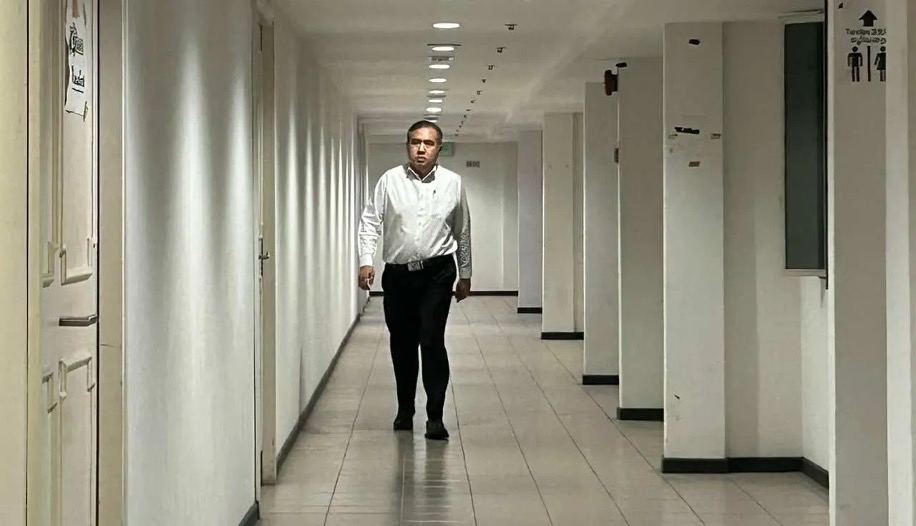
Minister of Transport Anthony Loke lost his state seat Chennah at the 2026 Negeri Sembilan state election, prompting his resignation as DAP chairman in Negeri Sembilan. Credit: Seth Akmal/Astro AWANI
Reading Pakatan Harapan’s Defeat in Negeri Sembilan
14 August 2026/6 Minutes of Reading
Another Electoral Defeat
The 2026 Negeri Sembilan state election has concluded, with 103 candidates contesting the state’s 36 seats.
After a strong performance in Johor just weeks earlier, Barisan Nasional (BN) emerged as the largest bloc, winning 18 seats, while Perikatan Nasional (PN) secured seven. Together, the two coalitions hold 25 seats, enough to form the state government. Their combined seats even make up the two-thirds majority in the state assembly (see Table 1).
Meanwhile, the poor outing of Prime Minister Anwar Ibrahim and his Pakatan Harapan (PH) coalition raises further questions about their electoral appeal.
The result marks a striking recovery for BN, which won only 14 seats in the 2023 election. This year’s election itself was unexpected—another poll was not due until 2028, but a constitutional crisis earlier in the year, which involved the state’s royal institution, forced its conduct.
The controversy soon spilt into state politics. The United Malays National Organisation (UMNO), a BN component and then a partner in the PH-led state government, withdrew support for Chief Minister Aminuddin Harun over his handling of the palace dispute.
What began as a royal and constitutional dispute quickly spiralled into a political crisis, raising questions over constitutional authority, royal legitimacy and the durability of the PH-BN arrangement.
Table 1: Negeri Sembilan 2026 State Election Result
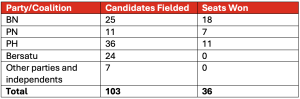
Source: Election Commission of Malaysia
Key Factors
PH’s poor outcome was more than simply another state election defeat.
Two significant outcomes highlight this: the loss of Democratic Action Party (DAP) Secretary-General Anthony Loke of his state seat in Chennah and the defeat of Aminuddin in Linggi carried symbolic significance and demonstrated the scale of the setback, respectively.
Together, these outcomes dealt a serious blow to Anwar’s administration and raised questions about PH’s direction, reform credentials and ability to retain support across communities. However, Anwar’s broader predicament can be classified into three different but interrelated factors.
Firstly, the electoral understanding between BN and PN. By avoiding contests against one another, the two blocs reduced the possibility of splitting the anti-PH vote while obtaining the boon of presenting themselves as a platform for Malay political unity.
This message appeared to resonate with voters who saw greater Malay solidarity as a response to their economic concerns. Negeri Sembilan thus emerged as a testing ground for this strategy for future contests, notably Melaka’s state election and the eventual 16th General Election (GE16).
The scale of Malay vote consolidation was visible in the Palong constituency, where Malays made up 92.22% of the electorate. The BN candidate secured 88.15% of the vote, compared with only 8.5% gained by PH and 3.35% by Partai Pribumi Bersatu Malaysia (Bersatu). While constituency dynamics differ, the result pointed to a strong concentration of support behind BN in an overwhelmingly Malay-majority seat.
More importantly, the effect was not confined to such constituencies. PH components Parti Keadilan Rakyat (PKR) and Parti Amanah Negara (Amanah) performed poorly in mixed-ethnic constituencies, despite their progressive credentials.
PKR retained only Chuah, a Chinese-majority constituency, and Sri Tanjung, where Indian voters form a substantial part of the electorate. Its failures elsewhere suggested that the party was unable to gain or at least retain both Malay and non-Malay support to remain competitive. Amanah, meanwhile, failed to win a single seat.
The BN-PN understanding, on the other hand, translated Malay vote consolidation into a broader state-wide electoral advantage.
In fact, PKR tried to regain Malay support by highlighting controversies surrounding Tabung Haji, a hajj fund SOE for Muslim pilgrimage. The government’s decision to declassify the Royal Commission of Inquiry’s (RCI) report only days before polling renewed attention on weaknesses in accounting practices, politically influenced appointments, questionable investments and excessive bonuses for senior personnel between 2014 and 2020. BN ruled the country during the majority of this period.
However, this stirring up of a storm seemed to impose limited electoral effect. Rather than drawing Malay voters back to PH, the election result suggested that questions of political representation and communal consolidation were ultimately more decisive at the polling stations.
Secondly, Anwar and PH earned a disadvantage from the inability to deliver reform promises. Anwar came to power on a platform of institutional reform, clean government and democratic renewal, but many voters appeared sceptical of his achievements in this department nearly four years into his premiership.
Key reforms – including the separation of the roles of attorney general and public prosecutor, the reduction of political appointments in government-linked companies, and stronger anti-corruption enforcement – were still seen as incomplete or delayed. This created a growing gap between PH’s reformist rhetoric and its record in government.
Among long-time supporters, the slow pace of change contributed to disappointment and political fatigue, while opposition parties increasingly portrayed PH as having compromised or abandoned some of its earlier principles. In Negeri Sembilan, this weakened the coalition’s ability to campaign on reform and moral leadership.
Thirdly, cost-of-living pressures may have contributed significantly to voter dissatisfaction. Many households continue to face higher prices, stagnant or slowly growing incomes, and rising daily expenses, making immediate economic concerns more important than broader political narratives.
Measures such as e-invoicing, tax changes and the rationalisation of diesel and petrol subsidies were closely blamed on the federal government and shaped public perceptions of its economic performance. Although these policies were presented as necessary fiscal reforms, many ordinary voters experienced them primarily as additional financial pressure.
Similar sentiments had also been evident among voters in Johor, suggesting that dissatisfaction over household costs was not confined to Negeri Sembilan but reflected a broader challenge confronting PH.
Troubled Waters Ahead
The election result suggests that PH can no longer take its traditional electoral base for granted.
Non-Malay voters, often described as the coalition’s political “fixed deposit”, showed signs of declining enthusiasm, lower turnout and, in some constituencies, a greater willingness to consider alternatives. At the same time, PH made little progress among Malay voters, leaving the coalition increasingly vulnerable on both sides of Malaysia’s ethnic electoral divide.
Altogether, these present a particularly serious challenge for Anwar. Unless PH can rebuild confidence among non-Malays while developing a more convincing appeal to Malay voters, its multiracial party coalition may continue to lose ground in future state and federal contests.
Pressure is also growing from within the unity government.
DAP, traditionally PH’s largest contributor of elected representatives, will hold its national conference on 16 August 2026. The convention is likely to become an important test of the party’s commitment to the unity government following the recent electoral setbacks.
Remaining in government without securing meaningful reforms risks further frustrating its supporters. However, withdrawing support would severely weaken PH and could destabilise Anwar’s administration, even if it would not automatically bring down the government.
DAP must therefore decide whether remaining in government still offers a credible path towards reform, while Anwar must demonstrate that continued cooperation can produce tangible policy and institutional change.
More troubling is that these external pressures now coincide with growing tensions within PKR itself. Anwar’s scion Nurul Izzah’s decision to relinquish her position as the party’s deputy president is particularly significant, coming only a year after an internal party election that triggered the exodus of staunch Anwar supporters, among them Rafizi Ramli and Nik Nazmi Nik Ahmad.
The fact that both the loser and the eventual winner of such an important intra-party contest could leave PKR within a relatively short period raises concerns about its internal stability, public image, and leadership authority.
In addition, concerns have emerged over constituency funding allocations. Ampang MP Rodziah Ismail alleged that her office’s access to the MyKhas allocation system had been suspended, following similar restrictions involving Subang MP Wong Chen and Petaling Jaya MP Lee Chean Chung. All three MPs are widely perceived as being aligned with Rafizi’s faction within PKR. Wong Chen subsequently resigned as MP at the time of writing.
MyKhas, administered by the Implementation Coordination Unit under the Prime Minister’s Department, is used to manage constituency development funds for welfare assistance, community programmes and local infrastructure projects.
This latest development has raised questions over whether the restrictions are administrative in nature or reflect a broader effort by Anwar to politically sideline figures associated with Rafizi.
Taken together, these developments suggest that Anwar’s challenge is no longer confined to rebuilding electoral support. He must also manage coalition dissatisfaction, contain internal divisions within PKR and demonstrate that his leadership remains capable of holding together an increasingly uneasy political alliance.
Conclusion
The Negeri Sembilan defeat is a warning that PH’s existing political strategy may no longer be sustainable.
The coalition appears to be losing support among some non-Malay supporters without making sufficient gains among Malay voters, while public frustration over reforms and living costs continues to deepen.
More electoral tests are likely to follow. Melaka could hold an early state election in the coming months, while speculation continues over whether Anwar might seek an early federal mandate before GE16 is due in 2028.
This leaves Anwar with limited time to rebuild trust, deliver visible reforms and restore confidence in his coalition. He must deliver visible reforms, address bread-and-butter concerns and offer a clearer political direction capable of appealing across ethnic lines.
Negeri Sembilan has spoken. It is now time for Anwar and his coalition to listen.
The views expressed are those of the authors and do not necessarily reflect those of STRAT.O.SPHERE CONSULTING PTE LTD. This article is published under Creative Commons Licence.
Republications minimally require: 1) credit authors and their institutions, and; 2) credit to STRAT.O.SPHERE CONSULTING PTE LTD and include a link back to either our home page or the article’s URL.