search


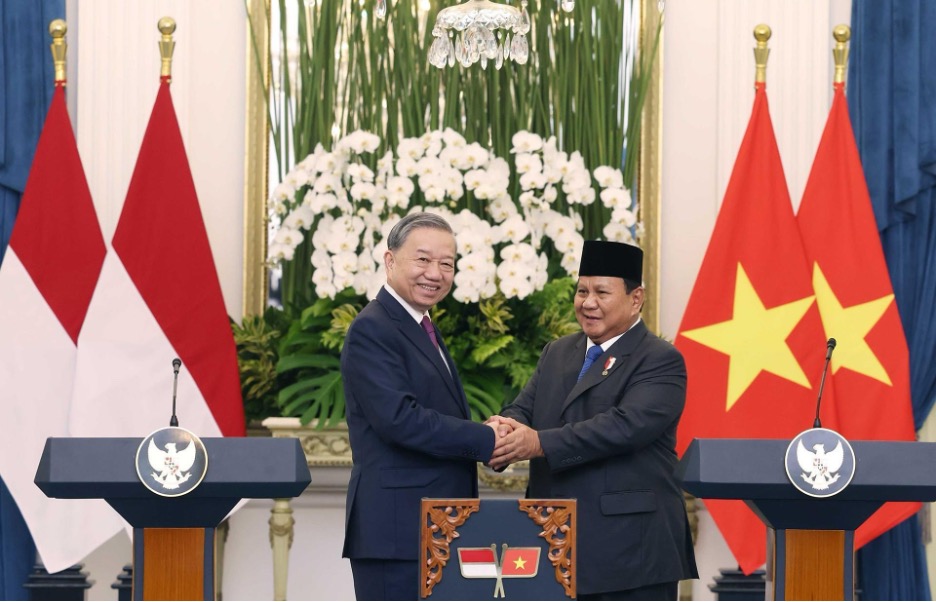
Former top cop To Lam sworn in as Vietnam’s new state president. Credit: Associated Press
Transition to Personalist Rule in Vietnam?
April 17, 2026 / 8 minutes of reading
Introduction
On 15 March 2026, Vietnam held elections for its 16th National Assembly (NA) and People’s Councils. The victory of the Communist Party of Vietnam (CPV) was never in doubt.
What made this election significant, however, was its place in the country’s leadership transition following the death of Nguyen Phu Trong – the party’s former general secretary – in 2024.
On 7 April, the newly convened NA formally ratified General Secretary To Lam’s assumption of the State Presidency, effectively merging the party and state posts under a single leader.
Historically, Vietnamese ruling elites have avoided formally merging these roles, even as other socialist systems such as China moved toward stronger personal leadership under President Xi Jinping.
This ratified merger marks the most significant restructuring of the country’s power-sharing system in decades and signals a dramatic shift from collective leadership toward a more personalist model of rule.
At stake is the future of the “Five Pillars” system—the informal quinquevirate through which political power has flowed and upon which four decades of political stability have rested.
Although the NA’s decision suggests strong elite consensus, countervailing forces within the regime are likely to persist, particularly among those wary of institutional change and the prospect of one-man dominance.
How did Vietnam arrive at this moment, and who might still resist the shift?
The 14th Party Congress
From 19 to 23 January, roughly 1,600 delegates convened at the 14th National Congress of the CPV to select a new cohort of leaders for the next five years.
The Congress elected 180 members and 20 alternates to the Central Committee (CC), 71 of whom were newcomers. Roughly 46 of the 200 members came from the military and security establishments.
This is nearly double the military’s representation of 23 members in 2021, further entrenching the institution as the largest voting bloc within the CC.
Most of the remaining members were drawn from central and provincial governments, with smaller contingents coming from the party apparatus, mass organisations and state-owned enterprises (SOEs).
Despite the reduction of provinces from 63 to 34, provincial representation remains strong.
The CC subsequently elected a 19-member Politburo, nine of whom are new. The reshuffle suggests the growing strength of a security-based faction. Most importantly, Lam – who has assumed the offices of the Minister of Public Security and State President – was unanimously confirmed as General Secretary, the most powerful post in Vietnam’s political system.
Other key bodies, including the Secretariat and the Central Inspection Commission, were filled swiftly, likely reflecting decisions that were horse-traded well before the Congress convened.
The People’s Army of Vietnam (VPA), once among the most sceptical of Lam’s reforms, appears to have acquiesced to the new balance of power.
Yet the marginalisation of Defence Minister Phan Van Giang – now ranked 7th in the Politburo – and General Luong Cuong’s retirement as State President may leave some elements of the military feeling sidelined.
Meanwhile, the ideologically puritan “party faction” has not mounted open resistance, perhaps reflecting the decline of its political influence since Trong’s death.
Elite Management in the CPV
Lam’s apparent path to dominance does not mean he faces no opposition.
Historically, three factions have shaped CPV politics: an ideological faction, a technocratic-reformist faction and a “buffer” faction. Conflict has typically centred on the first two.
The most notable confrontation occurred in 2012 between former general secretary Nguyen Phu Trong and then prime minister Nguyen Tan Dung. Trong attempted to remove Dung over corruption and economic mismanagement, but the CC blocked the move.
Dung survived by consolidating support among provincial leaders and SOEs. Crucially, he even appeared to be positioning himself for the State Presidency.
He ultimately failed. After serving two terms as prime minister, Dung lost the presidency to Trong, who assumed the office after Tran Dai Quang’s death in 2018.
Lam is better positioned than Dung ever was. He controls the security and central party apparatuses and lacks Dung’s reputation for crony capitalism. Even so, his reforms have created new frictions.
His retrenchment of large numbers of civil servants in the name of bureaucratic reform has likely alienated the old technocratic faction traditionally associated with the prime minister and cabinet.
A key institutional rival here is the Central Government apparatus, which was led by former prime minister Pham Minh Chinh and is now being placated by Le Minh Hung, his successor and an ally of Lam. At one time, Chinh was thought to be in line for the party leadership after Trong.
Now, both Chinh and Luong Cuong, who represent key civilian and military constituencies, have been excluded from the new Politburo. Their absence from the top leadership is striking.
Although the calm response may imply political acquiescence, both figures retain deep networks within the party and government. Chinh maintains strong ties with the ideological faction, while Cuong is a former army general with authoritative links to the military bloc. Their exclusion may yet generate resistance.
Aware of these risks, Lam has moved carefully to build his own version of China’s “coalition of the weak” on top of strengthening “friendly” elite networks linked to his home province of Hung Yen, which recently sent 24 delegates to the CC—the second-highest total after Ninh Binh.
He has recruited young party hopefuls, retired old guards and “tainted” former officials, including figures like former party leader Nong Duc Manh and ex-premier Dung.
Notably, Dung leads the powerful “capital and interest faction” in the south, which is known for its extensive pro-business and pro-Western networks. This group will burnish the technocratic credentials of Lam’s coalition, in addition to helping him actualise his ambitious growth strategy.
By awarding coveted honours such as the Golden Star and the Military Exploit Order to some of its members, Lam appears to be signalling, if only ostensibly, that these groups still have a place in the emerging political order, thus subduing them while leveraging their political strength to counterbalance rival elites in the conclave.
Personalist Power Creep?
Vietnam’s collective leadership model has long distributed responsibility across various state institutions, reducing the risks associated with personalist rule. The dismantling of the “Five Pillars” system would concentrate accountability – and vulnerability – in a single office.
Although other state institutions will remain formally separate, they are led by Lam’s allies, creating de facto control by a single faction or man. This would represent the strongest concentration of power in one individual since 1991.
The very fact that the 14th congressional session was cut short by two days suggests that most of the delegates may have already long consented to the de facto merger of the two offices under Lam, who is now primus inter pares within the ruling clique.
Yet personalisation carries risks. For instance, Lam’s attempt to fast-track the promotion of Nguyen Duy Ngoc – his former deputy in the Ministry of Public Security – was met with some resistance from party elites. This is on top of the steady supply of conservative and ideological pushbacks that reformists often face in the party.
There should be no doubt that the merger of the party and state positions will ruffle some feathers for practical reasons alone, as it closes off a key avenue for career advancement among senior party members, undermines existing patronage networks, and limits access to the lucrative perquisites associated with holding high office.
The enhanced powers of Lam’s Central Party apparatus over the Central Government, NA and Vietnamese Fatherland Front – the CPV’s mass mobilisation vehicle – may also be ephemeral as it would still have to ratify policy decisions via the NA and most importantly the CC which can overturn decisions made by the Politburo. The CC, unlike other state organisations, is relatively pluralistic and therefore harder to dominate by any one faction.
The key question now is whether Lam can sustain his elite management strategy over the long term.
In Saudi Arabia, Mohammed bin Salman (MBS) consolidated power by sidelining rivals within the court and centralising authority with the help of state security and intelligence services. The lack of internal opposition then allowed him to seamlessly oversee ambitious reforms.
Conversely, personalist rule can unravel quickly, as revealed in Gabon when Ali Bongo’s tightly controlled state collapsed after a military coup created the conditions for well-connected elites to double down and unite against him.
In authoritarian regimes, personalisation can strengthen short-term regime control while simultaneously increasing the risk of elite defections, coups or succession crises. By reshaping the foundations of executive authority, personalism reshapes the rules of elite accountability. Vietnam under Lam may be entering precisely such a phase.
No Certain Outcomes
The country’s “personalist turn” comes as it navigates slowing global trade, supply-chain realignment and mounting pressure to sustain high economic growth.
Lam’s consolidation of power may bring greater policy coherence and faster decision-making in the short term. But it also weakens the collective leadership model that has underpinned decades of political stability. Whether this shift ultimately strengthens or destabilises the one-party regime will depend on Lam’s ability to manage elite relations and maintain cohesion within the party, military and bureaucracy. The durability of Vietnam’s carefully calibrated authoritarian order may now hinge on the success – or limits – of one man’s political project.
This article is published under a Creative Commons Licence. Republications minimally require 1) credit authors and their institutions, and 2) credit to STRAT.O.SPHERE CONSULTING PTE LTD and include a link back to either our home page or the article URL.