search

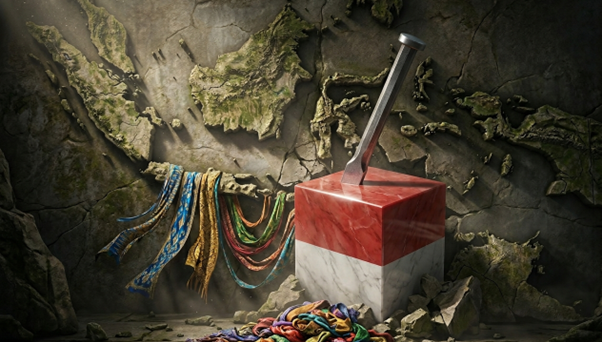
Any attempt to “liberate” history from colonial hands often results in a different kind of entrapment: an anachronistic, state-driven “imagined community” that risks erasing the very diversity it claims to protect. Credit: Google Gemini
Essay: Whose Indonesia? Whose Nusantara?
April 17, 2026 / 8 minutes of reading
Introduction
There have been efforts by the current Ministry of Culture to consolidate and promote the Indonesian national identity, which have manifested in a 10-volume official history of Indonesia that is to be Indonesian-centric.
It follows the trend in the post-colonial world, where there is an understandable sense of urgency to erase evidence of imperial hands and presence. It is also against this backdrop that the Indonesian government sees it natural that a previously colonised nation desires to detach itself from the memory of its oppressor, that the response to subjugation is liberation.
However, nations that narrativise history or exclude external accounts to foster a rhetoric of independence should be cautioned against omission. Thus, while the recent call for Indonesian-centric research and history under the government may seem like a valiant effort by the colonised to reclaim their past, Indonesia must still be subjected to the same scrutiny.
The Nation
The main issue that arises from this project is the lack of a clear definition for “Indonesian-centric.” One potential way to explain this is that Indonesia has fallen into the trappings of a post-colonial nation-building effort. As a plausible consequence, its existence is a disjuncture of history rather than a continuation, making it rather haphazard.
To better understand Indonesia’s arbitrariness as a nation, Benedict Anderson’s Imagined Community and his definition of the nation are necessary.
To Anderson, the nation feels concrete, and this stems from its necessity in the post-World War II era, in which the world has been forced into a clear division into a nation-state system. In this age, individuals may never meet despite being tethered to a socio-cultural imaginary of strict boundaries and adhering to a strong sense of horizontal fraternity. The nation is tangible enough that people would put their lives on the line for it. Anderson uses such a framework to explain post-colonial societies in Southeast Asia, drawing examples from Indonesia, the Philippines and others.
But still, the nation remains imaginary.
Anderson proposes that this post-war global architecture would lead to a paradox between “the objective modernity of nations to the historian’s eye vs. their subjective antiquity in the eyes of nationalists.” While the state promotes the nation as a temporally universal, authoritative category, the historian subjects it to the critique of being a very contemporary creation.
This conflict is necessary to understand that this article is not a condemnation of the actions of the Ministry of Culture, nor is it suggesting the redundancy of its efforts to promote a much-needed revisit to Indonesia’s history. Rather, it seeks to highlight that the conflict between the needs of the state in fostering nationalism and the suspicion of the historian is inescapable, as Anderson predicts.
Whose Indonesia?
Returning to Indonesia’s arbitrariness, we must start by looking at its composition. With over 17,000 islands, 1,000 ethnic groups and 500 languages, Indonesia is home to a wildly diverse population, whose people inherited the lands of a constellation of kingdoms and tribes. All of this makes it difficult to create a unitary community or identity.
As it stands, the string that ties Aceh and Papua together exists only as their shared trauma of the Dutch Empire. Beyond this, Aceh and Papua are no more interconnected than Japan and Venice in that they reside within the same maritime supply chain.
But if the Dutch colonial encounter is to be the key commonality across the Indonesian archipelago, can the history that precedes this moment be considered as the history of Indonesia and as happening within or to Indonesia?
Consider the example of the first century of the Acehnese Sultanate, starting from the turn of the 16th century. The infamous Cornelius de Houtman, the first Dutch commander to bring a company to the Malay Archipelago, only arrived in Aceh in 1599, and therefore, all events predating this year do not fulfil the Dutch requirement.
Furthermore, consider the reign of Sultan Alauddin Riayat Syah al-Kahar (r 1537-1571). Sultan al-Kahar was the third ruler of the Acehnese Sultanate and is best known for his efforts to ally with the Ottoman Empire against Portuguese aggression in the Strait of Malacca and in the Islamic pepper trade. He even wrote letters to Sultans Suleiman the Magnificent and Selim II appealing for military assistance and protection under the Ottomans.
To him, the region he believed he was serving was bounded to the northern half of Sumatra and perhaps Melaka and Johor, which now belong to a different nation-state entirely. Accordingly, the great encroaching power was not the Dutch; instead, it was the Portuguese. Sultan al-Kahar had not yet conceived of a collective entity beyond this, nor could he understand the magnitude of the Dutch East India Company.
Then perhaps, if not the colonial encounter, the name “Indonesia” could be the commonality, despite the etymology of “Indonesia” being a little dubious.
“Indonesia” is made of “Indo” (east) and “Nesos” (islands). These words are Greek but of British creation. Specifically, it has been attributed to the British ethnologist GW Earl in 1850 and then to the British Lawyer JR Logan who used it specifically in terms of geography. For Logan, it encompassed the “Indian Archipelago”, which comprised most of Indonesia’s islands, with the addition of the Philippines and the subtraction of New Guinea.
The issue that arises once we understand the origins of this name is that no Indonesians were included as part of this naming process and that it only appeared in 1850. This leads to two unanswered issues.
Firstly, if this rewriting of history intends to minimise colonial voices and push for indigenous voices, then what is to be done with borrowed colonial words to describe it?
Secondly, if we apply this name to history before 1850, such as to the period of Sultan al-Kahar in the 16th century, would this not be anachronistic?
Then, if the issue is “Indonesia”, perhaps there is an argument for “Nusantara” and “Nusantara-centric” to be more fitting for this history writing. However, if the goal is liberation, “Nusantara” still brings forward the memory of the binding of the islands in a situation of the conqueror and the conquered.
“Nusantara” is a word created by the Majapahit Empire to describe the islands on the outskirts of the Javanese imagination. These were the islands that were brought forcefully under Majapahit as either a tributary or a vassal state. Thus, choosing “Nusantara” over “Indonesia” should also come with careful consideration, as its use poses the risk of illustrating subjugation within the horizontal comradeship of Indonesia as permissible. The same caution should be applied to anything that the state decides to include or omit.
There is seemingly no other alternative that may more harmoniously describe the confines of the Indonesian nation-state, but perhaps it is just that. In no way was Indonesia truly a collective entity until the republic’s independence in 1945, and we are not bound to see it as such. This is not a call for the dismantling of the nation— it is just the historian critically analysing the employment of history by the state.
Nationalism vs Liberation: Writing History
To address the issue of who is allowed to write history, there must be an understanding that history is transnational, fluid, converging, overlapping and contradicting.
Two accounts of one event can be true to two different parties. The coloniser believed their mission to civilise to be just as true as the terror the colonised had to endure. Both perspectives are needed to understand the full extent of a historical moment. Thus, perhaps, dismembering Indonesia from colonial accounts only compresses its history.
As a historian myself, I, too, believe in the need for Indonesians to write and investigate the stories of the civilisations that lived in this archipelago. However, I am hesitant to disregard certain voices.
I propose that historical liberation manifests as a holistic record of autonomous individuals without chastising whether they or their decisions were morally good or bad. Yet the Ministry’s project moralises histories by prescribing attributes like “positive” and “affirmative” as well as dismissing sources based on authorship rather than content.
When the criterion for inclusion is whether an account flatters the nation, omission is inevitable. This project demands a usable iteration of the past for the state despite incompleteness, which reads like another compressed version of history.
Conclusion
History is always subjective, and this case is no different. The Ministry of Culture’s efforts to rewrite history are motivated by a need to foster national unity and purge colonial bias. Yet when these qualifiers are turned inward to Indonesia, they struggle to hold up. Every available name for this country inherits a legacy of conquest, be it colonial cartography or forced vassalage. The latter forces the Ministry to admit a version of subjugation as acceptable.
In all honesty, the horizontal comradeship Indonesia is supposed to embody has never quite existed beyond the imaginary, and confessing that only brings us closer to a more truthful version of history.
Ultimately, the absence of a clear definition of “Indonesian-centric” forces the dynamic, vibrant and transnational history of this archipelago into the artificial confines of a modern nation-state that could be either anachronistic at best or confusing at worst. Thus, while a turn to the history of this archipelago is necessary and has been long overdue, readers should consider this project as a mechanism of nation-building, not an act of historical liberation.
This article is published under a Creative Commons Licence. Republications minimally require 1) credit authors and their institutions, and 2) credit to STRAT.O.SPHERE CONSULTING PTE LTD and include a link back to either our home page or the article URL.