search

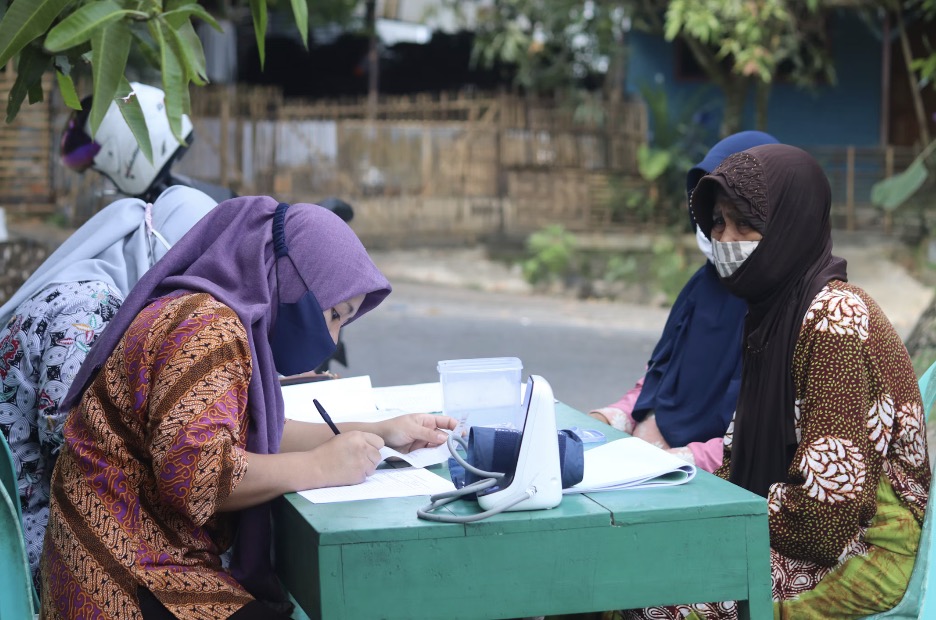
Healthcare volunteers measuring elderly’s blood pressure. Credit: Unsplash/Mufid Majnun
Unsung Frontliners
12 October 2026/5 Minutes of Reading
Introduction
Notwithstanding the years-long emphasis on the Sustainable Development Goals (SDGs), Indonesia’s kader kesehatan (community healthcare workers – CHWs) are still unable to attain decent work as befits the standard of SDG8: Decent Work and Economic Growth.
CHWs mostly work in rural areas and are widely seen as volunteers. They are usually operators of Pos Pelayanan Terpadu (posyandu) or community-based health stations in villages.
A government regulation requires them to master 25 basic competencies and provide care beyond operating posyandu—a whopping number of skills and responsibilities for individuals whose status is that of volunteers, not healthcare professionals.
These include collecting health-related household data, assisting pregnant women, conducting home visits to patients, monitoring children’s development and delivering nutrition programmes to everyone in the community.
In the Indonesian context, volunteerism is deeply rooted in the virtues of gotong royong (mutual cooperation) and civic participation. These values encourage individuals to contribute to the wellbeing of others and to support communities beyond their immediate interests.
In the context of public healthcare, this spirit of volunteerism has enabled CHWs to become important frontliners in delivering primary care and social services, particularly in areas where formal health systems have limited reach.
However, volunteerism should not be understood as an expectation that individuals must provide essential public services without adequate support or compensation. While altruism may motivate CHWs to contribute their time and skills, they are also the executors of the state’s most basic social and healthcare initiatives on which the communities depend.
As of February 2025, more than 304,000 posyandu are supported by approximately 1.4 million CHWs across the country. This establishes them as an important policy target group.
Considering their number and responsibilities, it raises questions as to the decency of their work. The standards of decent work, as articulated by the International Labour Organization (ILO), encompas employment creation, rights at work, social protection and social dialogue.
Unfortunately, in Indonesia, these healthcare volunteers have yet to attain decent work if we go by these standards.
When Volunteerism Becomes a Justification
Research conducted by the 1000 Days Fund – an NGO that aims to eradicate stunting through formalising 1 million CHWs – in Lombok’s two villages captures the issues that might be symptomatic of a wider problem.
The CHWs in Lombok’s two villages dedicate a median of 26 hours per month (6.5 hours per week) to stunting prevention work. In practice, however, local volunteers reported they only received around Rp232,000 (US$12.96) per month. Even this amount does not represent the actual take-home wages; volunteers shared that they must spend extra out-of-pocket money to perform their duties, such as for transportation and communication necessities.
Extra costs like this should not have to be borne by the volunteers who signed up to deliver public health programmes on behalf of the state and whose financial condition is already strained.
Meanwhile, the compensation they receive depends on the budget of each local government, which is also facing considerable challenges from budget cuts from the central government. In other words, the amount of the incentive, if an incentive is provided at all, varies considerably and depends on the local government’s policy commitment.
Furthermore, there is also a question of expanded responsibilities. Following a new government regulation, healthcare volunteers are now tasked with collecting data across six areas of Minimum Service Standards, which are varied and wide-ranging. These include data on prospective newlyweds, pregnant mothers and public nutrition, among others. In some cases, they are also tasked with distributing the government’s Makan Bergizi Gratis (Free Nutritious Meal) programme.
These new tasks sit on top of their more traditional responsibilities mentioned above, giving them an unrealistic workload that the system does not protect them from.
The WHO 2018 guideline – shaped by the ILO decent work agenda – already calls for written contracts specifying healthcare volunteer roles, working conditions, remuneration and workers’ rights. However, evidence shows that Indonesia is still behind on these standards.
Meanwhile, their status as volunteers and lack of a formal contract render them vulnerable to sudden job replacements entirely unrelated to their job performance. This is due to the absence of job security or legal safeguards.
It also directly links to the mistaken and often harmful expectation associated with the label “volunteer”. They are perceived as offering free or cheap labour, often used as a justification to pay them a pittance or prolong a system that disadvantages their standing.
Such an attitude could become detrimental if those in the policy circles also embody it. If decision makers already consider CHWs as doing something other than “real work”, then their time and labour spent are viewed as voluntary contributions that do not require adequate compensation. It could translate into further expansion of CHWs’ workload without a corresponding increase in support.
Exacerbating this is the absence of bargaining power on the part of the volunteers. They have neither a formal mechanism for collective bargaining nor do they retain seats in policymaking processes that affect their working conditions.
Without any of these, CHWs are not equipped to negotiate better workload, compensation, safety or programme design. As programme administrators, they have no involvement in policymaking processes made at national, district or village levels. Their lack of formal representation in this process renders the experience gained from the ground meaningless.
To illustrate this, the Prabowo administration has reallocated a portion of the village funds, which are instrumental to maintain posyandu, to other flagship programmes.
Naturally, this means decreasing financial space for existing village programmes, raising questions as to CHWs’ wages and potentially expanded responsibilities without adequate compensation.
Structural Recognition
If allowed to continue, volunteers in indecent work conditions could quickly develop demotivation, burnout and work attrition.
For instance, demotivation among volunteers in the stunting reduction stream has led to a reduction in the frequency of household visits, which are vital for monitoring child growth and education. This leads to a decline in the overall quality of services provided by the CHWs to families, while also creating problems with volunteer retention. A high turnover can disrupt the continuity of long-term programmes, such as stunting prevention.
Although stunting cadres provide a useful illustration, these challenges are not unique to volunteers solely working on stunting reduction.
CHWs operate across a wide range of public health and social programmes, often serving as the critical link between government services and communities. Their effectiveness, therefore, depends not only on programme-specific training or incentives but also on the broader conditions under which they work.
Addressing these challenges requires more than higher incentives or additional training; it requires structural reform that recognises CHWs as an integral part of public service delivery.
A key policy opportunity lies in strengthening the regulatory and institutional frameworks governing CHWs.
For example, the renewal of Peraturan Presiden tentang Percepatan Penurunan Stunting (Presidential Regulation on the Acceleration of Stunting Reduction), which expired in 2024, provides an opportunity to strengthen the recognition and support of cadres involved in community-level health services.
More broadly, however, such regulatory reform should establish principles that can be applied across different programmes, including nationally standardised and tiered trainings for CHWs.
Such reform should also establish clearly defined roles, responsibilities, appropriate occupational support and adopt sustainable financing mechanisms for cadre incentives. These mechanisms should be integrated into national and local budget planning rather than relying on fragmented or programme-specific arrangements.
Moreover, a realistic compensation framework for CHWs should be based on actual working hours, regional minimum wage standards and full reimbursement of work-related expenses. Operational costs – including transportation, communication and essential supplies – should be covered through dedicated local health budgets rather than deducted from workers’ stipends.
Evidence from Lombok provides an indicative monthly compensation benchmark of approximately Rp731,500-783,000 (US$40.87-43.75) based on the wage-equivalent value of 26 working hours and median out-of-pocket expenses. This is particularly important because the sustainability and quality of community-based public services depend heavily on the people who deliver them.
Ultimately, effective public service delivery at the community level depends not only on ambitious policy targets or well-designed programmes but also on the conditions under which frontline workers are expected to deliver them.
Ensuring decent work for community health workers and cadres requires adequate recognition, fair and sustainable support, appropriate training, safe working conditions, and meaningful institutional protection. Without these foundations, even well-designed programmes risk being undermined by demotivation, burnout and turnover.
Strengthening decent work standards for community-based workers is, therefore, not simply a matter of worker welfare; it is a prerequisite for sustaining the quality, equity and effectiveness of public services.
The views expressed are those of the authors and do not necessarily reflect those of STRAT.O.SPHERE CONSULTING PTE LTD. This article is published under a Creative Commons Licence.
Republications minimally require: 1) credit authors and their institutions, and; 2) credit to STRAT.O.SPHERE CONSULTING PTE LTD and include a link back to either our home page or the article’s URL.