search

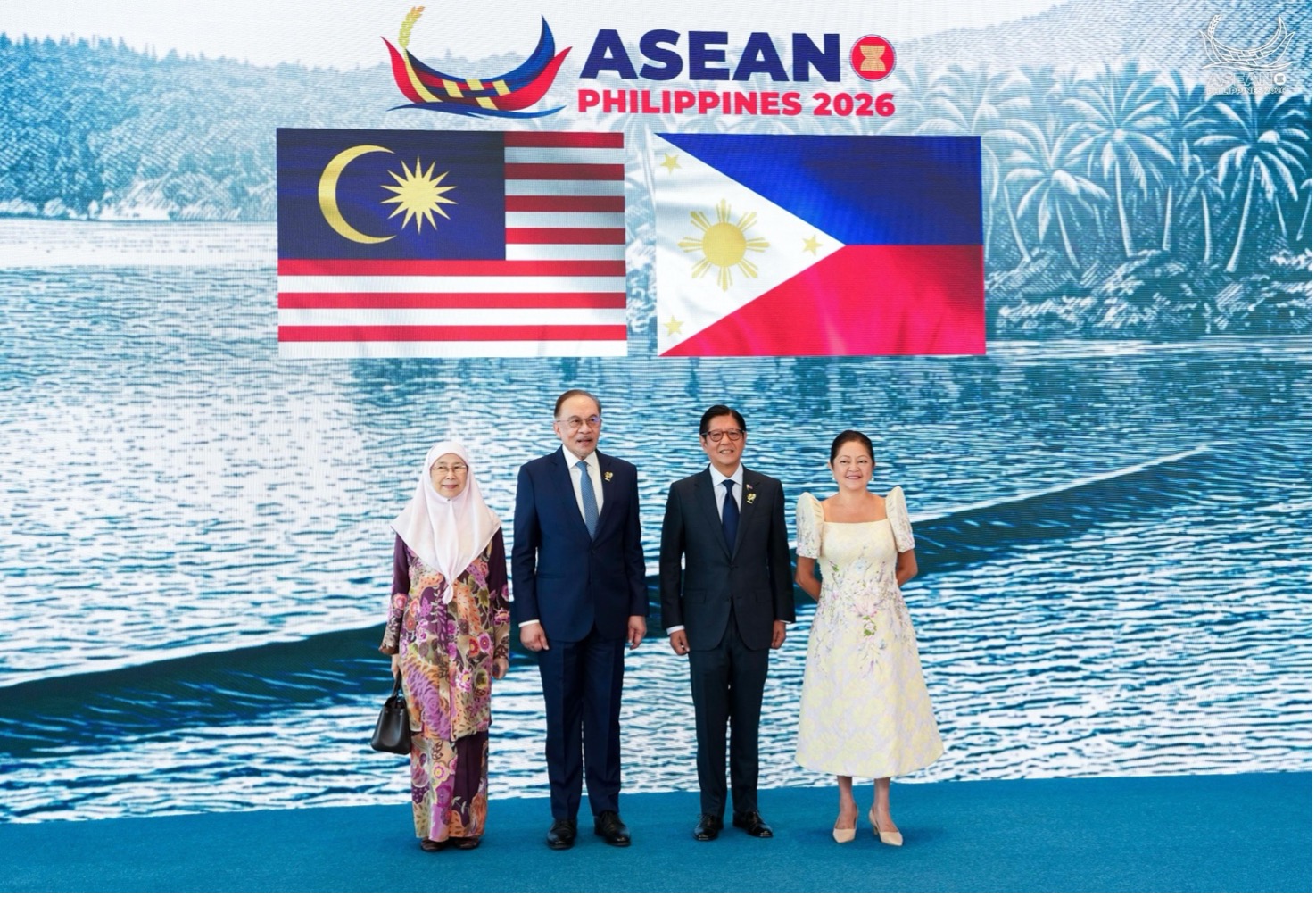
Prime Minister Anwar Ibrahim and President Ferdinand Marcos Jr at the 48th ASEAN Summit in Cebu, 8 May 2026. Credit: Presidential Communications Office/Wikimedia Commons
Behind the Posture: Why Malaysia and the Philippines Diverge on China
4 September 2026/6 Minutes of Reading
Ten Years, One Signature
Ten years ago, an arbitral tribunal in The Hague found no legal basis for China’s expansive claims in the South China Sea. On its anniversary, 14 governments signed a statement reaffirming the finality and legality of the verdict.
Only one of these is a Southeast Asian country: the Philippines, the very country that filed the arbitration case years earlier.
Like other ASEAN countries, Malaysia did not sign the statement, despite the ruling also restricting China’s claim that overlaps Malaysia’s. Conspicuously, a mere 10 days after the statement, the top diplomats of both countries sat in the same room in Manila for the ASEAN Foreign Ministers’ Meeting (AMM), which joint communiqué made no reference to the award at all.
What explains this diverging posture?
Three explanations are on the table, and all of them are structural.
Manila’s reaction is overt and loud because it holds a mutual defence treaty with the United States, while Putrajaya is more circumspect because its economic exposure to China runs deep.
ASEAN’s consensus principle also means that any joint declaration moves at the pace of the organisation’s most reluctant member, so neither Malaysia nor the Philippines can assert much through the bloc regardless of what each of them wants.
While this offers some explanation, it does not capture the whole picture. This piece aims to look at the dynamics inside each country to better explain the divergence in posture vis-à-vis the South China Sea tribunal ruling.
Same Pressure, Different Answers
Both countries are claimant states in the South China Sea territorial dispute. While both found their legal position strengthened by the ruling, each reacted differently.
When it comes to the South China Sea, Malaysia has largely adopted a “light hedging” strategy, often associated with quiet diplomacy, risk avoidance and the deliberate downplaying of Chinese incursions. The Malaysian government employs a low-profile approach and economic pragmatism so as not to antagonise China, its top economic and investment partner.
In contrast, the Philippines favours a “heavy hedging” and “hard balancing” strategy, which involves strong pushback, public condemnation and active resistance. Manila, for instance, has openly confronted China on the issue, pleaded for support on international platforms and even resorted to legal action to justify its own claim.
This divergence in no way assumes that Malaysia puts less emphasis on its claim than the Philippines does. Both countries are actively negotiating the Code of Conduct in the South China Sea between ASEAN Member States (AMS) and China. Both are also facing the same pressure: the rising political, economic and military might of China. Meanwhile, the two countries have security arrangements with the United States, although at different degrees.
Instinctual thinking dictates that if two countries are facing a similar challenge together, then their reactions and counter-strategies should be similar, if not in sync. But that is not the case here.
Institutional Fragmentation
Malaysia’s more diluted response stems from its domestic political reality: that the government, regardless of which administration is in power, has always sought its domestic legitimacy through economic performance rather than through the assertion of sovereignty.
In other words, foreign affairs rarely matter to domestic political calculation and regime maintenance.
Meanwhile, the machinery responsible for addressing the South China Sea issue is fragmented across several channels, leaving no single actor with neither the full mandate nor the incentive to arbitrarily determine the national response, or reaction, to China’s maritime incursion. This includes the ability to escalate or de-escalate the situation—consequently, the country’s overall posture vis-à-vis the South China Sea can be said to be relatively stable and not subject to fluctuations.
This is evidenced by unique developments across different administrations in the last decade. During the premiership of Najib Razak, the government created the Inter-Ministerial Committee on China Affairs to coordinate non-security and functional issues but explicitly excluded the South China Sea dispute from its agenda. While it might seem confusing, the exclusion strategically afforded the government the benefit of ambiguity and room to manoeuvre diplomatically without offending the Chinese mandarins overseeing maritime affairs.
During this administration, the response to the Chinese incursion was also intentionally fragmented. The best example of this occurred in March 2016 when Shahidan Kassim – who was a minister overseeing the Malaysian Maritime Enforcement Agency (MMEA) and the National Security Council (NSC) – accused a Chinese fishing fleet of encroachment near the Luconia Shoals.
However, then defence minister Hishammuddin Hussein and former navy chief admiral Ahmad Kamarulzaman contradicted Shahidan’s statement, claiming that no Chinese ships had been sighted.
Following the tectonic general election in 2018 and a regime change, Mahathir Mohamad’s second administration transferred the purview of the MMEA from the Prime Minister’s Department to the Ministry of Home Affairs, alongside 40 other agencies, in a move to rationalise the structure of the Prime Minister’s Department.
No ministerial explanation was given to explain the MMEA’s transfer—the only rationale on record came a year later from its director-general, who stated that an enforcement agency was better grouped with other similar bodies and agencies.
This fragmented pattern holds under the Unity Government. In 2023, it finalised the purchase of FA-50 fighter jets from South Korea to modernise the navy and air force. However, the purchase was not presented as Malaysia’s answer to Chinese incursion. Because no single agency is tasked with responding to the maritime dispute, nobody is responsible for explaining what the fighter jets are for.
Three Voices in Manila
On the other hand, the Philippines exhibits a different kind of fragmentation, one that is more coalition-based and less isolated compared to Malaysia.
While some states adopt hedging as a deliberate strategic planning, in the Philippines it stems from a bureaucratic “tug-of-war” between the office of the president, the foreign affairs department and the military.
Diverging interests and institutional competition among the three bodies encourage the Philippines’ hedging posture, whereas a convergence of interests among them instigates a balancing act against China.
Convergence under President Ferdinand “Bongbong” Marcos Jr is visible in all three bodies at once. The palace granted the US military access to four additional sites under the Enhanced Defense Cooperation Agreement (EDCA) in 2023. The foreign department filed 63 diplomatic protests against China that year alone (by then 130 since Marcos took office). Furthermore, the military traded its inward, land-centric posture for an outward-looking, maritime defence posture encapsulated in the Comprehensive Archipelagic Defence Concept, which projects force into the exclusive economic zone. By March 2024, an executive order had placed all three inside a single National Maritime Council chaired by the Executive Secretary.
A flare-up of tension in June 2019 demonstrated a similar pattern of divergence as the one seen in Malaysia over the Luconia Shoals debacle. Former defence secretary Delfin Lorenzana condemned the sinking of a Philippine fishing vessel at Reed Bank by a Chinese ship. Then foreign secretary Teodoro Locsin Jr also ruled out any joint investigation with Beijing. Nevertheless, just days later, former president Rodrigo Duterte accepted China’s offer to conduct a joint probe into the incident. Within a week, Lorenzana himself had reclassified the incident as an accident.
Same Disorder, Opposite Effects
Examples presented above display two versions of the same institutional rationale, identified separately but resulting in diametrically opposed outcomes.
In Malaysia, institutional fragmentation has led to the isolation of the South China Sea issue. Without a singular agency that can escalate or de-escalate the situation, Malaysia is not pushed to take any overt position. Domestic political realities also play a part—nobody is campaigning to win elections by telling potential voters that they will claim Malaysia’s portion in the South China Sea.
In the Philippines, because institutional fragmentation is so apparent, foreign policy vis-à-vis China is ultimately a culmination of the interaction of three different bodies. When they are in agreement, they adopt a balancing posture, but when they disagree, the posture appears to appease China.
The examples also show that the posture adopted by each is influenced more by institutional rather than strategic considerations. This has several implications.
Firstly, state posture is more malleable than previously suspected. Previously, questions arose as to whether the passing of ASEAN chairmanship from Malaysia (2025) to the Philippines (2026) would pave the way for a more assertive ASEAN on the South China Sea. However, as demonstrated, the Philippines’ position is not fixed, and this is reflected in this year’s ASEAN joint communiqué on the South China Sea, which barely changed from last year’s. If anything, the 2026 text is softer, dropping the previous year’s reference to accelerating the Code of Conduct.
A chair’s agenda is bound to the machinery that supports it. Rotating the seat to a more assertive claimant does not necessarily translate to a more assertive text.
Secondly, the proposed Code of Conduct warrants similar scepticism. Much has been made of the progress logged so far, yet the deadline for finalisation has been pushed again to the November ASEAN summit. Involved nations must still grapple with three fundamental questions: the Code’s geographical scope, whether it is legally binding and which body enforces its terms. After more than two decades of negotiations, nations are still nowhere near answering these as when they first started.
Thirdly, external partners are at risk of misreading both countries’ postures. Washington, Tokyo and Canberra treat Malaysia’s quiet as consent and the Philippines’ noise as commitment. Each reading mistakes an institutional artefact for a preference, and each builds expectations that neither government is structured to meet.
Neither posture is as fixed as it looks. Neither was chosen in the way the word “strategy” implies. As the saying goes, foreign policy begins at home.
The views expressed are those of the authors and do not necessarily reflect those of STRAT.O.SPHERE CONSULTING PTE LTD. This article is published under a Creative Commons Licence.