search

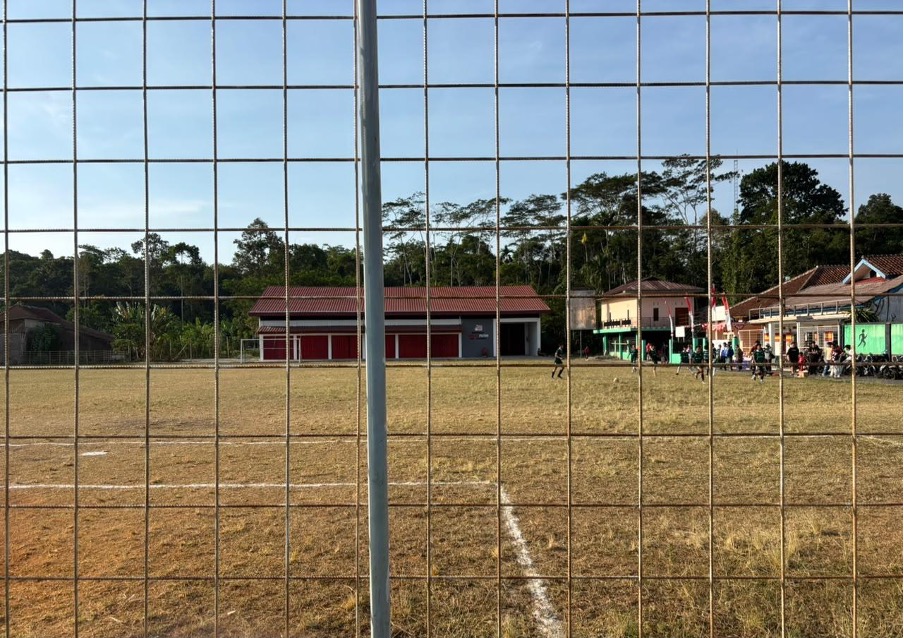
A KDMP side by side with an SD Inpres in Tasikmalaya, West Java, August 2026. Credit: Author’s collection
Hard Questions for Indonesia’s Development
4 September 2026/6 Minutes of Reading
Large-Scale Programmes
In early August, an academic paper became a public sensation for suggesting that President Prabowo Subianto’s Makan Bergizi Gratis (Free and Nutritious Meal – MBG) programme should be nominated for the Nobel Peace Prize.
The paper lists the president as one of its authors but has since been removed from its publishing platform.
Given ongoing discourse about the programme, with many criticising its inefficient execution, proposing it for the Nobel Prize consideration might sound like a stretch. Instead of aiming for international accolades, the more fundamental agenda is how to build institutions and governance that are adaptive to challenges and have a capacity to continuously learn.
This shift also necessitates asking a question about Indonesia’s state of development, specifically what large-scale programmes like MBG reveal about it. This is a timely query against the backdrop of Indonesia’s recently commemorated 81st year of independence.
Feeding Indonesian children is certainly a noble goal. Indeed, if properly implemented, MBG could improve nutrition, reduce persistent stunting and potentially affect children’s educational outcomes.
But good intentions alone do not ensure a programme’s success. Nor does the scale of government spending on it, which is humungous, automatically make this state intervention transformative.
Feeding Minds
In the 1970s, Indonesia had engaged in another large-scale intervention as a response to illiteracy and low access to primary education.
President Soeharto’s response was the issuance of Instruksi Presiden No 10/1973 (Presidential Decree No 10/1973), which ordered the mass establishment of Sekolah Dasar Instruksi Presiden (Presidential Decree Elementary School – SD Inpres).
Using state revenue from the oil boom in the 1970s, the ambition was straightforward: to build schools and improve the country’s human capital.
Over two decades later, a young PhD candidate by the name of Esther Duflo studied SD Inpres as part of her dissertation research. Duflo was less interested in the number of schools built throughout the country than she was in asking deeper questions about the programme.
Her doctoral research examined the programme’s long-term effects on education and labour-market outcomes. She did this by investigating the differences in children’s access to the school across Indonesian regions and cohorts.
Indeed, like today’s MBG, the large scale of SD Inpres development has instigated debates about its impacts.
Duflo’s research highlighted that SD Inpres contributed to higher access to education, which eventually led to an increase in labour participation and earnings. However, a new study in health economics revealed a negative consequence: the increased likelihood of female graduates developing obesity, as higher incomes led to higher consumption of ultra-processed foods.
Duflo would later share the 2019 Nobel Prize in Economic Sciences with others, a recognition for her masterful work in developing a powerful way of understanding how development interventions actually work.
Indonesia can learn something from a famed developmental economist who once studied its education sector—that asking deeper questions and uncovering hidden consequences are more pertinent than counting the numbers.
Indonesia’s Return to State Capitalism
The above story could be juxtaposed against today’s context, whereby Prabowo’s flagship programmes are rolled out on a large scale. Thanks to MBG, the state is now the biggest purchaser of food stuffs and the largest food distributor. Koperasi Desa Merah Putih (Red and White Village Cooperative – KDMP) seeks to strengthen economic institutions and activities at the village level. Meanwhile, Danantara, Indonesia’s super-sized sovereign wealth fund, places state capital and state-owned assets at the centre of a broader development and investment strategy.
Though each targets different goals and operates in distinct domains, they all share a common thread: greater state intervention in market regulation. In fact, the extent of the state’s hand in this matter suggests that it is increasingly attempting to shape the market.
This development is part and parcel of a broader resurgence of state capitalism in Indonesia. While this might raise alarm among certain quarters, it is more urgent to learn from Indonesia’s past experiment with it.
The pros and cons of the SD Inpres debate demand that any large-scale programme should be equally concerned about the quantitative and qualitative aspects, given that “hidden” variables – such as what the obesity research discovered – could lead to less intuitive consequences.
Supporters and detractors of the MBG programme, for instance, each like to highlight the total number of students served with free meals and the number of students suffering from food poisoning. However, participants of the MBG debate should also zoom in on food safety, budget transparency and instances of military intervention within the whole system.
Indeed, MBG has the potential to elevate children’s nutrition levels. However, true to the discussion here, the task of research analysts now is to explore whether MBG has really improved this and reduced malnutrition. Other hidden variables they need to consider include school attendance, concentration and learning, household food expenditure, new markets for local farmers, and local food production.
This is a discussion that requires interdisciplinary approaches that extend beyond the quantitative consideration.
Can the State Build Better Markets?
Expanding this line of inquiry further, a similar question can be asked about KDMP. The village cooperative programme is based on a relatively simple proposition: that stronger local economic institutions could improve the ability of villagers to access goods, finance and markets.
The root problem KDMP aims to tackle is the growing predicament of economic insecurity, as indicated by the rising cases of citizens taking out loans from online platforms or engaging in online gambling. People with limited access to affordable credit, stable income or legitimate economic opportunities can easily turn to predatory financial platforms for quick solutions.
Thus, the deeper question about KDMP is whether the programme, beyond its stated goals of strengthening economic institutions, could also encourage the establishment of legitimate financial services, prudent economic behaviour (e.g. saving) and local employment.
There is an interesting parallel between Indonesia and New York, where Mayor Zohran Mamdani seeks to launch his proposed government-led affordable grocery stores to address high food prices.
Obviously, the contexts between the two are vastly different, but this parallel underscores a similar question. When markets fail to provide essential goods affordably, should governments simply regulate those markets or create alternative institutions?
Danantara elevates this discussion further, considering the amount of money involved. Essentially, Danantara is the embodiment of state capitalism in the financial domain, seeking to mobilise capital, optimise state assets and support strategic investment at a larger scale.
Acknowledging Danantara’s vast potential should be coupled with a separate understanding of the risks it creates. The bigger the capital placed under state control, the more important it is to have a state that is not only sensible to any hidden variables but also actively addressing them.
Danantara is currently facing criticisms over its perceived lack of transparency and conflict of interest. To improve its image and performance, it is incumbent upon the body to also ask deeper questions and discover the not-so-obvious consequences of its operation.
From Political Championship to Policy Learning
Prabowo’s ability to mobilise the state deserves commendation, and he will need to maintain this if his flagship programmes are to continue. Indeed, such a vibrant display of political championship demonstrates his government’s capacity to launch large-scale programmes, but it does not inform us how these will move forward.
For that, it is pertinent that the Prabowo administration develops capacities beyond just programme implementation. The government must engage research analysts, nutritionists, food scientists, geographers, public health specialists, economists, political scientists, sociologists, anthropologists, media scholars and other experts to understand the multidimensional impacts of programmes like MBG.
However, a certain distance must be ensured between these experts and the government so that no political interest could hamper the experts’ research quality, whose independence needs to be guaranteed.
After all, a state that learns, adapts and improves must be open to both positive and negative assessments of the programmes.
There is also a danger in interpreting science-based policy too narrowly. Evidence-based policy does not mean that every policy question should be reduced to a statistical experiment. Quantitative research can tell us whether programmes like MBG have fulfilled certain targets, but qualitative research can help us understand why these targets need to be achieved, how the programmes are designed and implemented, who benefits the most from them, and what the hidden variables are.
As mentioned above, it is not only about numbers; it is also about institutions, culture, relationships, political agenda and everyday practices.
Conclusion
This is perhaps why the 81st anniversary of Indonesia’s independence is an appropriate moment to reflect on another form of independence that receives far less attention: epistemic independence.
For decades, Indonesia has been an extraordinary site of developmental experimentation. Yet much of the most influential knowledge about Indonesia has been produced elsewhere, including that produced by Esther Duflo and other prominent experts.