search


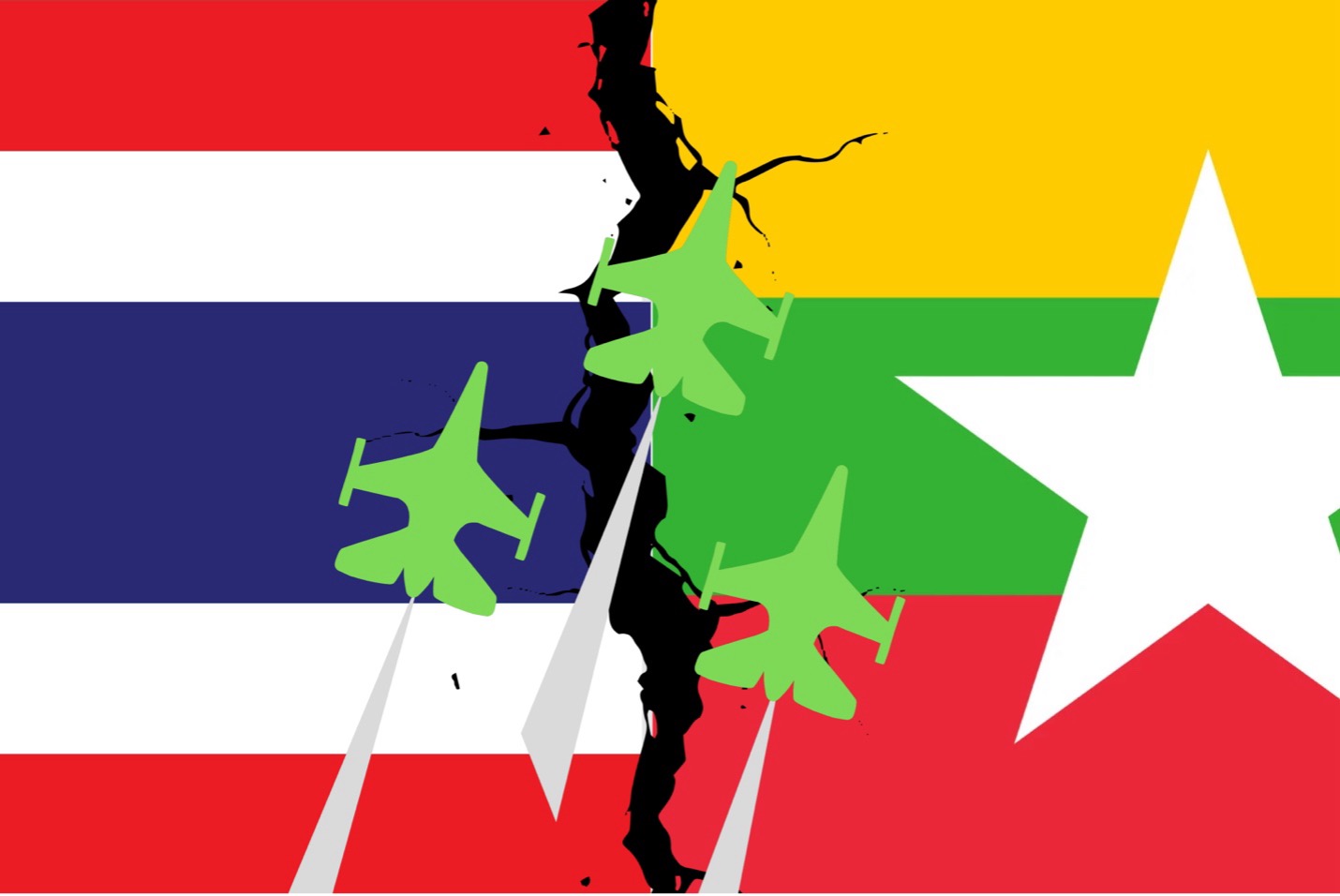
Can fighter jets on strict leashes deter airstrikes on Thailand’s border? Credit: snapshotsfromspira
Fire on the Riverbank
20 November 2026/4 Minutes of Reading
Deterrence on Display
A major Myanmar offensive against Karen resistance bases has brought the conflict to Thailand’s doorstep, particularly in Tak and Mae Hong Son provinces.
Warning shots have been fired and fighter jets are on alert, but these may not be enough to deter Myanmar’s military. It has acquired a newfound confidence from the friendly reception that junta chief-turned-president Min Aung Hlaing has been receiving from members of the international community.
Worse, ASEAN Member States (AMS) have been backtracking on their initial collective stance on Myanmar, pursuing their own interests under the guise of bilateral relations. This suits Myanmar well, as its leaders are in pursuit of the recognition and legitimacy the regime badly wants.
On the surface, it looks and sounds impressive: the Royal Thai Army has deployed armoured vehicles and reinforcements along the Thailand-Myanmar border. Meanwhile, the Royal Thai Air Force has sent F-16 fighter jets to patrol the airspace, secure Thai sovereignty and stop any spillover from the fighting in its western neighbour.
The Armed Conflict Location & Event Data Project (ACLED) noted that “the Myanmar military has repeatedly shown a disregard for Thai sovereignty and civilian safety along the border,” adding that “further spillover remains likely as long as the fight for southern Myawaddy goes on.”
Unanswered Missives
Since the 2021 coup, Thailand has sent more than 80 protest letters to the Myanmar government. Not one has received a reply.
Myanmar’s playbook is to routinely ignore these letters or publicly deflect blame. Following the recent casualties in Tak province, Myanmar claimed that Karen National Union (KNU) and People’s Defence Force (PDF) resistance fighters had deliberately fired ordnance into Thailand to sabotage bilateral relations.
No one believes this, of course, but calling the Myanmar government a bald-faced liar would be too much for Thailand to swallow, especially after Bangkok rolled out the red carpet for Min Aung Hlaing during his recent official visit.
Worse, during the visit, Min Aung Hlaing even called on Thailand to stop the flow of weapons across its border into rebel-held territory.
For decades, both sides avoided talking about the border buffer and the proxy wars along their common border, as the silence served both their purposes. It has long been understood that a friend of Myanmar is a threat to Thailand and that ethnic armed organisations (EAOs) fighting Myanmar could be a friend of Thailand.
For Min Aung Hlaing to raise this during his visit shows how confident the battle-hardened general has become in his newfound status as a so-called civilian president.
He is essentially telling Thailand: you may have friends on the Myanmar side of the border, but those friendships will not come at Myanmar’s expense.
Reactive Restraint
Thailand, for its part, has not been able to move beyond standard protocol. Chief of Defence Forces Gen Ukris Boontanondha summoned Myanmar’s military attaché, Win Thu Lin, to warn that the regime’s operations must not infringe on Thai territory or harm Thai citizens.
Security officials monitoring the situation said Thailand’s warning flares and the scrambling of fighter jets are purely reactive measures rather than a proactive display of military dominance.
The rules of engagement are very strict: the jets must not cross into Myanmar airspace or lock weapons onto the Tatmadaw’s aircraft. The aim is to reassure panicked residents along the border.
Some officials are openly wondering why Thailand will not go a step further and use its radar to track every aircraft, commercial or military, that takes off from airfields inside Myanmar, alerting the Thai military each time. Thailand employs this tactic against Cambodia, but not against Myanmar.
Myanmar does not seem to care. Naypyidaw has also declared that virtually all cross-border activity that does not go through government-installed border posts will not be tolerated and could come under attack. Its latest threats against KNU-linked trade suggest that border attacks, along with the collateral damage and stray rounds they bring, could resume at any time, leaving Thai border communities vulnerable.
These are strong words from the central government. But Myanmar’s regional military command, the Bureau of Special Operations – whose operational mandate covers the entire southeastern border theatre – takes an equally hard line. Because authority has been pushed down to field level, the actual orders come from local forward hubs rather than from offices in the capital.
As it stands, the current dynamic tells the Myanmar military that it can keep launching intense airstrikes right along the riverbank with minimal risk of Thai military retaliation, so long as its jets do not linger inside Thai airspace.
“We used to take comfort in the belief that Myanmar’s jets wouldn’t strike near the riverbanks, because the river’s sharp zigzags make it almost impossible to keep rounds from straying onto Thai soil. Recent incidents show that assumption no longer holds,” said a security officer in Mae Sot who monitors the fighting inside Myanmar.
Complicating the situation along the Mae Sot-Myawaddy corridor even further is the steady flow of Thai and foreign nationals crossing to the Myanmar side to work in scam centres.
The trend took hold after the Myanmar government staged a public-relations stunt by blowing up parts of Shwe Kokko and KK Park, the two largest scam complexes, which had housed more than 20,000 foreign workers, many of whom were lured by what they believed were high-paying IT jobs.
Myanmar publicised the demolitions, which covered only a fraction of the two complexes, to relieve pressure from Beijing and Washington and to burnish its credentials before the election.
But the scam economy largely adapted and moved southward toward areas opposite Kanchanaburi province and deeper into Myanmar, while smaller operations hold out in shophouses and apartment buildings throughout the Myawaddy border town.
Since the Thai military is unwilling to switch on the radar, much less arm the fighter jets flying up and down the border, civilian officials are urging the government to find other ways to send a stronger message to the Myanmar military.
Remaining Leverage
Meanwhile, the Thai government has allowed Naypyidaw to operate five Certificate of Identity (CI) centres on Thai soil to collect taxes and verify identities. Thai officials at the operational level see the centres as a cash cow for both Thai and Myanmar officials. They also say that these centres should be suspended until the Myanmar government gets the message: at the very least, respect Thai sovereignty and territorial integrity, and accept humanitarian norms and principles by ending airstrikes on civilian targets.
Moreover, the CI centres have faced immense local backlash. Labour rights groups argue that forcing low-paid Myanmar workers to remit foreign currency to the cash-strapped country compromises worker safety and undermines Thai sovereignty. More than 2 million Myanmar migrants in Thailand are reportedly boycotting the centres.
It is not clear whether Thai policymakers will take up any of these suggestions. So far, military measures along the border, such as shutting all the “traditional” and unofficial crossing points that EAOs and local villagers (including displaced people) depend heavily on have only played into Naypyidaw’s hands.
Thailand’s kid-glove diplomacy, which calls for normalisation and direct engagement with Naypyidaw, is driven largely by national dependencies such as energy: Myanmar supplies 15% to 20% of Thailand’s natural gas.
However, as for the immediate challenges – reassuring the Thai residents along the border that their safety is not overlooked – it remains to be seen what kind of measures the military will take up. For the time being, anything that greatly upset Myanmar is not on the table.
The views expressed are those of the authors and do not necessarily reflect those of STRAT.O.SPHERE CONSULTING PTE LTD. This article is published under a Creative Commons Licence.
Republications minimally require: 1) credit authors and their institutions, and; 2) credit toSTRAT.O.SPHERE CONSULTING PTE LTD and include a link back to either our home page or the article’s URL.