search

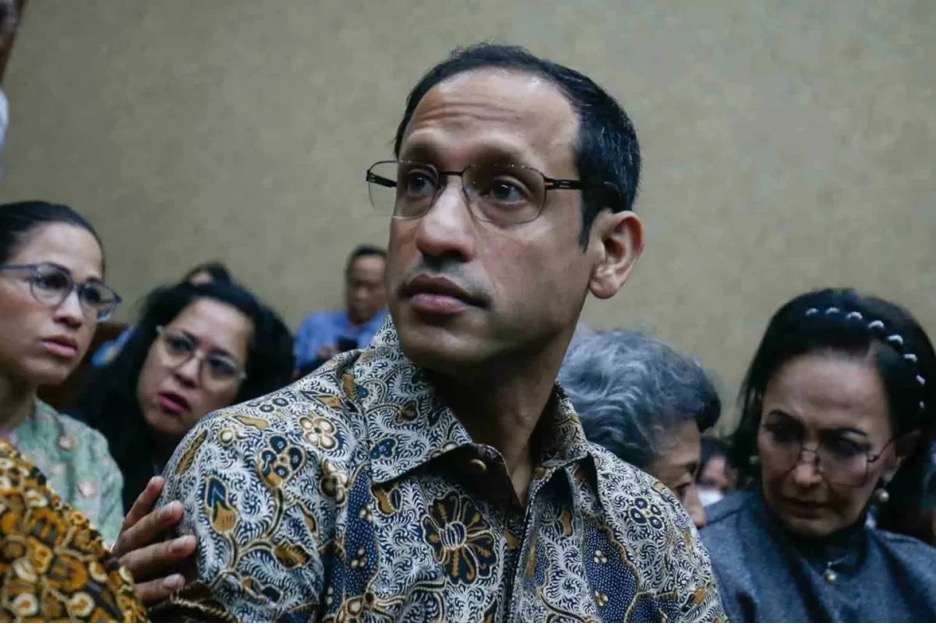
The embattled Gojek founder and former education minister Nadiem Makarim. Credit: RCTI+
Feature Report: The Minister, the Circus and the Bureaucracy
30 June 2026/10 Minutes of Reading
Introduction
The Indonesian public has been keeping a close eye on the ongoing trial of Nadiem Makarim. The Gojek co-founder and former minister is alleged to be involved in a corruption case that causes state losses totalling Rp 2.18t.
The case revolves around the Ministry of Education, Culture, Research, and Technology’s procurement of Chromebooks and CDM software under its education digitalisation programme during the Covid-19 pandemic, overseen by Nadiem as minister.
The ensuing public debate has centred around two major arguments.
The prosecutors and Nadiem’s detractors suggest that he has a vested interest in the procurement, which incentivised him to buy Google’s products. On the other hand, Nadiem and his supporters have maintained that he has no such incentive, and, to date, there is no definitive proof he has received a single rupiah from the purchase.
Some argue that the case would further weaken the public’s confidence towards legal institutions or hamper investors’ appetite for doing business in Indonesia, thus highlighting the importance of institutional reforms. However, Nadiem and many technocrats like him have kept running into a thick and tall wall while trying to introduce innovations and changes to the country’s institutions.
Against this backdrop, this piece is an attempt to offer a more grounded and realistic perspective on the case. It begins by examining the arguments from both sides that have contributed to lengthy, yet unproductive, debate. Afterwards, it outlines key lessons and takeaways for the business community and general readers as to why such criminalisation cases as Nadiem’s keep emerging. Potential impacts from the ruling of this particular case will also be considered.
By no means is this a legal review—this report is designed to critically assess the underlying perception problem and highlight the local mindset that shaped how we – including general readers, observers, business actors and politicians – might have approached Indonesia’s political and structural issues until now.
Old World vs New
Much attention has been placed around how the prosecutors have been having a hard time proving their own allegations. One possible root cause was beautifully explained by Hilmar Farid, a well-respected activist and former director general of the ministry’s cultural section who served three education ministers (including Nadiem).
In an aptly titled “The Old World Prosecuting the New” essay, Hilmar pointed to the glaring gap in historical experience between the prosecutors and Nadiem. In his view, the prosecutors came from the “Old World” that is bureaucratic, suspicious, and procedural, trained to read deviation as danger and innovation as irregularity. Meanwhile, Nadiem came from the “New World”, a world that is digital, experimental, networked, fast and comfortable with forms of risk that older institutions often find difficult to name, let alone understand.
This is why the trial feels like “the future is being asked to explain itself in the language of the past. And when it fails to fit that language, it is treated as suspect.”
The prosecutors’ case against Nadiem is built on three main allegations. First, they argue that the ministry had already tested Chromebooks in 2018 and found them unsuitable due to: 1) software compatibility issues; 2) users’ unfamiliarity with Chrome OS and; 3) limited internet access in many parts of Indonesia. This was rebutted by Nadiem, stating that the procurement was targeted at schools in urban areas already equipped with internet access.
Second, they allege that the Chromebook procurement was influenced by a business relationship between Google and Gojek, whose parent company, PT Aplikasi Karya Anak Bangsa, received US$786m in investment from Googlebetween 2017 and 2021, allegedly resulting in a Rp809b increase in Nadiem’s personal wealth. Nadiem’s team stated that this last figure is an internal Gojek corporate transaction and a corporate governance action that is irrelevant to the case.
Third, prosecutors claim the procurement caused state losses because the Chromebooks were purchased high above the market price. Vendors acknowledged that Rp3-4m was the cost of goods sold, while the suggested retail price (SRP) inputted in the government’s e-catalogue was Rp5-6m. Rebutting this, Nadiem’s team maintain that the ministry procured them at SRP without negotiating the price, stating that the Chrome OS is cheaper than Windows and the procurement resulted in a Rp3.9t budget saving for the government.
Unable to provide definitive proof that Nadiem has benefitted in any way from this deal, the prosecutors expand the scope of the case by suggesting now that Nadiem is involved in a white-collar crime through fraud, layering and image. They argue that Nadiem’s crime is not only corruption but also a crime of office, an economic crime and a corporate crime, thus inflating the case’s scope and allegation.
This argument may sound farfetched at a glance and implies that the prosecutors themselves are struggling to determine what the actual case is or how to definitively prove it. Nonetheless, the case has continued, and a verdict is scheduled to be passed on Tuesday, 30 June 2026.
Entrepreneurs: A New Hope?
In Javanese cosmology, the archetypal messianic figure Ratu Adil (the Just Knight) is believed to be a divinely appointed leader who will vanquish corruption, restore moral order, and usher in an era of lasting peace and justice.
One iteration of Ratu Adil is the Satrio Piningit (the Solitude Knight)—an intelligent, honest and righteous king that is neither elected nor seeking power yet orchestrates a massive revolution, according to the Jayabaya prophecy. In modern times, the Satrio Piningit-like status has been ascribed to figures ranging from Soekarno to Joko Widodo.
The veneration of Nadiem as an “ideal figure” since his rise with Gojek has placed him not too distant from the pantheon of figures believed to be the Satrio Piningit. Despite his privileged background, Nadiem is seen as a humble techpreneur who abandoned the comfort of his ivory tower to join the government and contribute to the country’s development.
He also fits the classic Indonesian “reformer” archetype: a political outsider with technical proficiency, international education, a drive to improve the system and minimal political baggage.
A figure with such images is highly relevant to the formally educated, professional and young middle-class Indonesians, Javanese or not. Many have hoped that Nadiem, with his reformist mind, could usher in innovation to the educational system beleaguered by red tape, outdated curricula, inefficiency and opaque governance.
Hence, when the case emerged, many struggled to comprehend the accusation that a good, successful, entrepreneurial man has enriched himself through a laptop procurement. It shattered the public’s admiration for Nadiem and the expectation towards him as a Satrio Piningit-like figure.
This is displayed by the reaction from Nadiem’s network of supporters, legal team and observers (including foreigners), many of whom also subscribe to this mindset. Key sentiments paint him as “a celebrated hero” and “a great leader” who “was trying to do good” while condemning the case as an “authoritarian overreach” and “politicised”.
Even Nadiem has leveraged these images of his to a certain extent. In his defence plea, Nadiem cited what he described as a growing wave of criminalisation targeting professionals and technocrats, including Tom Lembong and Ira Puspadewi, who have been implicated in similar cases. He argued that such prosecutions could create fear among young professionals serving in government that they may be the next targets, while also discouraging investors from committing capital to Indonesia due to concerns over legal uncertainty.
Two Lessons
Investors and business players aiming to expand to Indonesia could benefit from two key takeaways from this case.
First, the entrenched Ratu Adil mythos in the Indonesian psyche has inflated expectations on certain figures but created massive disappointment when they fail to deliver. It has also hindered the public from considering the bigger picture and understanding why the Ratu Adil figure stumbles in the first place.
Both the Indonesian public and state have continued to place inflated expectations and hope in individuals to deliver change rather than addressing systemic and structural problems gradually. In every election cycle, there are always presidential hopefuls projecting themselves as the only saviour-like figure who can address all the nation’s challenges. Such an expectation, in this case, seems to also extend to Nadiem.
When this mindset penetrates the business domain, especially with persona-building efforts commonly found among CEOs and founders in the tech sector, the problem further complicates. There is an assumption that a founder’s success in her/his own company would translate into a success somewhere else. This is further compounded by the constructed belief that technocrats, professionals and entrepreneurs with little to no political baggage are “clean” individuals, in contrast with bureaucrats and politicians.
Unfortunately, Nadiem, or rather the Indonesian public, fell precisely into this trap of expectations.
People cheer when “clean” individuals enter the government, hoping that they will bring about much-awaited changes, forgetting that these are people with all the inherent flaws, motivations and interests.
In contrast, people jeer when party politicians are given a position, assuming that these individuals are lacking the technical expertise and courage to deliver changes while ignoring that their proficiency in politics helps them navigate the complex, inter-agency policymaking process.
Solving Indonesia’s systemic and structural problems is a herculean task, but believing in Ratu Adil is easy and convenient. The former requires patience, capable individuals, inter-agency coordination and external support, whereas the latter is simply a matter of dumping all the nation’s problems on a single individual. In a country as big as Indonesia, with its massive challenges, many would be psychologically induced to opt for the easier option.
Second, Indonesia remains trapped in its traditional mistake: employing a technocratic approach to solve sociopolitical problems. Nadiem’s policies, programmes and innovation as education minister are only the latest instances of this.
As education minister, Nadiem introduced many initiatives aimed at improving the system’s efficiency. These include SIPLah for school procurement, ARKAS for school budget management, Rapor Pendidikan for evaluation and Merdeka Mengajar for teacher support, among others.
Unfortunately, his approach overlooked or offered little regard to prevailing biases, norms, interests, motivations and power relations embedded in the ministry.
His initiatives may have tackled inefficiency, but they have also shaken up vested interests in the ministry and education sector as a whole. His approach ignored bureaucratic motivations to adopt “new apps” and disregarded biases toward newly introduced innovations.
People, including bureaucrats, are adaptable to changes over time, but they dislike abrupt changes introduced at breakneck speed because it creates uncertainty. While this is a preferred mode for techpreneurs like Nadiem, perhaps their speed is unfavourable to the ministry’s bureaucrats.
A key caveat remains: bureaucracy is not merely a neutral administrative apparatus—it is a mechanism for addressing social problems in ways that reflect particular social purposes, class attitudes and interests. This does not mean that innovations cannot be incorporated into the structure, but they must not fundamentally alter the existing configuration.
This is a matter that Nadiem, like the rest of us, seems to have overlooked.
The entrepreneur’s lack of understanding – or unwillingness to understand – bureaucracy’s ontological and epistemological dimensions is a weakness and a key lesson that business players must take into account.
Professionals and technocrats like Nadiem might be blessed with skills and knowledge to understand the problems and devise solutions, but – owing to their lack of political experience – they might not know how to implement their programmes properly in Indonesia’s bureaucratic culture.
As a result, “innovations” and “breakthroughs” are introduced in such a manner that makes the operators, i.e. bureaucratic officials, feel uneasy, uncertain, and insecure. This is especially problematic when initiatives are introduced hurriedly, communicated poorly and disruptive to bureaucratic workflows. In such a context, resistance abounds.
“Bureaucracy” may have been too closely associated with inefficiency, poor services, sluggish performance and other negative labels. However, we often forget why bureaucratic institutions behave the way they are in the first place.
This is why simply leveraging the skills and expertise of a technocrat or professional may not be sufficient. An effective administrator must be able to consider multiple domains – including culture, norms, biases, motivations and interests – in their agency or firm before trying to introduce new programmes and initiatives that might upend workflows.
Conclusion
Despite its magnitude and public uproar, Nadiem’s case is unlikely to change anything fundamentally. He is not the first in such a case involving a technocrat/professional, nor would he be the last.
The case might have shocked educated middle-class and foreign-educated professionals, but it is business-as-usual for those well-informed and well-versed in Indonesia’s business and political landscape.
Even the eventual judgement might not be the central point of this whole case—President Prabowo Subianto could simply intervene and accord his pardon to Nadiem, just like he did with Tom Lembong and Hasto Kristianto.
Instead, the case further exemplifies that the legal and the political dimensions are intertwined in Indonesia’s landscape. The selection of Attorney General, leaders of the Corruption Eradication Commission and even the Constitutional Court’s judges are heavily political, while laws and regulations are products of political negotiation.
Numerous case studies have highlighted how the legal apparatus is deployed to pressure political opponents, from Anas Urbaningrum in 2013, to Johnny G Plate in 2023, to Tom Lembong in 2025, to name a few. Therefore, it is important to approach such a case from both dimensions, especially if it involves high-ranking officials in Indonesia.
Regardless, in the current economic constraints, cases like Nadiem’s, Tom’s or Ira’s contributed little if at all to the already-dwindling market confidence in Indonesia’s business climate. Indeed, institutional reform is key to addressing structural issues in Indonesia’s economic and bureaucratic landscapes.
However, “reform” and “institutional innovations” are less likely to take place as long as Indonesia places too much expectation on certain individuals and overemphasises a technocratic approach to solve a problem that is sociocultural and political in nature.
Therefore, it is incumbent upon everyone, including business actors, to manage expectations on individual policymakers to change the game for the better. Rather than depending on a Ratu Adil-like figure to come, businesses can consider leveraging diverse skills and professionals of various backgrounds with more context- and culture-sensitive approaches when dealing with Indonesian bureaucracy if they wish to survive and thrive in Indonesia.
The views expressed are those of the authors and do not necessarily reflect those of STRAT.O.SPHERE CONSULTING PTE LTD.