search

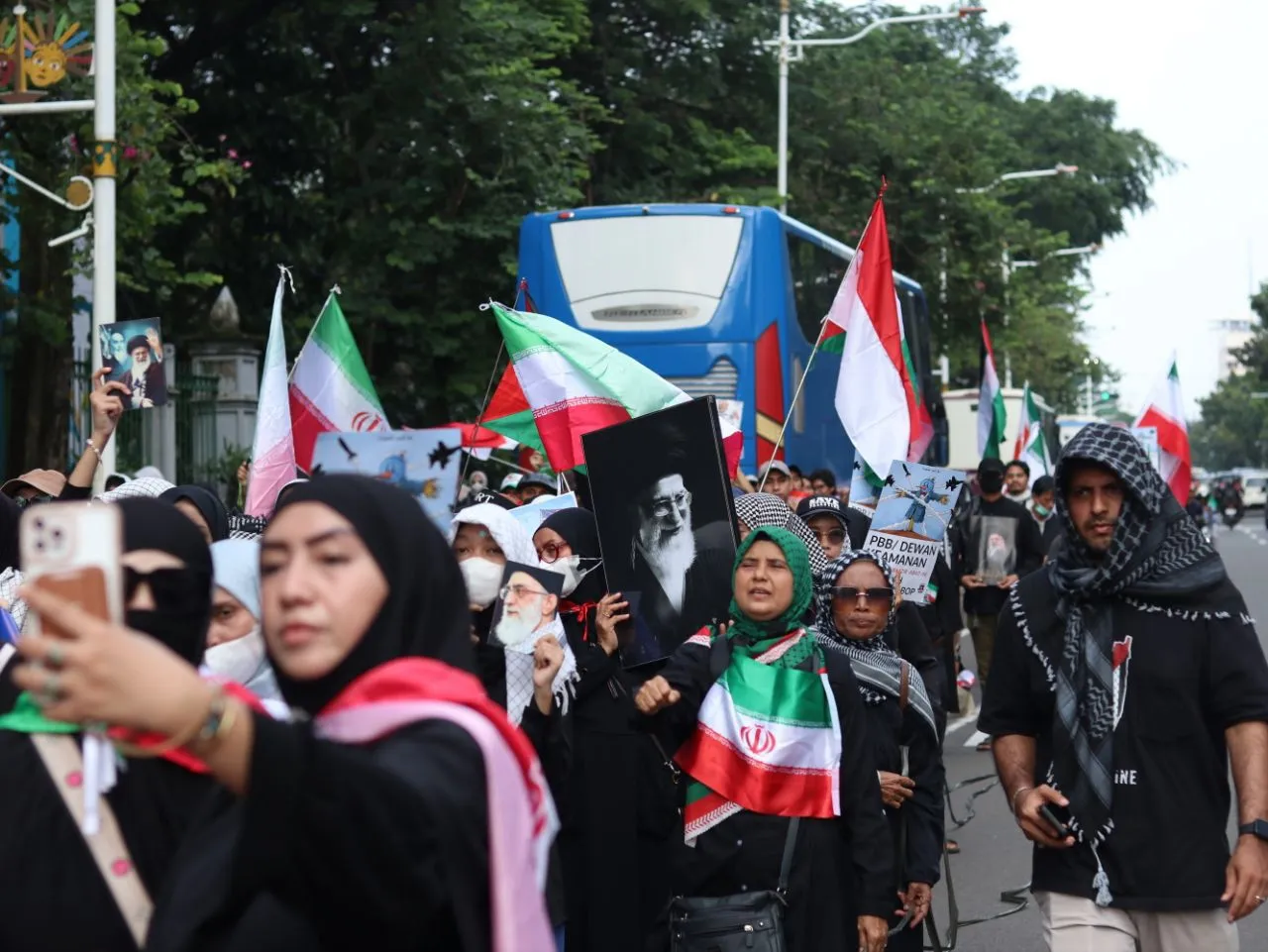
Protesters in front of the United States Embassy, Jakarta, Indonesia, on 9 March 2026. Credit: Ahlulbait Indonesia
Clear-Cut Sympathy
30 June 2026/6 Minutes of Reading
Muslim Solidarity
On 2 March 2026, following the confirmation of the death of Iran’s Supreme Leader Ali Khamenei in the joint US-Israel military strikes, condolence boards started pouring in at Jakarta’s Iranian Embassy, lining the road dramatically.
Three days later, the official residence of the Iranian ambassador, Mohamad Boroujerdi, in Menteng, Jakarta, hosted hundreds of grief-stricken Indonesians, an event covered by major Indonesian news networks. They had come to pay their final respects to Khamenei and, more importantly, to condemn the US-Israel attack on Iran.
Throughout the war, the Indonesian public has overwhelmingly stood on the latter’s side. In many ways, this came as no surprise.
A public poll conducted in 2025 found that among Indonesian social media users, Israel had become Indonesia’s most hated country (60.8%), followed by the United States (9.2%).
As a nation, Indonesia has had a long history of showing solidarity with other Muslim-majority nations. Successive Indonesian administrations have always adhered to this principle in foreign policy.
Iran, despite being a Shia-majority country, is highly regarded by the Sunni-majority Indonesians for its unflinching stand against Western, particularly American, hegemony.
During the India-Pakistan war of 1965, for instance, not only did former president Soekarno unhesitatingly side with Islamabad, angry protesters also besieged the Indian embassy in Jakarta and proceeded to ransack and torch the building, marking a low in Indonesia-India ties.
Prabowo Dithers
Yet as the joint US-Israel forces struck against Iran and the latter retaliated, President Prabowo Subianto’s administration issued a tepid statement through the Ministry of Foreign Affairs (Kementrian Luar Negeri – Kemenlu) in which it “called on all parties to exercise restraint and to prioritise dialogue and diplomacy”.
It also indicated Prabowo’s possible role “to facilitate dialogue to re-establish a conducive security condition”, with an emphasis that “the President of Indonesia was willing to travel to Tehran to conduct mediation”.
Indonesia’s use of neutral language to convey its stance paled by comparison to that of Malaysia, a neighbouring Muslim-majority country.
In its official statement, Malaysia “strongly condemned the attacks against Iran and the subsequent retaliatory attacks against several countries in the region” before pointing out that “[s]uch unilateral military measures risked further destabilising an already fragile region and endangering civilian lives.”
As the leader of the world’s largest Muslim-majority country, Prabowo’s preference to position himself as an impartial, honest broker between Iran – a country highly regarded by Indonesians – and the US-Israel coalition was surprising and arguably injurious to his own political standing.
Social media users in Indonesia were quick to criticise the president’s lack of solidarity with Iran, while Indonesian academics made a ridicule of his attempt to capitalise on the conflict by offering his mediation services.
Rumours even swirled around about Iran’s subsequent rejection, which Prabowo’s public relations team took seriously by rebutting them.
The timing of the US-Israel attack on Iran also did not work in Prabowo’s favour, given that he had officially signed onto the US-led Board of Peace on 22 January 2026 on the sidelines of the World Economic Forum in Davos.
His administration had defended the decision by claiming it was a “strategic” insider move “to ensure that the Gaza transition process remains focused on a two-state solution and does not develop into a permanent arrangement that ignores the rights of the Palestinian people”.
Since Indonesia’s advocacy of Palestinian independence has always been rooted in Muslim solidarity, the failure of the current administration to react accordingly to the Iran war is mind-boggling.
The non-partisan stance also went against the grain of Kemenlu’s instinct in such matters that the only conclusion to be drawn is that the directive had come from the president himself.
Prabowo’s lethargy on Iran was also evident in how former president Megawati Sukarnoputri, leader of Partai Demokrasi Indonesia Perjuangan (PDI-P) – the only political party outside Prabowo’s coalition – beat him in conveying condolences to Iran. PDI-P presented Megawati’s letter to the Iranian ambassador on 3 March,while Prabowo’s diplomatic letter was only dispatched to Tehran a day later.
As the Iran war dragged on, however, there were signs the president was becoming exasperated with the United States and his American counterpart, President Donald Trump.
By the end of March, faced by the constant mockery back home for joining the Board of Peace, Prabowo had stated that he was ready to withdraw Indonesia from it if it became apparent that the body failed to advance the Palestinian cause and was found to be detrimental to Indonesia’s interests.
Public Sentiments
A poll carried out between 12 and 31 March 2026 on public attitudes towards the Iran war and the government’s response to it supported the view that the president had misread the situation. Rather than gauging the full spectrum of public opinions on key issues, Prabowo and his subordinates overestimated the levels of public trust in the administration.
As many as 83% of the 1,066 respondents either opposed (60.1%) or strongly opposed (23%) the US-Israel attack on Iran, while 7.4% were divided between opposing and supporting. Despite this, 4.7% supported the war while 4.5% were undecided.
The poll, of which weighted samples (87.7% of Muslim respondents to 12.3% non-Muslims) were selected to reflect Indonesia’s religious composition (87.5% Muslim to 12.5% non-Muslims), also revealed that differences in stances on the Iran war are drawn along religious lines.
Additional numbers from the poll are also telling. As many as 21.5% believed that Israel was “God’s Promised Land for the Jews”, a common theological belief among Christians, while 58.7% disagreed. Furthermore, only 26.1% supported Prabowo’s decision to join the Board of Peace, while 50.9% were against it.
As the war in Iran raged on, reports of Christian pastors, especially of the Evangelical persuasion, delivering sermons prophesying Israel’s victory began to emerge. Some have even found their way onto social media.
Curiously, a similar Evangelical narrative is also popular in the United States, which some analysts believe to be instrumental in providing a support base for the offensive against Iran.
In Indonesia, however, the pro-Israel stance among religious minorities, especially the Christians, is more nuanced. Apart from perceiving Iran to be an avid sponsor of global terrorism, religious minority groups tend to have the romanticised image of Israel as a lone Jewish entity surviving against the overwhelming odds.
Frequent reports of discrimination against freedom of worship for non-Muslims have largely engendered this perception. Perhaps some Indonesian non-Muslims see a parallel between their plight and the situation in the Middle East, from Israel’s point of view. This, however, is an interesting research question that must be pursued further.
Energy Constraints
Domestically, Minister of Energy and Mineral Resources Bahlil Lahadalia initially tried to play down the economic impact of the war on Indonesia. Nevertheless, he later announced Indonesia would, in its bid to reduce gas subsidies, promote DME (Dimethyl Ether) – derived from natural gas, coal and biomass fermentation – as an alternative to LPG (liquefied petroleum gas). He argued that Indonesia’s rich deposits of coal would make DME a sustainable fuel source.
Industry insiders, however, have pointed out that DME as a replacement for LPG is premature due to the high initial outlay in creating a viable DME industry in Indonesia and the non-competitive production costs, which are projected to be even higher than LPG imports.
Yet, as the war entered its fourth month, coupled with further fiscal pressure from the depreciating rupiah against the US dollar, Bahlil decided to hike Indonesian RON 92 Pertamax by 30%. The unsuspecting public, lulled by earlier promises of fuel stability, responded negatively.
On 12 June, university students in Jakarta, partly in reaction to the Pertamax price hike, took to the streets in a wave of protests followed by students in other major cities across the country.
While the Prabowo administration tried to act sensibly by diversifying Indonesia’s energy supply chains to avert fuel shortages, its overconfidence in weathering the crisis proved to be its Achilles heel.
The Pertamax 30% price hike, sizeable by any account, could have been carried out in increments to minimise adverse public reaction. Although Pertamax was always designated as unsubsidised fuel, the frequent shortages of the subsidised Pertalite meant that motorists were often forced to buy Pertamax.
Conclusion
The main lesson from how the administration initially reacted to the Iran war denotes a misalignment with the public sentiment that, as suggested by the figures above, overwhelmingly supports Iran in the ongoing war. It also demonstrates that Prabowo’s unorthodox instincts in foreign policy are often at odds with historical precedents. Unfortunately, these missteps have landed Indonesia in a precarious position internationally and domestically.
The Iran war, far from being an opportunity for the government to solidify Indonesia’s position on the global stage as a sensible player and consolidate public trust at home, turned out to be a Pandora’s Box for the administration. It has, alas, left the country in a weaker state than it was before the war.
The views expressed are those of the authors and do not necessarily reflect those of STRAT.O.SPHERE CONSULTING PTE LTD.
This article is published under a Creative Commons Licence. Republications minimally require: 1) credit authors and their institutions, and; 2) credit to STRAT.O.SPHERE CONSULTING PTE LTD and include a link back to either our home page or the article’s URL.