search


The barriers to climate adaptation are not just technical or financial—they are actively produced by the state to prioritise extractive industry over people. Credit: Google Gemini
Paradox of Climate Change Adaptation in Lung Anai
May 1, 2026 / 7 minutes of reading
From Upland Rice to Award-Winning Cocoa
A Dayak Kenyah village in East Kalimantan demonstrates remarkable climate adaptation yet remains trapped by the very governance institutions meant to support it.
Fieldwork reveals that soft limits to adaptation are not merely institutional failures but are actively produced by the state.
The impacts of climate change are felt not only in cities but also deep in rural hinterlands. Two to three decades ago, farmers in Lung Anai Village, Kutai Kartanegara, East Kalimantan, could work shirtless in the fields from eight in the morning until nearly noon. Today, working outdoors until even ten o’clock has become unbearable.
This is not a thermometer sounding the alarm; it is the bodies of Dayak Kenyah farmers who have toiled on open land every day for decades.
“We are farmers, so we understand climate change very well, because our lives depend on the land,” said Lukas Nay, the village head of Lung Anai, when the author met him at his office recently.
Lung Anai is one of the customary villages of the Dayak Kenyah people. Spanning 185 hectares near Indonesia’s planned new capital Nusantara, it is a residential settlement. However, a coal mining pit sits less than 700 metres from residents’ homes. Oil palm plantations and industrial timber estates close in from other sides. The village is, quite literally, besieged by extractive industries, with seemingly no way out.
Despite these pressures, the community has demonstrated remarkable adaptive capacity. With support from several stakeholders, Lung Anai’s farmers have evolved from upland rice cultivators into packaged chocolate producers through Rumah Cokelat Lung Anai (the Lung Anai Chocolate House), a micro-enterprise that processes local cocoa beans into chocolate bars of various flavours.
Their products now reach modern retail outlets, including Sultan Aji Muhammad Sulaiman Airport in Balikpapan, and have won first place for Outstanding Village Products at the East Kalimantan Appropriate Technology competition. The value of cocoa, once only Rp120,000 per kg of raw beans, has multiplied after processing.
This is a form of adaptation that is at once ecologically, economically and culturally sophisticated.
Yet herein lies the great paradox: despite the community’s demonstrable adaptiveness, they remain deeply vulnerable. Beside the scorching rise in temperatures, flooding frequently threatens their area.
The challenges facing Lung Anai are essentially barriers to adaptation that arise not only from geographical conditions that have changed beyond the carrying capacity of nature, but also from financial, governance and policy constraints.
In theory, adaptation options remain available. In practice, however, financial, governance and policy barriers foreclose the possibility of communities pursuing those options.
Within this framing, barriers to adaptation can be overcome if financial and institutional support is added. This assumption treats institutions as neutral entities that can be strengthened with relative ease if desired. If institutions are weak, the solution is to bolster their capacity. If budgets are insufficient, then increase funding.
The logic is technical and linear: adaptation barriers are a matter of capacity, not of orientation.
Our findings in Lung Anai, however, reveal a more complex picture. Institutions are not merely weak or lacking in capacity; they actively produce the very barriers themselves.
Options for adaptation are not “unavailable”; they are deliberately made unavailable. The question is not why institutions fail to overcome barriers, but why they continue to create them.
The Governance Logic of Extraction
The three processes discussed below demonstrate that adaptation barriers in Lung Anai are neither coincidental nor disconnected from one another but rather the product of a single coherent governance logic: that authority, budgets, and policies are directed towards facilitating extraction, not towards protecting the communities affected by it.
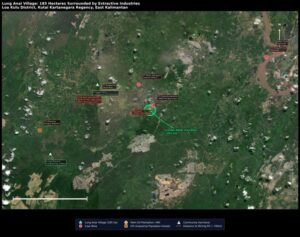
The map above shows the location of Lung Anai Village and the extractive industries surrounding it. Within a radius of less than one kilometre, a coal mining pit is already visible. On other sides, oil palm plantations and industrial timber estates stretch outward. These concessions did not emerge naturally; they are the product of licensing processes that have unfolded over the past two decades. The political-economic processes that enabled the presence of these extractive industries form a network that constrains the community’s ability to adapt. Map generated using Claude
First, licensing authority granted through decentralisation policies opened the door for the expansion of mines and plantations around Lung Anai. Activities in these industries have eroded land, forests and the livelihood rights of the community.
After Law No 3/2020 on mineral and coal mining recentralised the authority to issue mining permits to the central government, legacy concessions continued to operate while the community found itself even further from decision-making centres. Consequently, the damage inflicted during the decentralisation era has become harder to reverse due to diminished and inadequate government oversight.
Second, policies designed to be pro-environment have proven maladaptive. Bans on field burning have criminalised the Dayak practice of shifting cultivation, a centuries-old system that sustains forest regeneration.
“Five years later, the trees grow back tall, and the forest returns,” said Lukas in defence of this practice, which has received considerable criticism over the years.
However, when East Kalimantan implemented the Forest Carbon Partnership Facility (FCPF) programme, which was designed to incentivise communities that successfully reduced deforestation, Lung Anai was excluded, even as neighbouring villages received Rp100-250m.
Third, and most ironically, the village is surrounded by several coal mining and palm oil companies holding vast concessions. PT Multi Harapan Utama (MHU) holds a 30,409-hectare coal concession with a permit valid until April 2032, roughly the size of the city of Surabaya. In the palm oil sector, PT Niagamas Gemilang holds a concession of approximately 256 hectares.
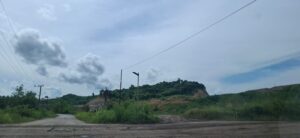
Post-mining overburden landscape near Lung Anai Village, less than one kilometre from residential areas, Kutai Kartanegara, East Kalimantan. Credit: author’s collection
In addition, there are industrial timber plantation and rubber estate concessions. Several of these companies are also the primary funders of community adaptation activities through corporate social responsibility (CSR) projects, including the construction of Rumah Cokelat, training programmes and technical assistance.
In other words, extractive companies serve as facilitators of adaptation through CSR while simultaneously producing soft limits to adaptation through their extraction activities. This context is consistent with the author’s interview with Lukas Nay, who confirmed that CSR funding is the primary source of support for adaptation initiatives.
Barriers
These are not three separate problems but a single coherent governance logic: authority and resources are allocated for extraction, not for adaptation. The IPCC assumes that soft limits to adaptation can be overcome by adding institutional capacity, as though a locked door simply needs the right key. The case of Lung Anai, however, shows that both the key and door exist, but opening the latter is not meant to be a straightforward matter.
The findings from Lung Anai also reveal that institutions themselves produce soft limits to adaptation. The recentralisation of mining permits within a decentralised system constitutes an institutional reform that fails to resolve the problem. The result is a misalignment of policy targets. What is needed is not to add capacity to existing institutions but to redirect their orientation.
Doing so means addressing three issues simultaneously. One is to return extractive licensing considerations to the regional level in certain contexts so that impacts on surrounding communities can be assessed more thoroughly. Two is to recognise shifting cultivation as part of a local knowledge-based adaptation strategy rather than criminalising it. Three is to transfer the responsibility for facilitating adaptation from corporate CSR mechanisms to measurable and accountable state obligations.
On the budget side, funding for climate programmes already exists, as does technical assistance from relevant agencies. What is missing, however, is the political will to direct these resources towards vulnerable communities like Lung Anai, who contribute least to climate damage compared to the extractive industries surrounding them but bear its greatest consequences.
“To eliminate flooding entirely—that I cannot do. To get through it, to bring the water down a little, that is the effort I can manage,” said Lukas.
This is not pessimism. It is an adaptive realism more advanced than many policy documents, an honest acknowledgement that adaptation is not about eliminating risk but about managing it.
The people of Lung Anai have already proven they can adapt; from shifting cultivation to winning an award for their chocolate enterprise. They do not need pity; they need policy space that does not obstruct them.
If the state can issue concessions spanning tens of thousands of hectares for a single mining company, it should also be capable of directing its policies to protect the 185 hectares of a village besieged by those very concessions. The question is not whether they can endure, but how long the state will continue producing barriers for communities like Lung Anai.
Author’s Note: This article is based on fieldwork in Lung Anai Village, Loa Kulu District, Kutai Kartanegara Regency, East Kalimantan, as part of the KOMITMEN study (Decentralisation and Climate Change Adaptation).
This article is published under a Creative Commons Licence. Republications minimally require 1) credit authors and their institutions, and 2) credit to STRAT.O.SPHERE CONSULTING PTE LTD and include a link back to either our home page or the article URL.