search

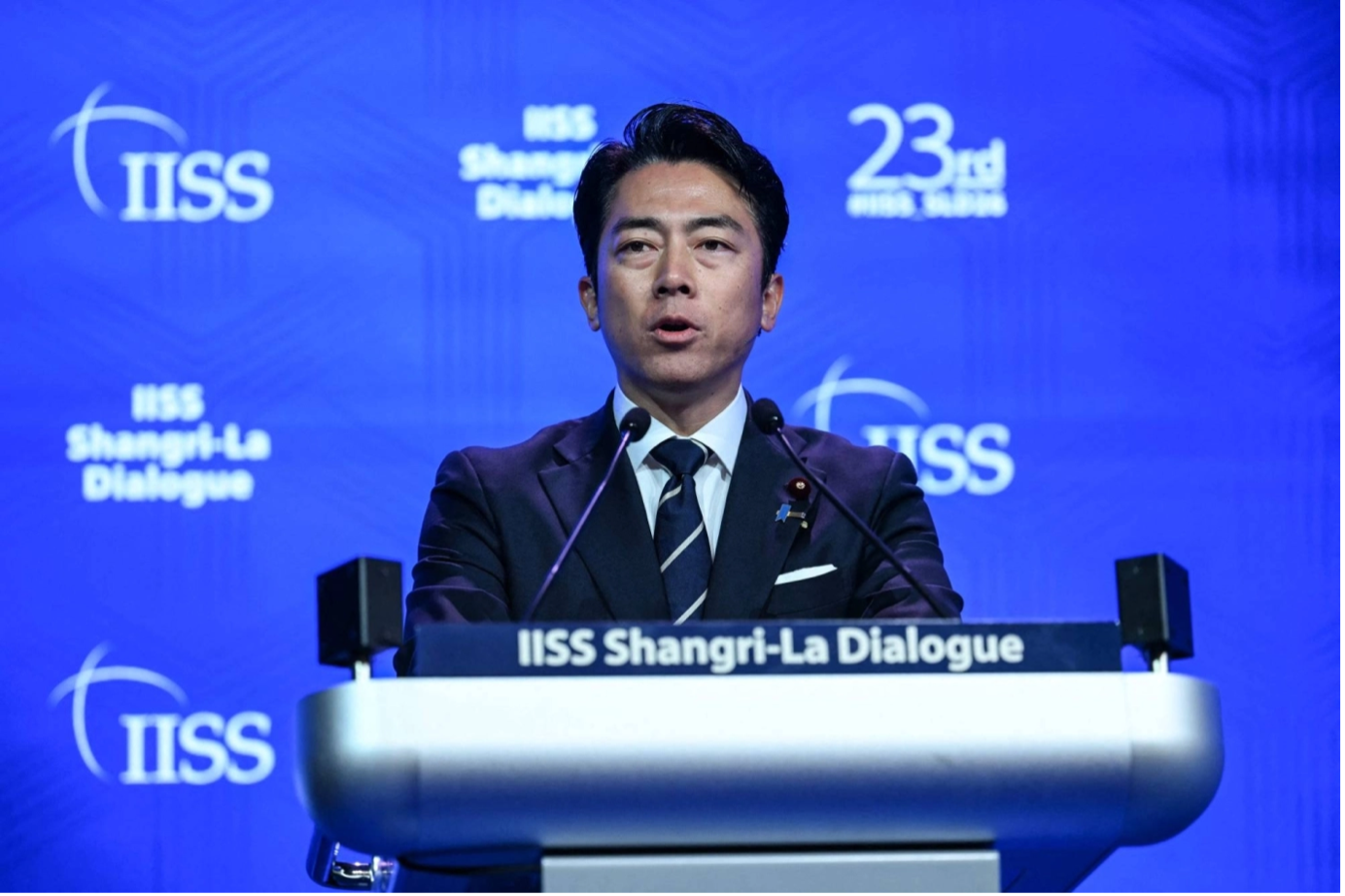
Japan Defence Minister Koizumi Shinjirō at this year’s Shangri-La Dialogue. Credit: AFP-JIJI
Singapore-Tokyo Partnership Secures Middle Ground Amid Global Tensions
6 June 2026 / 6 Minutes of Reading
Introduction
Following the conclusion of Presidents Donald Trump and Xi Jinping’s summit in Beijing, some close advisers to the US leader expressed concern that the chief result of the summit was a heightened risk of escalation over Taiwan in the coming years.
These concerns are not without basis—Xi emphasised that Taiwan is the “most important issue in China-US relations” and that any mishandling could put the bilateral relationship between the two largest economies in “great jeopardy”.
As major power competition drives unpredictability across the Indo-Pacific, strengthening flexible, issue-specific security partnerships has never been more urgent for small and medium powers.
Singapore and Japan offer a prime example in this case, especially considering the growing closeness between the two in recent times. This year marks the 60th anniversary of the establishment of diplomatic relations, and fittingly, the relationship was upgraded to a “strategic partnership” in March.
As the spectre of regional conflict threatens the foundation of a rules-based Indo-Pacific, Japan and Singapore should build on the momentum of their growing proximity to ensure their security.
Shared Vulnerabilities
The two nations stand to lose more than most from growing instability in the region.
Both are trading economies whose prosperity and influence are built on the free movement of goods. Singapore’s trade-to-GDP ratio stands at 322%, and Japan ranks as the world’s eighth largest exporter by value.
For Japan and Singapore, defending open sea lanes is a matter of economic and national security. The scale of the task, however, means that neither country can undertake this alone. Fortunately, they share a clear-eyed view of what upholding the international order should look like.
Tokyo’s Free and Open Indo-Pacific vision frames the Indian and Pacific oceans as one interconnected space and seeks to preserve the international order based on the rule of law, freedom of navigation, and free trade. Singapore’s approach is similar and mirrors the ASEAN Outlook on the Indo-Pacific (AOIP), which advocates for ASEAN centrality, prioritising inclusive dialogue, and maritime freedom.
Furthermore, Singapore has long mastered the art of balancing relations with multiple powerful partners. China remains the indispensable economic engine of the region and the largest investor in ASEAN, and Prime Minister Lawrence Wong has emphasised the importance of maintaining close economic engagement with China.
However, the shifting nature of regional military exercises and complex security environments – such as the scale of recent simulations in the Taiwan Strait – demonstrate how rapidly the regional status quo can be strained by major power friction. Compounding this, North Korea’s latest launch of 10 ballistic missiles serves as a persistent reminder that traditional security flashpoints remain volatile.
This volatility underscores a critical structural shift where regional flashpoints are no longer isolated maritime disputes but rather interconnected systemic risks capable of paralysing global supply chains overnight. For middle powers, waiting for a consensus among major powers is no longer a viable security strategy, which necessitates a proactive diversification of regional stabilisation mechanisms.
Strategic Responses
In the face of such threats, Japan and Singapore must place a greater emphasis on their own security, as well as security cooperation with likeminded, capable partners.
Singapore is already on a proactive path. Wong raised the defence budget by 6.4% in 2026 to SGD24.93b, while Singapore’s Total Defence framework provides strong building blocks for resilience in an ever more turbulent world.
Singapore also took part in a goodwill exercise in the South China Sea with Japan in March this year and carried out a mobilisation exercise where 3,000 Singaporean national servicemen were deployed, improving preparedness for future operational challenges.
Tokyo has moved further, responding to what Defence Minister Koizumi Shinjirō has called the most severe and complex security environment Japan has faced since World War II. His government announced a record defence budget of over ¥9t (SGD72b) for 2026, a figure that includes the deployment of domestically produced stand-off missiles, the acquisition of stand-off missile capabilities from the United States and Norway, and the equipping of Aegis destroyers with Tomahawk cruise missiles.
Significantly, in April this year, Japan also removed the restrictions that limited its defence exports to five non-lethal categories. Tokyo will now be able to export lethal weapons to 17 likeminded partners, among them core allies like the United States and Australia, as well as regional partners that include Singapore. This arrangement can perhaps be viewed in light of Koizumi’s remarks that Japan seeks to build relationships through defence equipment cooperation that will enable allies and like-minded partners to support one another in times of crisis.
For Singapore, this policy shift should be viewed not through the lens of forming rigid, exclusive military alliances but as an opportunity to enhance technological transfer, maritime capacity building and defence interoperability. As Prime Minister Takaichi Sanae noted, “No single country can now protect its own peace and security alone, and partner countries that support each other in terms of defence equipment are necessary.”
The practical value of closer Japan-Singapore security cooperation lies precisely in its ability to occupy the middle ground between symbolic diplomacy and formal alliance politics.
Singapore does not need, and would not seek, a treaty-style security arrangement with Japan. Such a move would be strategically unnecessary and politically counterproductive, especially given Singapore’s longstanding insistence on maintaining an open regional architecture.
What Singapore does need is a wider menu of credible partnerships that improve preparedness without narrowing its diplomatic room for manoeuvre. Japan is well suited to this role because its security posture is becoming more active, yet still constrained by a strong preference for rules-based cooperation, capacity building and institutional legitimacy.
Maritime domain awareness should be the first priority. Both countries depend on predictable access to sea lanes yet also face a regional environment where grey-zone tactics, coercive patrols, missile exercises and legal ambiguity can disrupt normal commercial activity without triggering open conflict.
Japan’s experience in surveillance, coast guard coordination and maritime technology would complement Singapore’s role as a logistics, information, and naval hub. The two sides could expand joint training, intelligence sharing on maritime risks and technical cooperation on unmanned systems, cyber resilience, and port security.
These are not escalatory measures—they are defensive tools designed to preserve continuity in trade and crisis management.
Singapore and Japan should also use their partnership to strengthen ASEAN-facing security cooperation rather than bypass ASEAN. This distinction is important. If the relationship is framed as a narrow bilateral hedge against China, it will generate suspicion in Southeast Asia and reduce Singapore’s strategic flexibility. If it is framed as a platform for wider regional resilience, it becomes more acceptable and more useful.
Furthermore, Japan can support Singapore’s 2027 ASEAN chairmanship by investing in maritime capacity building, crisis communication mechanisms, humanitarian assistance, disaster relief and supply-chain security initiatives that include other Southeast Asian states. This would give substance to the ASEAN-Japan Comprehensive Strategic Partnership while avoiding the impression of bloc formation.
The opening of the defence industry in Japan also creates a long-term opportunity that should be handled carefully. Singapore should not rush into high-profile weapons procurement that would attract unnecessary political attention. A better approach would be gradual cooperation in dual-use technology, maintenance ecosystems, sensors, communications systems and resilience infrastructure.
This would deepen interoperability without forcing Singapore into a binary strategic posture. The goal is not to militarise the Singapore-Japan relationship but to make both countries harder to coerce, better prepared for disruption, and more capable of supporting a regional order in which small and medium powers retain agency.
Moving Ahead
In a letter marking the 60th anniversary of diplomatic relations between Japan and Singapore, Wong reflected this philosophy of collaboration. He committed to continued cooperation with Japan through several frameworks, including the Comprehensive and Progressive Agreement for Trans-Pacific Partnership (CPTPP). Wong also confirmed that Singapore will work to deepen the ASEAN-Japan Comprehensive Strategic Partnership ahead of its 2027 ASEAN chairmanship.
Crucially, an enhanced Singapore-Japan partnership is not designed as a tool of containment against any single major power. Instead, it serves to reinforce a stable, multipolar equilibrium where ASEAN centrality is respected and international law remains the baseline.
The shared outlook, priorities and capabilities between the two make them natural partners in an era of global fragmentation. Greater cooperation with Tokyo – in defence technology, trade and multilateralism – offers Singapore a resilient path towards preserving inclusive regional stability.
The views expressed are those of the authors and do not necessarily reflect those of STRAT.O.SPHERE CONSULTING PTE LTD.
This article is published under a Creative Commons Licence. Republications minimally require: 1) credit authors and their institutions, and; 2) credit to STRAT.O.SPHERE CONSULTING PTE LTD and include a link back to either our home page or the article’s URL.