search

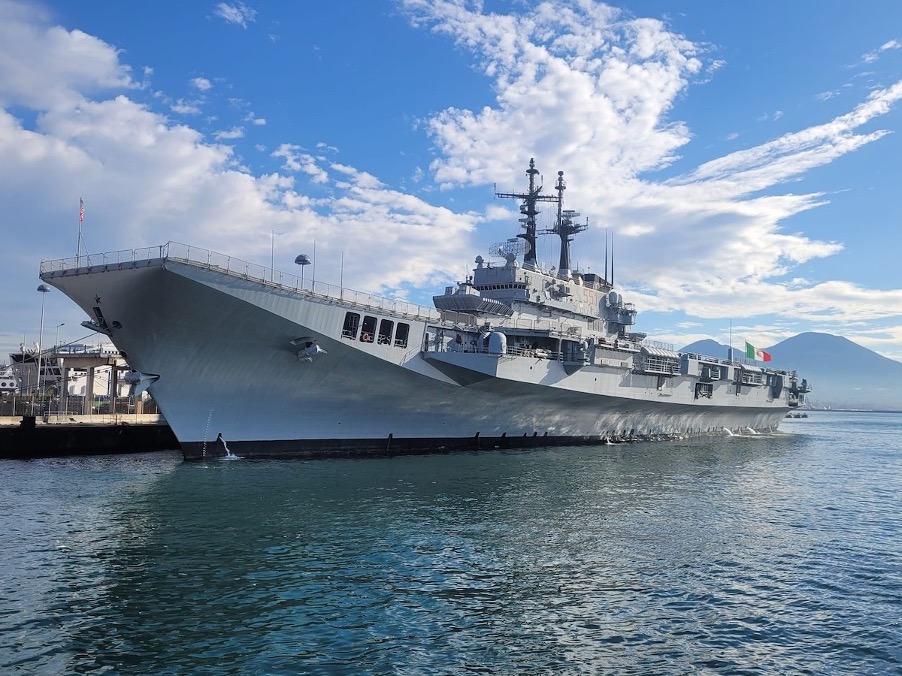
Giuseppe Garibaldi. Credit: Wikimedia Commons/Benzekre
Champagne Dreams on Coffee Budget
4 June 2026 / 6 minutes of reading
Introduction
A history in the making—Indonesia is set to welcome its first-ever aircraft carrier when it arrives on 5 October 2026, just in time for the 81st anniversary of Tentara Nasional Indonesia (TNI).
Giuseppe Garibaldi, a gift from Italy, will transform Indonesia into the fifth Asian country to operate an aircraft carrier, joining China, Japan, India and Thailand.
Some experts have argued that the vessel is an unnecessary luxury. The reality, however, is far more nuanced.
Conceptually, a carrier is a strategic necessity in Indonesia’s vast archipelagic geography. The challenge lies in the gruelling cost and operational demands that are required to keep it afloat.
The Indonesian government has committed to shouldering the cost, but if that commitment wavers, the vessel risks becoming nothing more than a sailing burden that drains the national budget without adding real security.
Adding to the problem is the divergence of theoretical foundations (i.e. Western and Indonesian perspectives) that underlie the necessity to own a carrier in the first place.
In the former, states construct and deploy major military platforms like aircraft carriers to achieve “command of the commons”, enabling them to project power, shape adversary behaviour and deter aggression far from home.
In contrast, Indonesia’s strategic approach to own a kapal induk (mothership) stems from the need to own a mobile command and control (C2) platform that can coordinate air-sea operations across dispersed maritime zones. This is considering the country’s geography that spans 5.8 million km2 of sea area, an 81,000 km-long coastline and 17,504 islands—thus emphasising the need for agile maritime operations.
Statement from the Ministry of Defence seems to reinforce this—Indonesia plans to utilise Giuseppe Garibaldi as a mobile hub for maritime command, surveillance and humanitarian operations. This necessitates the vessel to be repurposed for archipelagic defence and military operations other than war (MOOTW), the latter of which is an increasing trend in the country’s two latest administrations.
In other words, the vessel is not intended for power projection; Indonesia’s approach differs significantly from the Western carrier doctrine.
Yet two questions persist: do we need it now, and is the acquisition justified? Answering these necessitates our exploration of the advantages and disadvantages of welcoming Giuseppe Garibaldi into the navy’s repertoire.
Advantages
The first point of advantage is that the acquisition will chart Indonesia’s navy towards modernisation. Larger navies like China and India initiated their carrier programmes with secondhand ships to enhance carrier operations competency before developing their own indigenous designs.
The Indonesian navy could follow these steps and use Giuseppe Garibaldi as a vital bridge for both technical capacity building and capability modernisation, though it requires significant upgrades for modern sensors and communications. Once this is achieved, however, the ship’s status could be elevated to that of a command vessel, becoming the successor to the ageing KRI Multatuli as Indonesia’s flagship, one that is more modern.
The second point is Indonesia’s enhanced capability in disaster relief operations. Giuseppe Garibaldi’soperational capability as a versatile platform would significantly improve TNI’s capacity in humanitarian assistance and disaster relief (HADR) missions, especially if it is already assigned for non-military purposes.
The Brazilian navy has recently demonstrated the strategic value of its deployment of a helicopter carrier for a HADR operation during the 2024 floods in Rio Grande do Sul. For an archipelagic and disaster-prone country like Indonesia, situated precariously within the Pacific Ring of Fire, a carrier provides a mobile base for rapid relief.
Disadvantages
The lack of a clearly defined operational concept remains a core issue surrounding this acquisition.
Japan’s Hyūga-class warships, for instance, operate strictly as helicopter carriers. For Giuseppe Garibaldi to be fully optimised, the Indonesian navy must define a mission tailored to its specific capacity. However, as a legacy design from the late 1970s, Giuseppe Garibaldi’s structural limits leave little room for operational flexibility, which would make modern upgrades difficult.
Furthermore, as a carrier, Giuseppe Garibaldi cannot operate alone; it requires protective escorts such as frigates and submarines to secure its voyage. While the navy can physically assemble such a formation, a dedicated carrier strike group remains a distant goal.
The interoperability of Giuseppe Garibaldi with the navy’s existing naval inventory will be a primary hurdle, which is an immense challenge in coordinating diverse platforms into a cohesive tactical unit.
Moreover, Giuseppe Garibaldi charges too much cost for a smaller capacity. Despite the enhanced capabilities that Giuseppe Garibaldi offers to the navy, it falls short on the capacity front. The NATO standard dictates that a true helicopter carrier must be able to house and land 1,800 troops on its own. Giuseppe Garibaldi, unfortunately, can barely manage a fifth of that.
Practically, this makes it a little more than a high-priced alternative to the navy’s existing Makassar-class amphibious ships, which can perform amphibious roles at the fraction of the cost. In other words, utilising the Giuseppe Garibaldi for this role equals adding another expensive vessel with a smaller capacity.
This leads back to the question posed at the top: can the navy afford to operate the Giuseppe Garibaldi, or does the vessel risk becoming a floating burden?
Based on historical data from carriers of similar displacement, such as the United Kingdom’s Invincible, the annual operating costs in 2005 are estimated to be US$110-150m, unadjusted for inflation. For the Indonesian navy, this number alone would absorb 10% of its annual budget in 2025, excluding the massive “hidden” cost of specialised maintenance, life cycle supports and the port infrastructure required to base the vessel.
Conclusion
Giuseppe Garibaldi offers a highly desired additional capability to the Indonesian navy, but there is no urgency to acquire it now. This is not a question about necessity but about timing.
There is a clear operational justification: such a platform would enhance the Indonesian navy’s capability for humanitarian operations while also strengthening Indonesia’s defence. It also improves the Indonesian navy’s surveillance capability in the three Archipelagic Sea Lanes of Indonesia, which has traditionally proved to be a herculean task for the navy.
However, the country is facing a systemic budgetary challenge to sustain, operate and eventually develop this capability, especially if the long-term ambition is to build an indigenous platform, as seen in the Chinese and Indian naval roadmaps that began with retired carriers.
Indonesia’s Defence White Papers of 2008 and 2015 do not consider acquiring an aircraft carrier or similar platforms as a national priority, emphasising instead the importance of satellite technology and unmanned systems in monitoring the country’s vast maritime territory. The acquisition of Giuseppe Garibaldi, thus, raises a pertinent question: will this step alter Indonesia’s long‑term investment priorities in satellite and drone technology?
Inconsistency in defence planning risks undermining Indonesia’s long‑term strategic interests. A sudden pivot towards capital‑intensive platforms – without a clear integration plan – could dilute resources from surveillance, early‑warning and domain‑awareness capabilities that Indonesia has spent decades developing.
Ultimately, the Prabowo administration’s fiscal space is already overstretched as it is. Without a significant fiscal shift, the acquisition – and maintenance – of Giuseppe Garibaldi remains a champagne dream on a coffee budget. With the current geopolitical uncertainty pushing global oil prices above US$100 per barrel, Indonesia must exercise prudence in translating ambition into procurement.
The views expressed are those of the authors and do not necessarily reflect those of STRAT.O.SPHERE CONSULTING PTE LTD.
This article is published under a Creative Commons Licence. Republications minimally require: 1) credit authors and their institutions, and; 2) credit to STRAT.O.SPHERE CONSULTING PTE LTD and include a link back to either our home page or the article’s URL.