Introduction
The 2024 Regional Head Election (Pemilihan Kepala Daerah – Pilkada) of Banjarbaru emerged as one of the most notable phenomena in Indonesia’s latest local elections.
The dynamics that unfolded during this political contest highlighted the increasingly entrenched influence of local oligarchy, a discernible decline in the professionalism of electoral bodies and an allegation of vote-buying practice.
This particular pilkada marked a historic moment in the post-Reformasi era, registering an unprecedented number of invalid votes that surpassed those cast for the sole candidate, at least for its first round.
This outcome was a direct consequence of Banjarbaru’s Regional General Election Commission’s (Komisi Pemilihan Umum Daerah – KPUD) decision to disqualify the incumbent mayoral candidate pair less than a month before the polling day.
The unprecedented move sparked a chain reaction: four commissioners from Banjarbaru’s KPUD were dismissed by the Election Organizer Ethics Council (Dewan Kehormatan Penyelenggara Pemilihan Umum – DKPP RI), having been found guilty of serious ethical violations.
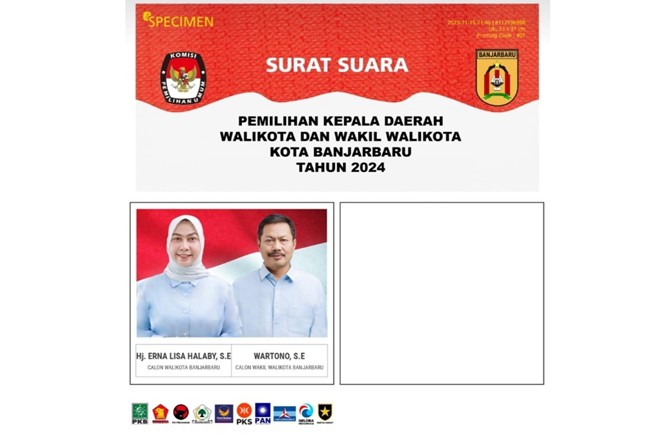
The reason for their dismissal was the continued use of ballot papers featuring two candidate images, despite there being only one candidate pair remaining in the contest.
This is against Article 54C Paragraph (2) of Law Number 10 of 2016, which states that in an election with only one candidate pair, the ballot paper must display two columns: one showing the photograph of the candidate pair and the other left blank.
Meanwhile, indications of vote-buying practices emerged during the full-scale repeat election (pemungutan suara ulang – PSU), which then were used as
Worse, the 2024 Banjarbaru pilkada fits the pattern of a single-candidate election that is potentially harmful to Indonesia’s democratic process, even though the empty box option only officially appeared in the PSU held on 19 April 2025.
According to data from the General Elections Commission (Komisi Pemilihan Umum – KPU), elections in 36 regencies/cities featured an empty box on the ballot; in two instances, the empty box emerged victorious.
Engineered Candidacy
Following Banjarbaru’s designation as the capital of South Kalimantan – replacing Banjarmasin in 2020 – its political appeal has surged.
As a key economic node on the island of Kalimantan, South Kalimantan holds considerable strategic value. It is therefore unsurprising that Banjarbaru has swiftly gained short-term benefits from its elevated status.
Banjarbaru’s newly elected mayor,
In August 2024, however, she hosted a fun walk with top-tier celebrity couple Raffi Ahmad and Nagita Slavina, attracting attention due to the high-profile nature of the guests and the substantial financial resources required, especially given the proximity to the election campaign period.
This action naturally raised questions: how had Erna Lisa accessed elite networks and amassed funds for such a lavish event?
At this point, Erna Lisa’s connection to Andi Syamsuddin Arsyad, better known as Haji Isam – a business tycoon from Batu Licin, Tanah Bumbu Regency – came into the spotlight. Haji Isam’s support, while not explained in detail, is confirmed by Erna Lisa herself.
Haji Isam is a prominent figure in Kalimantan’s political landscape. Known for his palm oil and coal empire, he rose to the national stage in 2019, serving as deputy treasurer for Joko Widodo-Ma’ruf Amin’s National Campaign Team (Tim Kampanye Nasional – TKN).
Several of his associates secured ministerial positions in the Red-and-White Cabinet, and President Prabowo Subianto appointed him to lead the one-million-hectare rice field project in Merauke, South Papua.
Every two years, Haji Isam’s company, PT Jhonlin Group, organises the Batu Licin Festival (Batfest) to entertain residents of Tanah Bumbu. The most recent edition featured major performances including, again, by Raffi Ahmad and Nagita Slavina.
Haji Isam’s support for Erna Lisa became more evident to the public’s eye when it was revealed that Erna Lisa’s relative, Timothy Savitri, has business ties with Haji Isam’s son, Jhony Saputra, through PT Nusa Mandiri Properti.
All of these seem to indicate that Erna Lisa’s and Haji Isam’s interests might intersect somewhere.
Between Erna Lisa’s stratospheric rise and the subsequent disqualification of a rival pair, this line of argument extends to highlighting a tactic among local economic elites – or oligarchs – seeking to shape regional governance by manipulating electoral conditions to produce a single-candidate race.
Indeed, a single-candidate contest reduces financial costs and limits polarisation. However, it tends to reflect the ambition of an elite circle as well, determined to dominate local politics by any means necessary.
Once in power, these elites often entrench their positions by distributing political rewards to their loyalists. In such cases, pilkada becomes nothing more than a ceremonial mechanism; a mere formality and a symbolic act that bestows legitimacy on a process that has already been predetermined.
With all pieces in place, Erna Lisa and her running mate Wartono formally challenged incumbent Mayor Aditya Mufti Ariffin and his partner Said Abdullah. As if the drama was not enough, Wartono was then the incumbent deputy mayor, which made him Aditya’s second-in-command before he jumped ship.
It was Wartono who lodged a report against Aditya-Said pair in the first place, leading to their disqualification.
Invalid Votes and Empty Box
The decision not to redesign the ballot after the disqualification of the Aditya-Said pair contributed significantly to the unusually high number of invalid votes. All votes cast for Aditya-Said were automatically deemed invalid—whether cast by unaware voters, genuine supporters of the pair or those expressing frustration over what they saw as a chaotic election process.
This mass invalidation triggered a public outrage, prompting calls for a re-election and raising constitutional concerns over Banjarbaru’s 2024 pilkada. The Constitutional Court (Mahkamah Konstitusi – MK) subsequently ruled that there had been serious violations of citizens’ constitutional rights and ordered a PSU with the presence of an empty box on the ballot.
Following MK’s ruling, four KPUD commissioners were dismissed and one received a severe reprimand. A newly appointed KPUD commissioners subsequently oversaw the PSU held on 19 April 2025. The comparison of the original vote count and the PSU results reveals a worrying trend, as displayed in the tables below:
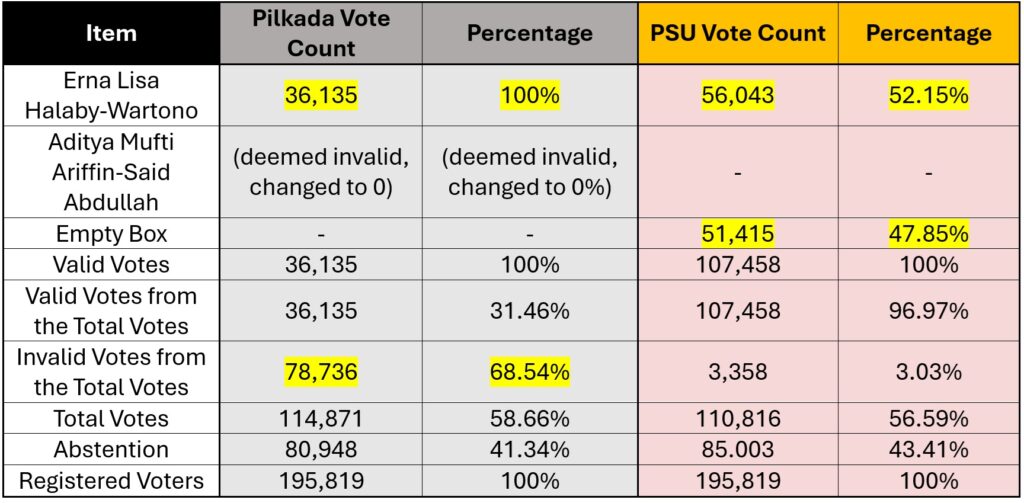
As evidenced above, the Erna Lisa-Wartono ticket gained 19,908 additional votes (in the top row), while the number of votes for the empty box (representing previously invalid votes) decreased by 27,321 ( i.e. difference between 78,736 and 51,,415). Furthermore, the abstention rate also increased.
If we examine the distribution of votes in greater detail, the results are as follows:
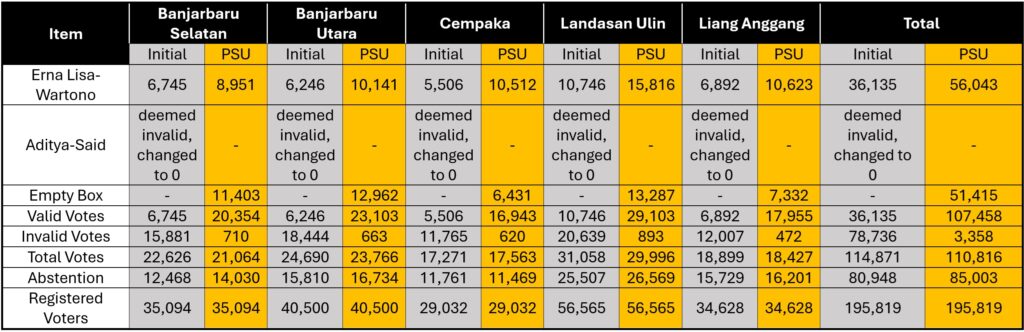
A closer look at the district-level results indicates several trends. Firstly, the number of votes cast for the Erna Lisa-Wartono pair across all districts was less than the number of invalid votes in the initial poll. Secondly, the pair won in three districts in the PSU, although their votes increased notably across all districts. Thirdly, the pair’s vote count nearly doubled in Cempaka, increased by 47% in Landasan Ulin and rose by 54% in Liang Anggang. Fourthly, the PSU abstention rate rose by exactly 5% compared to the initial vote count.
All of these suggest that the Erna Lisa-Wartono campaign team successfully mobilised individuals who previously cast invalid votes, convincing enough of them to switch allegiance.
The pair only needed to achieve a specific vote swing to surpass the winning threshold, all wh
Miniature Kings
Over the years, local elections have increasingly devolved into mere arenas of power-brokering between regional oligarchies and ambitious candidates seeking leadership positions. Local businessmen thrive and take part in the political system, often through indirect involvement.
The two sides support each other, with oligarchs providing support to their preferred candidates and if the candidates win, they will provide appropriate rewards, exceptional facilities and even lucrative projects that further enrich the oligarchs.
Another interesting point regarding this patron-client pattern is that the Banjarbaru case, while marked by such a transactional undertone, contradicts a popular argument about uncontested elections: when a candidate, usually but not always an incumbent, is seen as having insurmountable electoral strength, his/her presence will generate a “scare-off effect”.
Support for Aditya-Said was palpable given the number of invalid votes cast for the pair despite their disqualification, which doubled the number of valid ones (cast for Erna Lisa-Wartono). However, a succession of dramatic events eventually placed Erna Lisa-Wartono as the victor of this contest, thus underscoring the unique case of Banjarbaru as an antithesis to this popular argument.
Furthermore, the transformation of Erna Lisa – from an obscure civil servant to the mayor of Banjarbaru – strongly implies the influence of entrenched interests as well. Throughout the campaign period, she repeatedly projected signs of strong support from a powerful local oligarch.
The Banjarbaru pilkada also serves as a cautionary tale for the future of Indonesia’s decentralisation agenda. While it shows how local leaders have portrayed themselves as “miniature kings” over their dominions – influencing political dynamics while and local economy – it has also triggered a degree of consternation from the central government.
The most striking example of this is the surge in proposals for the establishment of new autonomous regions (daerah otonom baru – DOB), which rose from 65 in 2014 to 341 in 2025. President Joko “Jokowi” Widodo’s administration implemented a 10-year moratorium, with an evaluation by the Ministry of Home Affairs revealing alarming findings regarding the performance of newly formed regions.
These included a heavy reliance on central government funding, limited human resource capacity among local officials, disrupted public service and subnational development projects becoming hotbeds of widespread corruption.
Prabowo’s administration must be sensitive to this worrying decline in the quality of democracy across regions so that the president could swiftly take strategic action to foster an inclusive political culture and restore public trust, rather than allowing various forms of intimidation and suppression of civic freedom run wild.
Conclusion
Almost three decades into the country’s reform era, the decentralisation model faces a stark paradox. The rise of local oligarchies, persistent dynastic politics and recurring corruption cases at subnational levels have become more common phenomena within the framework of regional autonomy.
Decentralisation, instead of empowering the people, has often paved the way for patronage relationships which foster short-term loyalties—serving the interests of a select few local elites rather than prioritising the public interests.
It is vital to monitor how the Erna Lisa-Wartono administration unfolds. If they serve the people of Banjarbaru effectively, their manner of election may indeed be vindicated. If not, we should not be surprised because the signs were already there—we already know how this story began.