
Introduction
Nine years ago, I remember sharing on my now-deleted Facebook account a post about 9 Inspiring Muslim Men That Ruled 2016. I did not realise it then until a friend called me out—I just wanted to make it on that list someday.
It is 2026 now, and I am still nowhere near that index. When you have reached your 30s, as fellow millennials might have also experienced, sometimes you wonder whether you have wasted your 20s sleepwalking through life and falling into irrelevance.
However, a recent once-in-a-generation phenomenon has forced me to scrutinise my life and reignited my drive to achieve more as a Muslim man. I wholly blame Zohran Mamdani and his meteoric rise for inducing this life crisis in my head.
But first, a context: I do not usually compare myself to others (especially other men) after getting off most social media platforms in 2023. Moreover, I also do not really have a fixed male role model, contrary to what my friends and acquaintances might think.
These only inflated Mamdani’s impact when he first became known to me. He has become the new face of a major political party, won political contests against big money and establishments, and been elected mayor in the United States’ largest city. He achieved all these while being unabashedly progressive and unashamedly Muslim.
At 34, he has achieved what most people could only conceive as their final fantasy. Compared to that, I, a 33-year-old man, waste my time these days playing Clair Obscur: Expedition 33. If you do not follow, the in-game’s bizarre logic dictates that I will not have a future in fame and glory, as I will be erased from existence before turning 34 (gommaged). Oh, the irony!
Mamdani’s incredible success has led me to ask anyone who would listen to me why I cannot be like him in Makassar. Indeed, if we stretch this wider, why is it that Muslim-majority countries like Indonesia and Malaysia have not seen any individual lately as groundbreaking as he is?
Problematic Men
The adoption of Mamdani as a role model could perhaps be explained as my way of responding to a larger problem of which I am also a part: the global masculinity crisis. In essence, this is a chronic situation whereby dramatic structural and societal changes in the last few decades have led men to feel that they are losing direction and relevance in life.
Books such as Of Boys and Men and Notes on Being a Man explore this topic further and discuss its consequences at great length. In short, some of the challenges facing men today include academic underachievement, economic irrelevance, cultural obsolescence, adoption of online misogyny and the lack of role models.
The authors of both books agree that the presence of a male role model is one of the guardrails preventing men from succumbing to the problems often associated with being male these days. Dina Zaman’s famous article contextualises this discussion in a Malaysian setting and gives a few examples. However, if you still wonder how masculinity crisis usually manifests, it ranges from engagement in toxic masculinity attitudes, subscription to rabid online manosphere, development of severe mental health problems, being emotionally unavailable to adoption of questionable behaviours, such as gaslighting and ghosting.
It is no wonder, then, that “cowok red flag” (red flag boys) is a common topic in Indonesia’s dating-speak today, at least among my circles.
Role Model
My fascination towards Mamdani is multi-layered. First, by achieving something incredible, he is showing an example to all men out there that we need not be defined by this global crisis and can still succeed under this climate.
His privileges, including high education, a stable family and a supporting wife, only emphasise why men need to keep engaged with something bigger – be it positive institutions or the society – to be able to create “surplus value” for the people around him. I doubt Mamdani would have attained such a magnitude if he subscribed to the popular toxic ideologies of “lone wolf-ism” and “sigma male-ism”.
Second, Mamdani’s political success did not require him to keep his identity as a Muslim in the closet. When one belongs to a minority group in a society, oftentimes there is a societal pressure (or even expectation) to repress his identity or diminish her principles. All for approval and acceptance, to the point where it could feel like someone has to apologise for professing the Islamic faith, in the Muslim context.
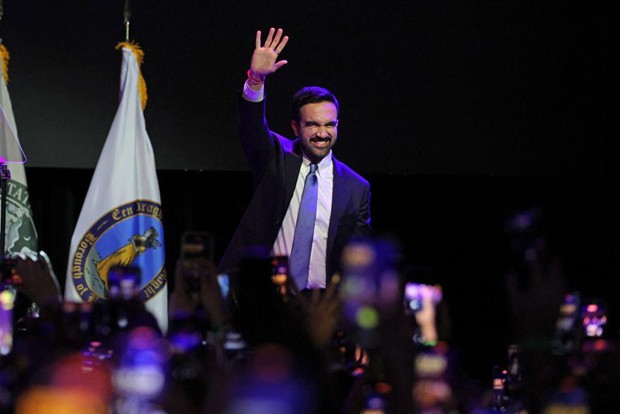
Mamdani reversed this. His campaign trail, victory speech and inauguration all exemplify a tremendous confidence in his religious belief and refusal to apologise for his Muslimness. His presence in the political domain is a welcome change, especially after trends in the past few decades to approach Muslims from a security lens (I used to research counter-violent extremism). His example is also a call for everyone to reach a common point of understanding, less by asking Muslims to explain themselves and more by demanding others try to understand Muslims with all their multifaceted experiences and backgrounds.
Some might see the problem in my thinking. We are already living in Muslim-majority countries like Indonesia and Malaysia, so don’t we already have the space and opportunity to showcase our Muslim pride?
This is where Mamdani’s progressiveness adds depth and complexity to his Muslim identity. He embraces many groups and issues that the more conservative streams of the faith would not approach with a ten-foot pole: socialism and LGBT, among others. A deeper discussion on his contrarian views falls outside the scope of this write-up; however, it is fascinating how he can both claim his faith while at the same time also challenge the views of most of his co-religionists, often in the same breath. That requires a tremendous amount of courage, self-conviction and security with one’s faith.
I wonder if, in a way, he has validated an emerging trend among Indonesian millennials and Gen Z whereby faith is being reinterpreted and realigned to match personal values, emotional needs, and daily experiences. My biggest curiosity at this point is if he has experienced a degree of internal conflict as he balances between the Islamic faith and his political convictions, but I would leave this to the psychologists and philosophers out there. This, however, has not alienated him from Muslim New Yorkers, some of whom expressed their joy at seeing a Muslim inst
Some may call this a contradiction. I call it on-the-ground realities. Personally, I am something of a non-conformist myself, often questioning the establishments and wondering why the majority subscribe to the same conventions.
Mamdani somewhat fits this bill when he demonstrates his paradox—a Muslim with contrarian views. But beyond my private convictions, he has successfully proven to the world that Muslims are more than just the one-dimensional image that the West has painted in the past few decades (i.e. backward and a security risk). This only reinforces the narrative that Muslims are just as complex, as grounded and as human as the rest of the people on the planet.
Mamdani has inspired me to achieve more as a Muslim and stand for what I believe in, even if it means ruffling some feathers sometimes.
Identity over Substance?
Mainstream as well as social media in both Malaysia and Indonesia erupted with a rare euphoria that more often than not highlights Mamdani’s Muslim background.
Such an excitement, nevertheless, has invited a degree of scepticism from some observers for what they call the people’s obsession with identity over substance.
To a large extent, this kind of criticism holds true. Southeast Asian political culture often emphasises personal identity, background and leadership style over ideology and policy. The fascination towards Mamdani’s Islamic faith, for instance, is not coupled with a similar degree of attention to his policies, which include rent freezes, universal childcare, free city buses and others.
If scrutiny over local politicians’ politics and policies is already at a bare minimum, it is unlikely that the people here would also give a second look at the programmes of a politician in a far-off place.
Even more problematic is the fact that this attention to Mamdani’s identity appears to be selective. Mamdani is a follower of Twelver Shi’ism, which should send many Muslims in Southeast Asia, who are followers of Sunni Islam, to an anxious state of mind. However, this fact did not get as many mentions. He is also a socialist, which to some people is worse, considering how leftist politics often gets associated with atheism still.
His more controversial positions, such as support towards the LGBT group, do complicate the reception towards him. However, this is not usually followed by a more in-depth discussion about various Muslim beliefs and identity, as it often quickly devolves into a binary discourse of whether Mamdani is Muslim or not. A trainer in my gym, for instance, both celebrated and deplored Mamdani within 10 seconds for this reason.
This presents an interesting facet of identity politics here, whereby individuals generally only pay attention to certain identities of a politician but not others. Clearly a new research question for those who are interested to explore this topic further.
Validating the Celebration
Nevertheless, such criticism ignores the people’s psyche as to why there is so much celebration over Mamdani’s election as New York City’s first Muslim mayor. I am offering a few takes as to why Muslims in this region are obsessed with Mamdani’s faith.
Firstly, there is a (perceived) shortage of inspirational Muslim figures today. A quick Google search or Gemini prompt for Muslim role models in Indonesia, for instance, usually yields examples that lean heavily towards certain categories, such as religious clerics, businessmen or historical figures. There is also a lack of a poll or survey detailing which Muslim figures are venerated in the region.
There are, of course, notable Muslims today who also inspire others. My Gemini offered a few names that include sportsmen (Mo Salah, Khabib Nurmagomedov), entertainers (Riz Ahmed, Ramy Youssef), religious leaders (Husein Ja’far Al Hadar, Ustadz Adi Hidayat) and politicians (Anwar Ibrahim, Anies Baswedan), among others.
However, there are no statistics detailing how many people are idolising such names or if they have motivated others as role models. My social circles are also dry; we do not really discuss inspirational Muslim figures. Meanwhile, social media continue to glorify the usual suspects, such as Elon Musk, Bill Gates, Rafi Ahmad or Atta Halilintar, ostensibly for their financial achievements or virality.
I am also guilty—it was really difficult to think of names even after a hard consideration. Only a few names popped up: J Robert Oppenheimer of the nuclear bomb or the fictional Hawke from the Dragon Age series.
Mamdani’s rise, thus, becomes relevant here. His achievements are one thing, but he also motivates other Muslims to be proud of who they are and what they believe in. He shows that one can be an exemplary model without having to be heavy-handed with religion, instead marrying religious obligations with the lived realities that Muslims experience. This ensures that he is accessible to a wide array of Muslims from different backgrounds.
Secondly, the impact of decades of Muslim securitisation. For so long, thanks to policies like the Global War on Terror, many Muslims have been led to believe that there is something inherently wrong with professing the faith. Instead of pursuing the ultimate truth through intellectual curiosity, a critical mind and an open heart, Muslims have been encouraged to approach religion with suspicion, fear, and insecurity. The growth of radical extremism certainly did not help, compelling Muslims to view the world through a lens of fire and hatred. To put a cherry on top, the sizeable Islamophobia industry further bolsters a global atmosphere that seeks to suppress Muslim identity and expression.
As competing actors dictate the “correct version of Islam”, the space for many Muslims to pursue and arrive at their spiritual truth organically becomes limited. Such actors offer discourses that are often embarrassingly ignorant of the vast Islamic history, worldview and values, creating a reductionist view of Islam that disrespects the agency of Muslims who are simply yearning for their God. Many have fallen into the fissures of both extremes – becoming radical Muslims or committing apostasy – while others may struggle to grow a sincere pride in the faith.
As touched on above, Mamdani challenged this trend, assuring Muslims worldwide that they do not have to apologise for embracing Islam or justify their faith to others. Whether one practices diligently or not is a separate question (Mamdani’s religious practice is something of an internet conundrum as well)—the point is, Muslims should be able
Thirdly, the euphoria bloomed against the backdrop of prevailing mindsets of many Muslims in Southeast Asia. These include ghazwul fikr (invasion of ideas), or the massive Westernisation of popular culture in Southeast Asia, and the siege mentality that perceives the West as an oppressor aiming to eliminate Islam, among others. Perspectives such as these cause many Muslims to y
Being a product of Islamic education institutions almost all my life (which means I was always in the company of committed Muslims), perspectives like these were a constant leitmotif, particularly in the 2000s, when the full force of globalisation began to mould life here in Indonesia. Even today, their expressions continue to manifest in various discussions about the Muslim world, usually coupled with discussions on the failure of Muslims to reclaim the Islamic renaissance that marks the zenith of this civilisation.
Mamdani’s win, thus, presented a refreshing break against this gloomy mood. A Muslim now presides as mayor at the United States’ capitalist and liberal heart, projecting a glimmer of hope towards the rise of Islam and – in the more binary mindset of some people – its (eventual) victory against the West. Mamdani’s anti-genocide stance further reinforces his credence among the audience that he is here to fight for the oppressed Palestinians.
These are just some perceptions that need to be considered to understand why Southeast Asian Muslims celebrated Mamdani’s win, with a special emphasis on his faith. This did not occur in a vacuum—the attention to his (selected) identity is the outcome of decades of history and experiences of what being a Muslim is here.
If there is one lesson that we could learn from this debate, it is that there is an imperative to understand Muslims for who they are truly: their rituals, mindsets, histories, experiences, practices and, oxymoronically, faiths.
Mamdani’s opponents and detractors only saw him as a member of a minority group and a potential security threat. They ignored his education, history, family values and connection to the society, as if any Muslim is devoid of all these things that make him/her a human. Of course other Muslims cheered when he won.
Conclusion
Mamdani might have inspired people like me and others in Southeast Asia, but it is unlikely that we will bloom into someone as revolutionary and impactful as he is soon.
To be a Mamdani is to be someone who does not shy away from sitting on the opposite side of other people, including other Muslims. In Southeast Asia’s conservative sphere, the opportunity to do this is restricted. Furthermore, it takes a great deal to grow confidence in one’s ideals and principles—going out of the mainstream way, to stand for what you believe in, means you are likely to be cast as an individualistic person, which is often scorned here. You need quality education, a robust support system and humility to negotiate with the masses to navigate the opposition that comes in your way.
Forget the masses; many men do not even know what they want and what they are doing in life. Sadly, I have come across many men who are struggling with these questions lately, with various manifest consequences. Maybe they are also Mamdanis deep down but are significantly affected by the global masculinity crisis. In other words, the cards may be stacked up against us. For now, however, I am just glad I finally have someone that I can relate and look up to.
