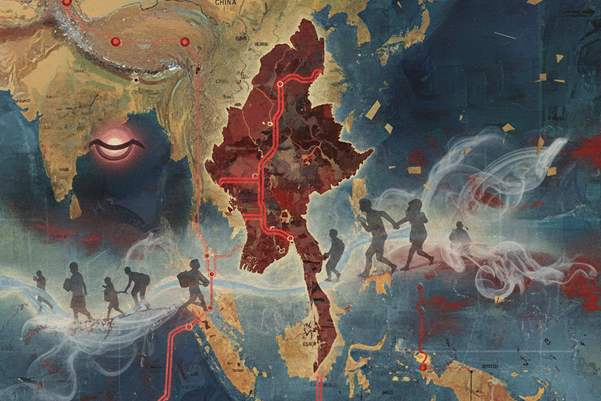
A woman wakes at dawn to the whine of drones. A trader abandons a shop whose customers have vanished. A riverbank swells with families turned back at an international gate.
These are not isolated scenes; they form a pattern drawn across Southeast Asia. They are also the everyday reality in Myanmar, where conditions have worsened dramatically since the military coup in 2021.
Forced migration in and from Myanmar is not a humanitarian footnote. It is a political metric; the most visible indicator of who holds power, who loses it and how external actors shape the battlefield in the ongoing civil war.
Discussions around China’s role in Myanmar tend to be framed in familiar terms: strategic corridors, major investments, influence over the junta and ethnic armed organisations (EAOs). Those are necessary frames but insufficient. They describe the machinery of power without tracing its human consequences. If displacement is moved to the centre of analysis, a more accurate map emerges; a map shaped not only by frontline violence but also by Beijing’s quiet signalling, its silences and its calculations.
Border Politics as Geopolitical Messaging
China’s pu
This dynamic is most evident along the China-Myanmar frontier. Every major escalation in northern Shan or Kachin generates two immediate questions: will civilians run, and will China let them in? Beijing’s border behaviour, sometimes permissive, other times abruptly restrictive, acts as a form of geopolitical messaging. Allowing crossings can stabilise local conflict dynamics; tightening the border can discipline armed actors or register political displeasure.
The result: displacement patterns that align not only with violence on the ground but also with shifts in China’s interest, leading to waves of forced returns or surges of escape depending on the border posture.
Infrastructure, Strategic Zones of Protection and Exposure
China’s infrastructure architecture in Myanmar – such as the oil and gas pipelines, the Kyaukphyu port and the Muse-Ruili trade zone – form a network of leverage rather than isolated investments. These nodes create differentiated zones of protection and exposure.
In areas critical to Beijing’s Belt-and-Road calculus, there tends to be a kind of “managed re
The recent displacement surges in places like Rakhine illustrate this clearly: China’s silence was not neutrality; it was permissive space.
Fragmented Regional Response: Why Displacement Remains a Crisis
Despite predictable patterns of forced migration tied to geopolitics, the regional response remains fragmented. ASEAN, via its Five-Point Consensus (5PC), remains structurally incapable of handling displacement at scale because it prioritises state sovereignty over cross-border humanitarian coordination.
The consequences of this fragmentation fall on individual states, which must improvise their responses rather than pursue a long-term strategy. For example, some countries allow temporary humanitarian corridors only to shut them with little notice. Others apply radically different approaches across their territories (often shaped by ethnic, political or security calculations). Many host secondary movements with newly displaced people routed via third countries without a unified legal framework linking domestic reception to regional displacement trends.
This policy fragmentation is not just inefficient. It is dangerous. The strategic choices of powerful external actors like China produce waves of movement. Southeast Asia’s inability to anticipate them creates cascading crises: overcrowded camps, expanding smuggling markets, fluctuating humanitarian access and political tensions among neighbouring states.
Displacement as a Strategic Diagnostic
The temporal dimension of displacement further complicates things. China’s engagement can generate brief, fragile pauses or rather windows in which families return, rebuild, or hide. But these are often replaced quickly by new surges when diplomatic restraint is withdrawn or armed actors attempt territorial gains.
Regional migration economies respond accordingly. When official borders close, smugglers expand routes and raise prices. When China allows temporary crossings, humanitarian organisations scramble to deliver aid amid shifting access rules. The business of escape grows more sophisticated in direct response to policy unpredictability. For many Burmese, paying a smuggler becomes the only consistent element in an inconsistent political landscape.
Crucially, none of this implies China is intentionally engineering displacement. Rather, displacement is a predictable externality of its strategic calculus, and predictable externalities demand structured responses. Treating forced migration as an unfortunate spillover invites only humanitarian triage
A Test for Regional Governance
If the junta’s planned elections proceed at the end of December amid regional ambivalence and weak accountability, Beijing’s leverage will harden. The military may intensify operations in areas where China exerts minimal restraining influence. EAOs will respond to shifting incentives. Civilians will move again, not because politics is uncertain, but because it is too clear.
The future of Southeast Asia’s displacement geography will be written by a combination of China’s calculations, Myanmar’s internal collapse, and the region’s willingness or refusal to respond collectively.
What is at stake is not simply the management of borders but the moral and strategic credibility of Southeast Asia itself. States that continue to treat migration as a peripheral risk are being overwhelmed by its con
Forced migration, then, is not collateral. It is a lens. It reveals which districts fall outside diplomatic concern, which borders are quietly opened, which routes smugglers exploit and which states absorb the consequences of decisions made far beyond their control. Every family pushed to a riverbank, every village emptied in a night, every makeshift camp beneath a shuttered border gate—these are not incidental tragedies. They are, line by line, the ledger of geopolitical choice.
Conclusion
To move forward, Southeast Asia must reframe displacement as a strategic diagnostic tool,
In Myanmar, population movements track political truths long before diplomats acknowledge them. When entire districts empty overnight, it is not because civilians misread the situation. But because they understood it sooner than the rest of us.
If regional governments analysed displacement flows with the same rigour they apply to trade flows, shipping lanes or military exercises, they would see emerging risks months in advance. Instead, states respond only when boats arrive
The years ahead will test whether the region can transcend habitual caution and reimagine migration governance as collective security. A coordinated framework could integrate climate-induced movement, labour mobility and refugee protection within a single regional architecture. Such a shift would not only mitigate humanitarian crises but also stabilise markets, reduce trafficking and foster regional trust. Th