
Introduction
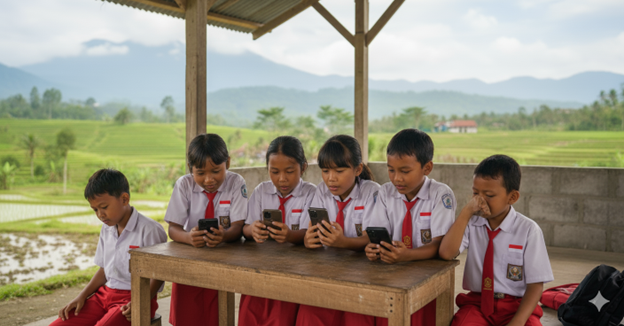
Amidst the cool climate of Kertek, Wonosobo, I was struck by a wake-up call: the profound impact of social media access on children in rural communities.
I witnessed this during her mandatory community service programme.
The schoolchildren of Kertek are widely hooked into TikTok, a short-video application popular in Indonesia. They memorise and share dance videos, become addicted to the velocity trend, and devour viral memes like tralalero tralala.
During an initial visit to an elementary school in the village of Tlogodalem, the principal and classroom teachers expressed a common concern: the pervasive influence of social media was eroding students’ ability to concentrate and affecting their character.
This concern recalls experiences from a previous teaching position, whereby students asked questions about social media accounts and showed great enthusiasm in requesting help to make videos imitating the latest TikTok viral trends.
Here is the grim reality: in my observation of these students, fifth and sixth graders appear far more fluent in choreographing hand movements for TikTok’s “velocity” videos than in reading a simple paragraph aloud, let alone grasping the meaning of a word like “beasiswa” (scholarship) or “interaksi”(interaction).
What Does the Data Say?
Accessing the Internet has become a daily routine for many people, but this means the impact of excessive screentime is also widespread. In 2024, 39.71% of children in Indonesia were mobile phone users, while 35.57% had access to the Internet.
Against this backdrop, 89% of Indonesian children are online every day, spending an average of 5 hours and 24 minutes.
Where do they go to when they are online? As of July 2024, Indonesia recorded 157.6 million TikTok users; children likely made up a big portion of this population.
Paradoxically, Indonesia ranked among the bottom 10 out of 80 countries for reading literacy. Data from the Ministry of Education also indicates that the national average for reading activity remains in the low category. Meanwhile, only 0.001% of Indonesians are active readers, implying that merely 1 in every 1,000 people regularly reads.
The Allure of Virality
Indonesia has the largest population of TikTok users in the world, but what makes this application so appealing to Indonesian youth?
First, the influence of celebrities, content creators and influencers. Content creators see TikTok as a platform to gain visibility through existing trends in a quick fashion—they feel thrilled when they see their engagement rate and views go stratospherically high within a relatively short period of time. This has undoubtedly inspired some sections of children TikTok users to aspire for similar quick path to glory.
If not to become content creators themselves, then the children might be encouraged to replicate the virality and fame that these creators have achieved within their own set of audience. This leads to our second point—the national popularity of following such trends develops a similar desire for fame. This is promoted by the massive number of users following such trends, which fuels a stronger desire among young users to have their replica content featured on others’ FYP. The more viewers engage with videos related to ongoing trends, the greater the chances these videos will rise in popularity, creating a cycle of visibility and virality.
Addiction
Social media addiction occurs when excessive time spent watching short videos causes people to lose track of time and feel anxious when they are unable to access video-sharing platforms, ultimately interfering with daily routines. When people disproportionately scroll through social media content, they are trapped in a situation called “doomscrolling”.
Social media addiction and doomscrolling are especially concerning for children, whose ability to concentrate is still developing. Research indicates that social media addiction can lead to academic procrastination – defined as the habit of delaying schoolwork – and increased stress levels. Previous studies have also shown that excessive use of social media is linked to increased academic procrastination, higher stress levels and decreased academic performance.
Exposure to social media also shapes moral development. Indeed, the connection between social media (where narratives and stories spread) and moral development has been taken for granted. This is not a new problem. In his Republic, Plato recommended the banishment of all storytellers unless their stories are aligned with the educational values that must be embodied by the soldiers. Plato believed that consumers of these stories might admire and imitate characters displaying poor behavior.
Similarly, children are impressionable beings—they might yet to develop the faculty needed to determine which content should be absorbed and rejected. Social media addiction, however, blunts children’s ability to do this, potentially affecting the development of their moral compass and perception of what is right and wrong.
Bottom line, childhood is the crucial period in character development, so it is essential to foster the children’s mindset and provide positive education during this time stretch. The role of parents, teachers and surrounding environment/community are equally important in a child’s growth process.
The preceding discussions emphasise the urgent need for strategies to mitigate the impact of social media addiction on children, especially as social media platforms become incr
Call to Action
Understanding social media addiction is integral in devising measures to stop such addiction from occurring. Real change requires serious intervention from parents and caregivers to implement boundaries and monitor the exposure of social media.
Recommendations below are some contributions to ameliorate the ongoing situation affecting our children in Indonesia.
Community-Based Approach
During mandatory community service, I organised Kawal Layar: Strategi Perlindungan Anak dari Eksploitasi Digital (Screen Guard: A Strategy for Protecting Children from Digital Exploitation), a discussion comprising 30 parents focusing on protecting children from social media addiction.

One of the most effective parental intervention, acknowledged by majority of participants, is to set a time limit for children to use technologies. This restriction is important in order to develop mindfulness of the time spent online and mitigate the likelihood of developing addictive behaviors.
Active involvement from both teachers and parents plays a vital role in guiding students’ use of social media platforms. It is essential to provide both education and supervision regarding social media usage, ensuring that children can access TikTok, Instagram or any social
Government Protection
In the legal sphere, the Indonesian government has enacted
More importantly, GR 17/2025 mandates that consent be secured prior to a ch
Given the existing regulations, it is essential that every citizen enjoys equal access to information protection. Disseminating and socialising newly enacted regulations within village communities plays a vital role in ensuring that residents understand both the risks posed by inadequate chi
Conclusion
The widespread use of TikTok and other social media platforms has undeniably transformed childhood in Indonesia, shaping not only how children spend their time but also how they develop cognitively, socially and morally. While digital platforms offer opportunities for creativity and connection, their potential to instigate addiction poses serious risks to literacy, concentration and character development. My observation shows that children are far more fluent in the language of virality than in the foundational skills of reading and critical thinking.
Addressing this challenge requires a collective effort. Parents and teachers must actively shape healthy digital habits for children, while community programmes can raise awareness and build resilience against the lure of online addiction. At the policy level, regulations such as GR 17/2025 need to be not only enforced but also effectively communicated at the grassroots level, ensuring that every child’s digital rights and welfare are protected. Ultimately, cultivating a healthier digital culture for Indonesia’s children lies in creating balance, embracing the opportunities of technology without letting it undermine fundamental skills and values.
