search


Did a “Blue Wave” occur at the recent Johor State Election? Credit: Unsplash/NHN
The Johor Surge: Is UMNO Truly Back?
24 July 2026/6 Minutes of Reading
Introduction
The results of the 16th Johor State Election, held on 11 July 2026, were both expected and surprising, perhaps to the same degree.
Although pundits and analysts predicted Barisan Nasional (BN) to retain power, the coalition significantly outperformed rivals by winning 48 of the 56 seats contested and gaining a two-thirds majority in the state assembly.
The United Malays National Organisation (UMNO) won 36 seats, while the Malaysian Chinese Association (MCA) and the Malaysian Indian Congress (MIC) garnered 8 and 4 seats each. Prime Minister Anwar Ibrahim’s Pakatan Harapan (PH), by contrast, secured only eight seats (see Table 1).
Dissolving the state assembly ahead of its April 2027 mandate suggests the ruling party wanted to capitalise on a favourable political condition.
Johor has long been regarded as one of BN’s strongest bases, being the birthplace of UMNO and where BN’s influence is entrenched at the grassroots level.
Table 1. The 2026 Johor State Election Results
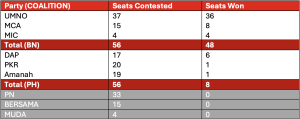
Source: Election Commission of Malaysia
Key Campaign Issues and Manifestos
The Johor election was shaped by three main competing stories among BN, PH and Perikatan Nasional (PN).
BN’s key campaign theme and manifesto were on stability, development and continuity, with BN hammering the message that continuity was essential to ensure the stability and growth of the state’s economy.
This was the correct messaging. In 2025, Johor recorded RM110b in approved investments, the highest in the country and a historic record for the state. Much of this optimism was linked to the Johor-Singapore Special Economic Zone (JS-SEX), formalised in January 2025, which seeks to deepen economic integration between Johor and Singapore.
For investors, stability matters. For BN, the message is straightforward: a strong mandate for the state government will ensure continuity for the JS-SEZ, data centres, logistics, manufacturing and cross-border economic projects.
On the other hand, PH’s campaign manifesto appeared to lack distinctive and concrete policy proposals capable of capturing the attention of Johor voters. Its key messages were also not effectively communicated at the grassroots level.
Throughout the campaign, PH struggled to explain clearly how its electoral promises would address voters’ immediate concerns, including the cost of living, employment opportunities, public services and state development. As a result, the coalition failed to present a compelling alternative to BN or to generate sufficient enthusiasm among fence-sitters.
Although PN did not launch a formal manifesto, its campaign sought to erode BN’s Malay support base by emphasising issues related to religion and political identity.
Johor is special in the sense that the “Bangsa Johor” (Johor Nation) notion is deeply inculcated among the grassroots. This means that while issues involving race, religion and royalty (3Rs) might still feature in the campaign, they are not able to dominate political discourse to the same extent as they had in some other states.
This potentially explains the failure of PN to capture votes from BN’s constituents.
Table 2. Key Themes and Elements of Party Manifesto
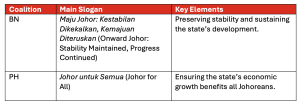
Source: Sinar Harian
What Contributed to BN’s Victory?
BN’s victory may be attributed to several factors, foremost among them the perceived performance of Johor Chief Minister Onn Hafiz Ghazi.
Dubbed the “checkpoint chief minister” for his frequent monitoring of the border traffic, Onn Hafiz built a reputation based on hands-on governance, cross-ethnic appeal and strong ties with the Johor royalty, thus reducing the space for confrontational politics.
BN, thus, benefited immensely from the presence of Onn Hafiz as its “poster boy”, who is both a prominent and credible state-level leader capable of articulating an alternative vision for Johor. This is something that PH was unable to offer to voters.
Another factor contributing to BN’s victory was the internal division within PN, which appeared to weaken the coalition’s appeal among Malay voters and allowed UMNO to regain political ground.
Tensions between Parti Islam Se-Malaysia (PAS) and Partai Pribumi Bersatu Malaysia (Bersatu) undermined PN’s ability to present a coherent alternative, while the absence of unified leadership, disciplined campaign machinery, and consistent political messaging created a space for BN to consolidate Malay support.
Although there was no formal electoral pact between BN and PAS, the conduct of the campaign suggested a degree of tactical understanding between the two parties.
PN contested only 33 seats, and PAS leaders reportedly encouraged their supporters to vote for BN candidates in constituencies where PAS was not contesting. This informal accommodation reduced the likelihood of fragmented Malay votes and placed BN in a more favourable position, particularly in constituencies where it faced a straight fight against other opposition parties.
What Went Wrong for PH?
PH failed to expand its electoral presence in Johor, with the Democratic Action Party (DAP) securing only six seats, compared with 10 in the previous election. This setback suggests that PH not only struggled to attract new voters but also faced increasing difficulty in retaining parts of its traditional support base.
Several factors may explain this underperformance.
First, PH’s campaign lacked a sufficiently focused and persuasive leadership narrative. Although Anwar remains a charismatic national figure, some of his campaign remarks appeared defensive and insufficiently connected to the concerns of Johor voters.
Dismissive campaign remarks from Anwar Ibrahim – including jabs at state leaders and emphasising his secure federal tenure regardless of the result – reinforced perceptions that PH viewed the contest strictly through national political rivalries.
PH could have garnered more votes had it highlighted the federal government’s achievements, explained how national policies had benefited Johor and presented a credible programme for future federal-state cooperation.
Second, PH’s campaign was framed largely around national political controversies rather than constituency-level concerns.
Its messaging relied heavily on issues such as the “Release Najib” campaign and the perceived threat of a “Green Wave”. While these themes may have helped consolidate PH’s existing non-Malay supporters, they were insufficient to broaden the coalition’s appeal, particularly among younger and undecided voters. PH also failed to connect these narratives from everyday concerns such as wages, employment, housing, transportation and public services.
Meanwhile, the presence of several federal ministers on the campaign trail also failed to produce a stronger connection with local sentiment.
Third, discontent grew among Chinese voters over slow institutional reforms, unresolved education issues (like Unified Examination Certificate recognition), and federal cost-of-living policies such as e-invoicing and diesel subsidy rationalisation.
More broadly, the coalition struggled to present a clear and compelling economic strategy specifically for Johor. Although BN and PH are partners in the federal government, BN successfully localised the election around Johor’s leadership, development record and economic prospects. PH, by contrast, appeared to bear a disproportionate share of public dissatisfaction with federal policies.
Fourth, PH failed to retain its base or gain Malay voters, with dissatisfied supporters either abstaining or shifting toward Rafizi Ramli’s Parti Bersama Malaysia (BERSAMA) party. Without rebuilding trust across communities and offering a distinctly Johor-centred agenda, PH may find it increasingly difficult to reverse its electoral decline.
What Lies Ahead for UMNO?
BN’s victory in Johor marks a significant political comeback for UMNO, but it should not be interpreted yet as evidence of a nationwide resurgence. Its strong influence, effective political machinery and popular state leadership are advantages that cannot be replicated elsewhere.
The immediate test is whether UMNO can extend this momentum into upcoming state contests like Negeri Sembilan, proving the “Blue Wave” is more than a localised phenomenon.
Analysis of future contests should also zoom in on UMNO’s success or failure at recapturing the Malay votes and whether it can do so without alienating moderate and non-Malay voters.
The challenge will be greater in a general election that, unlike state contests, is more strongly shaped by the choice of prime minister, economic performance and overall governance. PH may remain competitive in a general election, particularly in urban and ethnically diverse constituencies.
In fact, Johor’s results also accentuate UMNO’s strategic dilemma. Although BN and PH remain partners in the federal government, they are increasingly direct competitors at the state level. This rivalry may strain cooperation between Zahid Hamidi and Anwar Ibrahim as the next general election approaches.
Additionally, pursuing tactical cooperation with PAS risks alienating non-Malay voters and fracturing UMNO’s federal partnership with PH.
Johor has restored UMNO’s confidence and strengthened its bargaining position, but its future will depend on whether it can reproduce this state-level victory in a broader, coherent and inclusive political strategy at the federal level. Otherwise, it may prove to be only a local and short-term victory.
The views expressed are those of the authors and do not necessarily reflect those of STRAT.O.SPHERE CONSULTING PTE LTD.