search

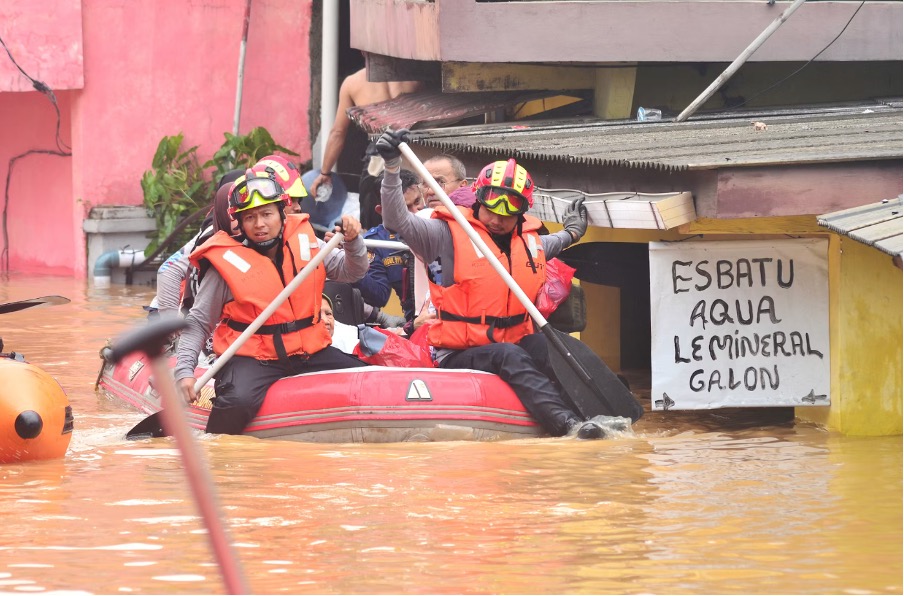
Flash floods are becoming more frequent across Indonesia. Credit: Unsplash/Iqro Rinaldi
Ambition Over Reality
26 June 2026/5 Minutes of Reading
Introduction
Indonesia has promised to achieve decarbonisation and a low-carbon economy by 2050, but it still targets an 8% economic growth rate. Given its political, economic and geographical conditions, these targets will be difficult to attain.
To put this into context, Indonesia is the 20th country most affected by the climate crisis. It is especially vulnerable in terms of the hazard and exposure criteria—between 2023 and 2024, as many as 6,800 climate-related catastrophes occurred in the country.
The island of Java offers a good example of this. Jakarta is grappling with rising sea levels. Java’s northern coastline – popularly known as “Pantura” (Pantai Utara) – has been threatened by tidal flooding. Meanwhile, both East and West Java have been hit by intense storms.
To put a cherry on top, the “Godzilla-level” El Niño is expected to exacerbate climate-linked challenges throughout the whole country in the middle of this year.
However, when the efforts to push for economic growth conflict with these climate-related activities, the political will to address this crisis gets dampened. Indonesia is still dependent on extractive industries to boost its development.
In other words, the vision to mitigate the negative impacts of climate change is hindered by the country’s own policies and development models.
This brings up a critical question: is it realistic for Indonesia to declare climate commitments when its economic strategy still relies on these extractive activities?
Policy Discrepancy
Indonesia’s climate commitments face challenges from three interconnected factors.
The first is a policy discrepancy between the government’s declared climate commitments and its 8% economic growth target. Its pursuits of decarbonisation and net zero by 2050, as declared by President Prabowo Subianto, collide with the enduring national economic strategy that puts an emphasis on extractive industries.
In other words, the net-zero target is overshadowed by the government’s target to achieve an 8% economic growth. To achieve the latter, the government must double down on the extraction of natural resources, considering much of the economic growth is still spurred by extractive industries.
The numbers speak for this. In 2024, the government announced that of the US$618b projected total investment in the downstream commodities, 91% of which would be allocated to the energy and mineral resources sector, such as coal, oil, and gas.
All of these commodities are part of the resource-extraction industry, economic sectors that place a heavy emphasis on not only exporting raw materials but also downstreaming. Unfortunately, this is the current growth model beneficial to Indonesia—the sectors are attractive to investors, whose money can create jobs in the short term.
Meanwhile, progress in renewable energy has stalled or even declined, and this has preceded Prabowo’s administration. Indonesia’s target of renewable energy transformation could spoil the productivity of these mineral resource sectors, which in turn would hinder the 8% growth target.
In recent years, Indonesia had failed to meet its renewable energy target, prompting the government to reduce the targetsfrom 23% to 17%-19% in 2025 and 26% to 19%-21% in 2030.
The 8% economic growth target will also find challenges from the plan to phase out coal-fired and all fossil-fuelled power plants that, although it will contribute to the green energy transition, will slow down heavy activities in these two sectors. Attaining this target is rather unrealistic amid persistently high coal production, inefficiencies in carbon markets and unclear climate finance structures.
In short, Indonesia is stuck in a Catch-22 situation. On the one hand, it is committed to green transformation, but this has limited potential for economic growth. On the other hand, it is aiming to achieve an 8% economic growth, but this demands greater productivity from the extractive industries.
Entrenched Dependence
Linked to that is the second point: Indonesia’s continued dependence on extractive industry to spur growth. Here, the examples of nickel and fossil fuel offer a good picture.
As the world’s largest nickel producer (with annual production reaching approximately 2.2 million tonnes), nickel donwstreaming has emerged as a prime topic in public discourse in recent years. Nickel mining and downstreaming, nonetheless, continue to rely on non-renewable energy, which then places a consistent demand on the country’s fossil fuel sector. This means that the large-scale investment in the nickel downstream poses a risk of development lock-in.
The nickel sector is also expected to grow significantly, driven mainly by, ironically, the demand for cleaner technologies such as electric vehicle (EV) batteries. If no intervention is made, it will create a constant loop whereby the continued demand for nickel will also trigger a continued demand for fossil fuel.
National consumption of fossil fuel has also not slowed down. Fossil fuel subsidies had gradually crept back up, reaching Rp551t in 2022 despite previous reforms and pledges, while only 1% of total energy subsidies were allocated to renewable energy.
Even the global constraint in oil supply and the recent furore over Pertamax price increase have not instigated a heightened awareness of non-renewable energy nationwide. The discourse continues to be arrested on subsidies and the impacts on the lower class community if the oil price is not controlled.
Injustice
Furthermore, the continued presence of the extractive industry has also deepened inequality and ecological injustice, particularly in resource-rich regions.
This structural issue becomes even more complex when the distribution of economic benefits is taken into account. Various observers have noted how large-scale mining by big corporations has led to the emergence of “poverty premium”.
This is a condition in which communities in resource-producing regions experience poverty exacerbated by environmental degradation and the high costs of accessing basic services (such as clean water and electricity). Such a situation can be found where mining activities have been shown to disproportionately benefit investors while local communities bear environmental and social costs.
Nickel mining in Raja Ampat, for instance, threatens the livelihood of surrounding communities and degrades its rich ecosystem. In another instance, the mining sector accounted for 43.19% of GDRP in East Kalimantan in 2023, but the province’s development rate remains uneven.
As long as the state continues to embrace the narrative that Indonesia’s natural resources must be exploited primarily for capital gain, it will continue to fail in delivering a just development to vulnerable communities and protecting Indonesia’s rich ecosystem.
From a political economy perspective, this demonstrates the country’s inability to transcend beyond extraction-based development, whereby the state and the private sector still heavily exploit natural resources for growth. Despite the proposition that the green economy can yield double the economic benefits of extractive industries within a decade, instances above show that the appetite for this transition remains low.
Conclusion
These challenges suggest that Indonesia’s climate commitments are more constrained by structural contradictions embedded in the current development model than by technological limitations. While further adoption of technology and innovation may offer hope for Indonesia’s future low-carbon planning and decarbonisation, technical instruments alone are insufficient to deliver climate objectives.
The Indonesian government generally recognises the importance of investing in green infrastructure, credible carbon markets and low-carbon policies. However, as shown above, these are not sufficient to offset the environmental risks and economic costs associated with extractive growth.
The main challenge facing the government is the need to pursue long-term climate mitigation as a goal that underpins Indonesia’s national development. If the government does not shift the developmental model from extractive growth to long-term investment in green technology and innovation, the gap between climate ambition and policy reality is likely to continue.
The author expresses sincere appreciation to Radityo Dharmaputra for his significant feedback in the development of this article.
The views expressed are those of the authors and do not necessarily reflect those of STRAT.O.SPHERE CONSULTING PTE LTD.
This article is published under a Creative Commons Licence. Republications minimally require: 1) credit authors and their institutions, and; 2) credit to STRAT.O.SPHERE CONSULTING PTE LTD and include a link back to either our home page or the article’s URL.