search

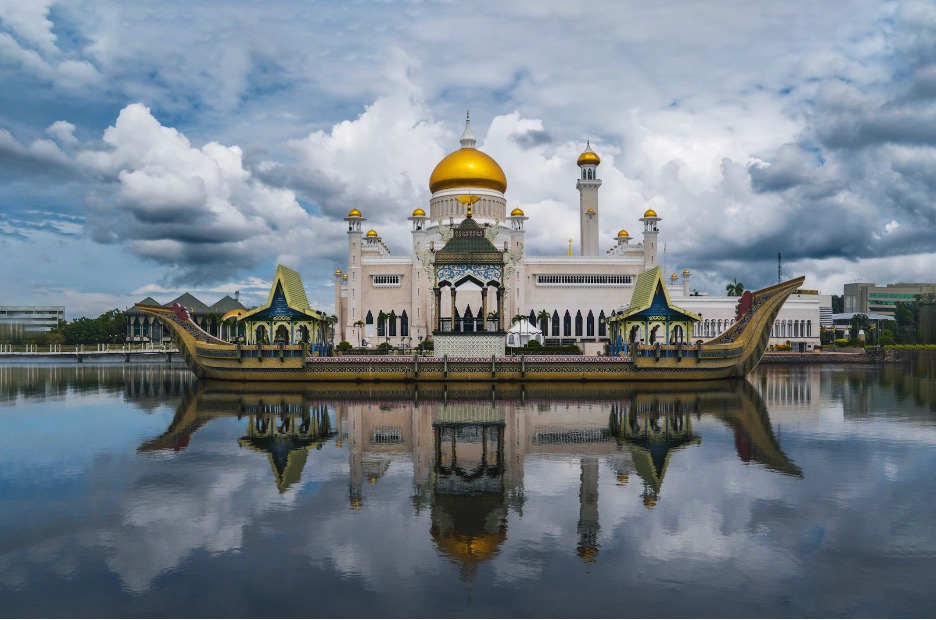
Is Brunei’s sovereign wealth model past its expiration date? Credit: Unsplash/Jie Yeu Teoh
Brunei’s Ticking Fiscal Clocks
16 June 2026/7 Minutes of Reading
Separation
The administrative separation between Brunei’s sovereign wealth fund and its industrial diversification apparatus represents one of the last single-mandate sovereign wealth structures across ASEAN.
This coincides with a sobering look at Brunei Investment Agency’s (BIA) 2026 budget, which reaffirms the troubling decline in Brunei’s hydrocarbon wealth.
In March 2026, Second Minister of Finance and Economy Mohd Amin Liew Abdullah tabled the FY2026/27 budget, a B$6.3b package anchored on Wawasan Brunei 2035 and five priority sectors: downstream oil and gas, food, tourism, ICT, and services.
The most consequential commitment was the Hengyi Phase 2 expansion, a US$5b project expected to begin operations in 2029. Phase 2 is a domestic development initiative administered through Damai Holdings and the Strategic Development Capital Fund. None of the BIA’s external portfolio sits inside this structure.
This separation captures the strategic question Brunei now faces. BIA invests abroad for returns. The Brunei Economic Development Board, the Petroleum Authority and the Strategic Development Capital Fund administer the downstream and the diversification.
Across ASEAN and the Gulf Cooperation Council (GCC), this architecture is increasingly the exception among sovereign wealth funds. Indonesia’s Danantara, Malaysia’s Khazanah Nasional, and Singapore’s Temasek now operate as dual-mandate vehicles, expected to generate foreign yield and anchor domestic industrial transformation concurrently.
The structural question for Brunei is whether a country with a 27-year reserves horizon for oil and gas, as well as with 75% of its budget tied to hydrocarbons, can sustain two separate sovereign capital institutions indefinitely. This is especially at the time when the global model for sovereign wealth funds consolidates into one vehicle that bolsters domestic industry and reaps returns in foreign markets simultaneously.
BIA and Brunei’s Industrial Apparatus
BIA was established in 1983 under the Brunei Investment Agency Act, taking over external reserve management previously handled by the British Crown Agents. Its mandate has been exclusively external since founding.
Estimates of its assets under management range from US$35b-78b, a spread that reflects the absence of audited disclosure. BIA scores 1 out of 10 on the Linaburg-Maduell Transparency Index, the lowest position on the index.
The sultanate’s domestic development apparatus operates in parallel. The Brunei Economic Development Board, established in 2001, leads investment promotion and downstream projects. The Petroleum Authority, created in 2020, regulates upstream, midstream and downstream activity previously housed inside PetroleumBRUNEI.
The fiscal math points to a waning future for Brunei’s energy exports. The FY2025/26 budget projected total revenue of B$3.26b, of which approximately 75% came from oil and gas.
Crude production has declined from a 2006 peak of approximately 221,000 to 84,000 barrels per day (BPD) in the first half of 2025, per Energy Intelligence data. The IMF’s most recent Article IV consultation places the depletion horizon at approximately 27 years at current extraction rates.
BIA’s institutional history includes a substantial governance episode. Prince Jefri Bolkiah chaired the Agency from 1983 to 1998 and served as finance minister from 1986 to 1997. After the 1998 collapse of his Amedeo Development Corporation, audits traced approximately US$14.8b of about US$40b in special transfers from BIA accounts to Jefri-linked spending. This episode remains the reference point against which any expansion of BIA’s mandate must be measured.
The Dual-Mandate Model
Most sovereign wealth funds today are built to do two jobs at once: earn returns by investing abroad and help build industry at home. The logic for combining them is straightforward. Investing overseas is getting more expensive, and building new industries at home requires patient, government-backed money.
Splitting these jobs into two separate funds wastes the advantage of pooling capital, and it cuts the home-investment side off from the financial discipline that comes with competing for real returns in global markets.
Indonesia’s Danantara, launched in February 2025, is the clearest example. It pools the country’s state-owned companies into a single fund approaching US$1t in assets, with a double job written into its mandate: collect profits from those state companies while building the capacity to invest abroad and draw foreign partners into priority sectors.
Malaysia’s Khazanah Nasional, worth roughly US$23b, runs two pools of money side by side: one chases returns globally, the other holds stakes in Malaysian companies tied to the government. A newer programme, Dana Impak, pushes the fund further into backing domestic startups and emerging technology.
Singapore’s Temasek, worth S$434b, owns controlling stakes in national champions such as DBS, Singapore Airlines, Singtel and PSA International while also investing worldwide. Singapore’s other fund, GIC, is the exception: it invests only abroad.
BIA looks far more like GIC than like the combined-purpose funds. Everything about it, from its legal mandate to how it chooses investments, is geared toward earning returns abroad. Brunei has deliberately kept the work of building domestic industry in entirely separate hands.
That choice comes at a price, with the clearest cost being lost information.
BIA deals constantly with global investors, fund managers and company operators, but none of those contacts or market insights flow back to the people building Brunei’s industrial projects at home, because the two sides simply do not talk to each other. Sitting back as a passive investor carries a hidden cost, even more so as global stock markets soften under geopolitical conflict and uncertainty.
The second cost is money. When the Strategic Development Capital Fund must bankroll a multibillion-dollar expansion like Hengyi, it does so from a far smaller pot than what BIA controls.
Meanwhile, BIA keeps spreading its money across global investments that have nothing to do with Brunei’s industrial plans. Leaning on payouts from foreign stocks does not remove the risk of a revenue shock; it only moves that risk around. And because BIA typically invests as a silent partner in outside funds, it has little say over how those investments are actually run.
The other major Southeast Asian funds have moved in the opposite direction. Brunei’s split between investing and industry-building, once the regional norm, now makes it the odd one out.
The Dalio Framework and Brunei’s Bloc Exposure
In August 2025, BIA bought a nearly 20% stake in the parent company of Bridgewater Associates, the most notable of its recent investments abroad. The choice of partner is telling, with one qualification.
Bridgewater’s founder, Ray Dalio, gave up control of the firm in 2022 and is no longer its chief executive, so the investment is a bet on the company itself, not a sign that Brunei is adopting his personal worldview.
Even so, that worldview is worth taking seriously here. Dalio’s reading of the current moment (drawn from his writing on long cycles of national debt, political conflict inside democracies, and the reshuffling of the world into rival power blocs) maps closely onto the pressures Brunei now faces.
Brunei is effectively betting on both sides of a great-power divide at the same time. Its biggest investments abroad sit in American and European real estate, stocks and US investment firms. Its biggest project at home, the Hengyi refining and petrochemical complex on Pulau Muara Besar, is backed mainly by Chinese capital and Brunei government incentives and stands as the largest Chinese investment the country has ever received.
Dalio’s account of a shifting world order warns that, as these blocs harden, countries will be pushed into choices their existing institutions were never built to handle.
Brunei keeps its overseas investing and its domestic industry-building in separate boxes, an arrangement that works in calm times because each side can run on its own. A sharper divide between global blocs takes that independence away. If Brunei were ever forced to pick a side, its foreign investments and its home industries would have to move in step, and its current setup gives them no place to coordinate.
Outlook
The institutional separation has functioned for four decades because hydrocarbon revenue compounded sufficiently to fund both BIA and domestic industry. Yet, the arithmetic supporting this structure is crumbling.
Each year that BIA deploys capital abroad without sharing intelligence or capital with domestic industrial development is a year in which the institutional case for separation weakens and the regional case for consolidation strengthens.
For the rest of Southeast Asia, the BIA case is the clearest institutional comparison available on whether the dual-mandate stratagem is genuinely superior or simply the regional consensus. A small, opaque fund operating a single-mandate model against a declining revenue base at home runs the very real risk of leaving Brunei dependent on companies it has no real operational control over.
As the GCC countries have learned, a post-oil transition requires diversifying the country’s industrial base gradually and enhancing control over select industries by funding domestic “national champions” capable of competing abroad.
Such thinking has propelled the likes of Saudi Arabia and the United Arab Emirates to anchor sovereign capital in domestic firms that later expanded outward, from the Emirates’ DP World and Etihad to the Public Investment Fund’s holdings across Saudi industry, logistics, and technology.
The harder analytical question concerns whether Brunei would gain more from preserving the separation as an explicit signal of fiscal discipline or from consolidating BIA into the dual-mandate model that has become the regional norm.
Consolidation would deliver the information and capital synergies that Danantara, Khazanah and Temasek are now built around. Both options carry costs the sultanate has not yet been forced to confront.
The available time is short. The institutional architecture Brunei chooses now will shape what kind of state the country becomes after 2035, and the consequences of that choice will extend well beyond Bandar Seri Begawan.
The views expressed are those of the authors and do not necessarily reflect those of STRAT.O.SPHERE CONSULTING PTE LTD.
This article is published under a Creative Commons Licence. Republications minimally require: 1) credit authors and their institutions, and; 2) credit to STRAT.O.SPHERE CONSULTING PTE LTD and include a link back to either our home page or the article’s URL.