search

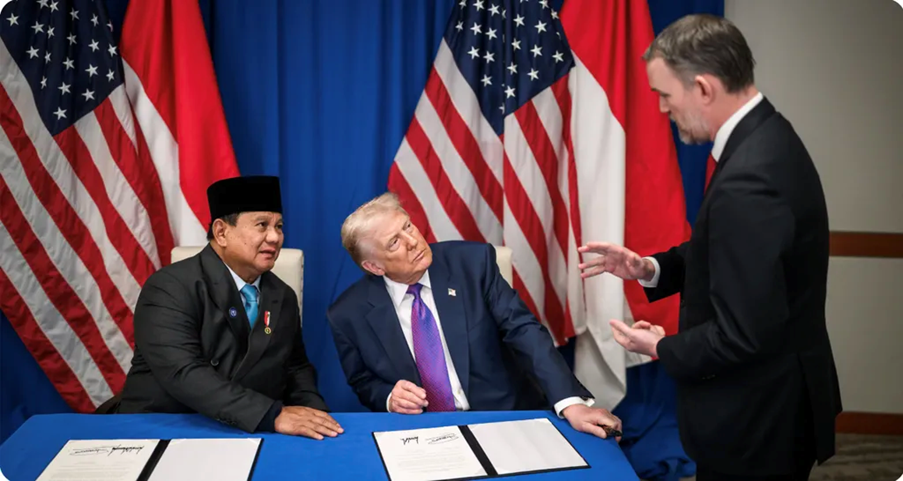
Presidents Prabowo Subianto and Donald Trump at the signing of the Agreement on Reciprocal Trade (ART). Credit: The White House
Feature Report: Is Prabowo Pivoting from Bebas Aktif to the US Economic Orbit?
May 22, 2026 / 9 minutes of reading
Watershed Moment
Signed on 19 February 2026, the US-Indonesia Agreement on Reciprocal Trade (ART) was touted by President Prabowo Subianto as a watershed moment in the Washington-Jakarta economic ties.
Going into effect on 20 May, the ART is important because – for the first time in decades – an Indonesian administration has signalled willingness to align its economic trajectory with that of the United States’, fully cooperating in supply-chain integration, export regimes and mutual investment.
Far from being a free trade agreement, it is in essence a targeted system of mutual access to each other’s lucrative industries and markets.
As the name suggests, the chief factor in the ART is quid-pro-quo reciprocity, a preferential system both countries allow for one another on a set of preconditions.
The new agreement also heralded a turning point in Prabowo’s interpretation of Indonesia’s foreign policy precept of bebas aktif (free and active). A marked departure from his predecessor’s inclination for closer economic ties with China, the current administration has been courting the United States and other powers with equal zeal while growing lukewarm on China.
How viable, however, is Prabowo’s latest gambit in aligning himself with the United States, entrusting the latter with the economic future of Indonesia’s 280 million people?
A New US Client State?
Under Article 5.1 on Complementary Actions, if the United States “imposes a customs duty, quota, prohibition, fee, charge, or other import restriction on a good or service of a third country”, Indonesia “shall adopt or maintain a measure with equivalent restrictive effect”.
This may sound like sensible alignment. However, the one-sided nature of the initiating process – highly in favour of the United States – makes the ART, as many Indonesians see it, an “unequal treaty”.
Under the Complementary Actions section, Indonesia is also prevented from entering into a new free trade agreement with another country “that jeopardizes essential US interests”, at the pain of the ART’s unilateral termination by the United States.
Still under the same section, it also requires Indonesia to enact domestic laws “to regulate the trade in national security-sensitive technologies and goods through relevant existing multilateral export control regimes”.
Moreover, under the Digital Trade section, Indonesia will be compelled to “communicate with the United States before entering into a new digital trade agreement with another country that jeopardizes essential US interests”.
The ART will also enable US entities to “to explore, mine, extract, refine, process, transport, distribute, and export critical minerals” within Indonesia “on terms no less favorable than it accords to its own investors in like circumstances”.
These clauses have put the United States in a position to weaponise the agreement for strategic gains against American rivals, notably China, whose economic presence in Indonesia has over the years outmatched that of the United States.
Data on 2025 foreign investment puts China, already Indonesia’s foremost trading partner, as Indonesia’s third biggest investor at US$7.5b, after Singapore and Hong Kong. However, in a 2019 speech, Luhut Pandjaitan – then coordinating minister for Maritime Affairs and Investment – claimed that Chinese investors are known to have used back channels in those two countries to access the Indonesian market.
A 2025 survey across Indonesia found that the percentage for China’s economic influence in all of Indonesia’s 38 provinces averaged at 41.2, down from 47.4 in 2024. In the first semester of the same year, the United States ranked the 6th largest foreign investor.
If fully implemented by Indonesia, the ART has the potential to curb China’s economic dominance in the country. It is also likely to boost American investment and business operation by dint of levelling the playing field vis-à-vis Chinese counterpart.
It may achieve this through the structural “reforms” to be undertaken by the Indonesian side as spelled out under the agreement.
Indonesia’s Domestic Reform Concessions
American investors and businesses operating in Indonesia have long had beef with several issues, typically as outlined in a 2025 report by the American Chamber of Commerce in Indonesia. These include uncertainty, transparency, and complexity related to the bureaucracy, market conditions and the tax system.
Under the new agreement, Indonesia will waive its Local Content Requirement for US products and open up the previously highly regulated agricultural import sector to American exports. American investors will also be exempt from the transfer of technology when setting up shop in Indonesia, which is a requirement under the Indonesian law.
Another sizeable concession on Indonesia’s part is how it will treat its state-owned enterprises (SOEs), known for their reliance on government subsidies and favour in order to dominate the market, in relation to US products and services.
The ART stipulates that Indonesia “shall ensure a level playing field for U.S. companies in Indonesia’s market with regard to SOEs”.
Indonesia has also agreed to carry out a series of administrative reforms in taxes, customs procedures and even halal certification in order to comply with US standards and enable US companies to do business with greater ease than before.
Indonesia’s commitment to furthering labour rights (e.g. the gradual phasing out of outsourcing) and environmental protection (e.g. such as adhering to mining quotas and upholding strong environmental governance structures) is also enshrined within the ART.
Indonesia has also agreed not to “not impose customs duties on electronic transmissions, including content transmitted electronically”. By virtue of this clause, neither the Indonesian government nor Indonesian entities will be able to tax or charge American tech giants like Apple, Meta and Google for running Indonesia-generated copyrighted content.
What Indonesia Stands to Gain
Under the agreement, Indonesian products still pay the hefty 19% tariff, at least initially. A day after the ART was signed, the US Supreme Court struck down President Donald Trump’s tariff regime under the International Emergency Economic Powers Act (IEEPA) provision, effectively making the 19% slapped on it redundant.
Later, Indonesia claimed that, following the ruling of the Supreme Court, its tariff was now 15%.
However, the ART grants Indonesia zero-tariff status for 1,819 products, including key export commodities such as palm oil, cocoa and coffee. The list also represents 24% of Indonesia’s traditional exports to the United States. Indonesia’s exports to the United States in 2025 stood at a surplus of roughly US$18b.
The United States will also allow certain Indonesian textile and apparel products to receive zero or reduced tariffs on the condition that the said products are made from American cotton or other man-made fibres.
This, in time, may reinvigorate Indonesia’s recently beleaguered textile industry, notably by the closure of one of the country’s flagship textile giants, PT Sritex, due to insolvency.
Conversely, the ART compels Indonesia to import US$33b worth of products and services from the United States, made up of three main sectors: energy, aviation, and agriculture.
While Indonesia’s export prospects from its key commodities will undoubtedly receive an advantage from the tariff exemption, it hardly compares to the guaranteed sum of 33 billion the United States stands to gain from the agreement.
The asymmetry is jarring, to say the least.
Domestic Rumbling
In the aftermath of its inauguration, the impression that the ART is fundamentally skewed in favour of the United States, while making Indonesia look servile, was swiftly established with the Indonesian public.
Characterised as impinging on Indonesia’s sovereignty by the local media, it is now notoriously known for having 214 “Indonesia shall” sentences as opposed to only seven “The U.S. shall”.
Moreover, Indonesians baulk at the waiver for the Local Content Requirement, designed to protect local small-to-medium-sized enterprises (SMEs). The provision of halal certification, to be carried out on the American end without Indonesia’s oversight, is also troubling for many Indonesians, the world’s largest Muslim-majority country.
While the Indonesian government tried to remain optimistic about the merits of the agreement, the opposition to the ART has been growing.
The outbreak of the war on Iran has complicated matters, too. Skyrocketing global crude oil prices have also put fiscal strain on Indonesia as government fuel subsidies – some Rp25b in 2024 – balloon.
Trust towards the current US administration may also be wearing thin in Indonesia.
To its dismay, Indonesia learned that the Trump administration on 11 March launched an unfair trade practices probe against 16 countries, including Indonesia, under Section 301 of the Trade Act of 1974 so that it can restore the 19% tariff benchmark.
Despite Indonesia’s accommodation of US interests in the ART, the Trump administration did not seem to hesitate in sacrificing Jakarta to achieve its objectives. Any remaining illusion that the post-ART Indonesia was now somehow a valued US ally had been shattered.
This explains Prabowo’s sudden pivot as he paid President Vladimir Putin a visit in Moscow on the 13 April, where the two were engrossed in a five-hour talk. The focus of the meeting was reportedly cooperation in the energy sector, including possible Indonesia’s oil purchase from Russia.
Court Bombshell
The most recent challenge to the ART has presented itself as a lawsuit at Indonesia’s State Administrative Court (PTUN), filed in Jakarta by four plaintiffs, namely the Center of Economic and Law Studies (CELIOS), the Alliance of Independent Journalists (AJI), Indonesia for Global Justice (IGJ), and Perserikatan Solidaritas Perempuan (Women’s Solidarity).
They argued that the ART constituted an “unlawful act” by Prabowo, as the clauses are deemed detrimental to Indonesia’s interests.
However, lawsuits at the PTUN have never had a history of success, especially when filed against government officials. A recent civil society lawsuit against Minister of Culture Fadli Zon was rejected by the court.
It is doubtful the PTUN is able to adjudicate presidential policy, given that its purview is administrative. Therefore, the four civil society groups’ lawsuit against the ART may not represent a serious enough challenge to derail it.
Nevertheless, a judicial review by Indonesia’s Constitutional Court (MK) would be a different matter entirely since its ruling can overturn any legislation or treaty with a foreign power, in the same way the US Supreme Court dismissed Trump’s tariff regime.
In 2018, the MK ruled – in the face of a judicial review of a 2000 law – that a trade or investment treaty with another country must be ratified by the House of Representatives (DPR), precluding the executive’s sole prerogative.
The ART was essentially an initiative by the executive, signed without parliamentary consent, making it vulnerable to judicial review. Its clauses could be interpreted as having violated Indonesia’s constitution, which stresses the paramount principle of sovereignty in dealing with foreign powers and maximum benefit to the populace.
Conclusion
While Indonesia can potentially gain considerably in the long term from the agreement, it is difficult to dismiss the accusations that the ART gives the United States the upper hand, leaving Indonesia with reduced bargaining power.
The main problem with the new agreement remains that the projected benefits may not outweigh the concessions made to secure it in the first place.
It also overlooks how deeply interconnected China and Indonesia are in trade and investment, with Chinese products dominating Indonesia’s imports. China has also helped spearhead emerging industries in Indonesia, such as electric vehicles (EVs) and digital technology.
While diversifying Indonesia’s economic ties – with the object of avoiding overdependence on China – is a worthy goal, it should be done with sustainability in mind, especially as Indonesia prepares to move from low-tech to advanced industrial capability.
It is, for instance, unimaginable that – without the promise of technology transfer – US companies may be able to compete with their Chinese counterparts with regards to long-term benefits for Indonesia.
Given it has also had an acerbic public reception in Indonesia, Prabowo should consider renegotiating the terms with the United States after inviting DPR and public stakeholders to deliberate further on the ART.
On the other hand, the United States should also bear in mind how the ART will affect its already deteriorating soft power with Indonesians. Regardless of the congenial terms offered to US companies by the agreement, a positive image of the United States will go a long way in enticing Indonesians to buy American products.
The views expressed are those of the authors and do not necessarily reflect those of STRAT.O.SPHERE CONSULTING PTE LTD.
This article is published under a Creative Commons Licence. Republications minimally require 1) credit authors and their institutions, and 2) credit to STRAT.O.SPHERE CONSULTING PTE LTD and include a link back to either our home page or the article URL.