search


Can a video game stop a terrorist recruit? Credit: Unsplash/Oberon Copeland
Roblox 2026: The Wall Against Radicalisation
May 8, 2026 / 6 minutes of reading
Introduction
Based on data from Badan Nasional Penanggulangan Terorisme (Indonesian National Counterterrorism Agency – BNPT) in 2025, approximately 112 children had been radicalised through social media and video games such as Roblox. The children, aged 10 to 17, were exposed to Daesh recruiters on these platforms and later pledged to the terrorist organisation.
As a platform, Roblox is more popular among Gen Z and Gen Alpha, averaging more than 80 million daily players (40% of them under the age of 13 in 2024). With such a size, it is a mature platform that must implement a necessary security measure to counter extremist activities in its domain.
The company did just that; on 7 January 2026, a security update was rolled out to uphold the gold standard for communication safety. It manifested in the global ban of chat features for those who fail to complete an age authentication check, which in turn requires a face verification process.
With the rising concern of adult players targeting and manipulating young users, this security update is expected to become the antidote to “unacceptable risks” that the children were being exposed to.
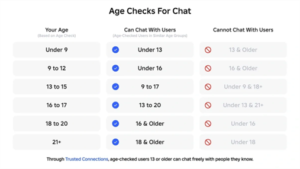
Detailed age classification to access chat. Source: Roblox
However, this has invited criticism from the community, who cited user friction and privacy concerns. To understand why the security update was necessary, despite detractors calling it excessive, we need to consider how recruitment takes place in Roblox.
Pattern of Recruitment
The pattern follows the convention (as has been observed in the cases in Indonesia and Singapore), although it manifests with some uniqueness specific to Roblox’s features.
For instance, recruiters use Roblox’s chat function to disseminate radical narratives or invite targets to join conflict zone-themed servers, such as Syria or Marawi, where they play simulations of gunfights with others. Often, targets are encouraged to play the role of “mujahideen” in their confrontation with others.
Once such engagement is established, recruiters would attempt to deepen the relationship with targets through a grooming process, further indoctrinating targets by sharing pro-Daesh messages after their conversations are shifted to Telegram or WhatsApp. It is through these platforms that children are taught about concepts like taghut (tyrannical), justification for terrorist attacks or even how to create explosive devices.
With all the pieces in place, recruiters would then mobilise targets or encourage them to conduct attacks, but only after the targets have pledged allegiance to Daesh.
Why is Roblox a Hotbed?
But if they are children who typically log on Roblox for recreational purposes, how did they end up getting pulled into extremism? Four factors must be considered when examining why youth on Roblox could fall victim to online recruiters.
First, each child’s background matters. Roblox is designed for younger users, many of whom are still developing cognitively and emotionally, thus becoming prime targets for extremist recruiters and their narratives. Unfortunately, youths with certain grievances, such as broken family or socially marginalised life, are more susceptible owing to their longing for belongingness and social worth, which the recruiters can provide.
Second, youth are impressionable beings, and they could develop a strong sense of solidarity towards marginalised groups, especially if they share similar backgrounds. Third, youth aspire to contribute to a perceived greater cause, which could manifest in religious terms or a willingness to fight and sacrifice for oppressed individuals. Extremist narratives could easily offer a resolution to these two needs, however twisted they are.
Fourth, and this is unique to Roblox, recruiters are able to blend a mix of humour, entertainment and extremist ideology to normalise extremist narratives in chat boxes to the point that recipients consider them standard Roblox culture. This way, the online interaction through chat boxes gives ideology an emotional texture that feels like a part of the game, even if the discourse in that interaction is harmful or toxic.
The Benefit of Roblox’s Chat Ban
Against this backdrop, could Roblox’s new security measure address the growing problem?
First of all, there is a need to acknowledge that this measure is necessary, despite some criticism that it is excessive. Considering many parents might not accompany their children when the latter access Roblox, compounded with the concern that parents themselves might not be equipped to address this problem, an increased security measure on Roblox’s part is imperative.
Given that young users are susceptible to radicals’ influence, there is a need to limit the method with which recruiters – who are mostly 21 years of age and above – could engage children (i.e. the chat box). The new security update does not allow users who are not in the same age classification to communicate with each other. If they insist to do so, their messages are replaced with undefined characters (i.e. “***”). This update would also help parents who do not have the time to monitor their children’s activities on Roblox.
This is not a silver bullet, however. Roblox continues to lack moderation in its user-generated content, allowing users to simulate the aforementioned conflict zone-themed servers and inviting children to participate in online gunfights. This has emerged as Roblox’s enduring problem of normalising violence on its platform.
Way Forward
In an effort to make Roblox a safer community for users, particularly the youth, several recommendations need to be considered.
First, there needs to be increased moderation for user-generated content, both for servers (maps) and for items available on the Roblox marketplace. Numerous pre-verified accounts are still listed in the marketplace, giving recruiters a potential loophole to engage young users.
Second, Roblox’s AI in chat and voice chat features must be further improved, especially in monitoring the use of words that could be associated with extremist messages. These include “k@fir” (infidel), “th0ghut” (tyrannical) and “d4wl4h 1sl4m1y4h” (Daesh), among others. Obfuscated or parody usernames, such as “J1had”, “Atolf Zitler”, “1s15” and others, should be acted upon immediately upon their first report.
Third, Roblox should address the use of chat bypass, as it remains accessible to exploiters who can type or speak prohibited or flagged words without detection. This issue should be addressed by either removing certain languages from the Roblox settings or increasing moderation for those languages.
Fourth, Roblox needs to improve its monitoring system in detecting chat box conversations that aim to shift the engagement to other applications such as Telegram or WhatsApp. Any private chat within Roblox between two users must be terminated immediately if the conversation heads this way.
Fifth, pre-verified accounts listed in the marketplace must be moderated, and accounts sold on the marketplace must be immediately reviewed upon several reports and must be required to re-verify their account or else be terminated.
Finally, parents should be more attentive and must apply parental controls on their children’s Roblox accounts. To support this solution, Roblox can engage in awareness campaign about potential risks as well as ways to mitigate them, such as instructional videos for parents to handle difficult situations.
Conclusion
Roblox’s recent security update, which led to limitations of the chat feature, is necessary, particularly in the context of countering violent extremism. A consistent application of security measures would neutralise Roblox’s image of being a Trojan Horse for radical groups. However, some challenges remain, particularly with regards to moderating user-generated content, removing monikers or parody names and detecting attempts at bypassing the new security update.
Indeed, this entire conundrum rests upon the debate of privacy vs security, and Roblox is just the latest battlefield where the dialectic is taking place.
This article is published under a Creative Commons Licence. Republications minimally require 1) credit authors and their institutions, and 2) credit to STRAT.O.SPHERE CONSULTING PTE LTD and include a link back to either our home page or the article URL.