
 search

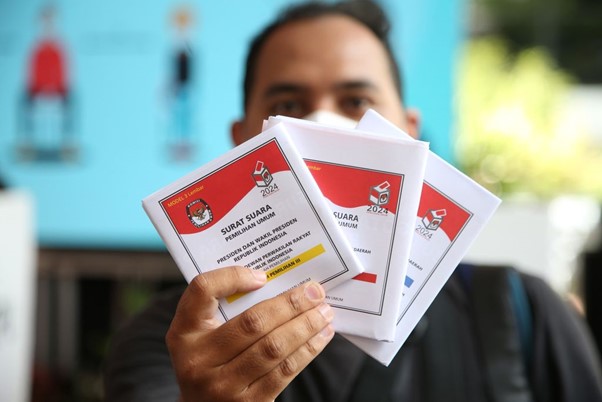
Samples of the voting ballot for the upcoming 2024 general elections in Indonesia. Credit: Kompas/Hendra A Setyawan
Dunning-Kruger Effect, Partisanship and Political Education in Indonesia
August 13, 2023 / 8 minutes of reading
Introduction
With Indonesia’s political year (2024) being less than six months away, the atmosphere in the society has taken on a political tinge as political parties declared support to their respective presidential candidates. The public’s response to this development is worth our further observation and analysis.
Though we hope for a peaceful democratic process until the election concludes next year, we cannot deny that the potential for intergroup conflict will continue to hang over us. This is sadly a curse from our past history as a democratic nation.
It is still fresh in everyone’s mind how the 2019 political contestation instigated a public spat between supporters of both presidential candidates, giving birth to derogatory terms cebong (tadpoles) and kampret (small bats) as each camp tried to denigrate the other. The digital trail of both camps is well documented online for everyone to observe and it is very clear how firm each was in defending their argument and support to their candidate.
To me, this is a political behaviour that warrants further discussion, which we may begin by asking: how could it happen in the first place?
In the United States, the public’s political attitude can be observed through their professed ideology, such as liberal, conservative, left or right wings, among others. Their political behaviour also transcends directly to their respective political ideologies, such as their voting behaviour and loyalty to a political party.
In contrast, Indonesia lacks that element of ideology which can distinguish supporter of one political party from another, making the task of mapping political behaviour more challenging.
However, if we consider the polarization during the 2019 election, we could see how a candidate’s charisma factored more significantly than the parties that support him. This phenomenon – whereby the public was more enthralled by a candidate’s leadership and individual style rather than his policies or party ideology – is an instance of political partisan in the world’s third largest democracy.
Basically, partisanship can be interpreted as a tendency of an individual or a group to side with a certain political party or figure. Simply siding or supporting is not enough – the key ingredient is strong conviction in one’s perception or opinion and firm rejection of any alternative viewpoints.
In the Indonesian context, political ideology usually has a minimum impact in shaping one’s political behaviour while partisanship tends to be temporary, but its effects continue to have a great influence in shaping the public’s political attitude.
Implication
Partisanship paves the way for a sharp political polarization within a society. On individual level partisanship becomes the political capital for parties or candidates to gain votes or support. Undeniably, partisanship could be a thorny presence that erodes the social cohesion in our society.
It could lead towards the creation of a social identity which heavily influences the way one processes information and take action. This could also affect one’s reasoning process that drive them to develop excessive loyalty or support towards a certain figure or party. This attitude then encourages a person to value their position excessively, but treats alternative viewpoints unfairly.
We need to be aware of the negative implication that partisan behaviour breeds, such as the proliferation of disinformation and misinformation as well as the tendency of the people to develop selective perception (a tendency to dismiss information that contradicts one’s own). It influences the way people consume political information daily, leading people to access only information that conforms to their belief system.
The Dunning-Kruger effect reinforces this tendency by making a partisan person to be convinced that they have all the information needed to form their worldviews, even if their knowledge on the matter is incomplete or biased. Trust in information will always be tied to one’s position on a certain context (such as politics), which could lead towards intolerance against an out-group. This would disable the formulation of a constructive political dialogue and stimulate tension between political parties and candidates.
This is not to mention social media disputes that often bleed into the real world. Many conflicts that occurred during the 2019 elections involved supporters of different political camps. To prevent this condition from happening again, measures must be taken to address it.
We could start by introducing more political education to the people, enabling them to have a more holistic understanding of various political issues as well as developing their critical thinking in approaching political figures or parties. Additionally, constructive dialogues must be fostered among different political perspectives. This last measure could also improve tolerance among opposing groups by letting them listen to each other’s viewpoints and understand different perspectives.
Apart from that, the media has a responsibility in shaping fair political opinion and perception among the people while presenting a balanced news which focus on facts, not speculations that can exacerbate intergroup divisions. These steps do not guarantee that the problem will be ameliorated, but they can be the first steps towards meaningful change.
Failure to take the steps will be worse, inflicting significant impacts in various sectors.
In the social sector, the Dunning-Kruger effect and partisanship could incite further social division and increase intergroup tensions. The lack of understanding of other groups’ perspectives and needs could further erode social cohesion.
In the security sector, the implications could disintegrate intergroup tolerance which breeds an atmosphere of fear and insecurity. We hope that Indonesia’s internal situation would not devolve into such a state. It is imperative that Indonesians develop a more analytical approach to complex issues such as politics, instead of relying on our emotions and prejudices in developing our political attitude. Otherwise, shall we continue to be trapped in the endless loop of the Dunning-Kruger effect?

Latest Articles
-

Scholars: Sacred Politics and Religious Narratives in International Relations
· September 12, 2026
-

PeaceTech AI Lab: Initiative for AI and Peacebuilding
· September 12, 2026
-

Costing, Continuity and Outcomes: Malaysia’s New Youth Policy
· September 04, 2026
-
Hard Questions for Indonesia’s Development
· September 04, 2026