
Introduction
Indonesia has consistently supported the One China policy, which views the Republic of China (Taiwan) as an inseparable part of the People’s Republic of China (China).
Recently, however, several countries have questioned the essence of the One China policy and challenged the United Nations Resolution 2758, which views the latter as “the only legitimate representative of China to the United Nations.” This Resolution, which was passed in 1971, consequently removed Taiwan’s seat.
These countries maintain that the Resolution does not restrict Taiwan’s participation at the United Nations and objects to the notion that China could assert authority over Taiwan, although rising geopolitical tension might have encouraged such a position.
The Netherlands and the European Parliament are of the position that the Resolution does not entail Taiwan’s exc
Although these are the stances of certain European countries, their arguments are nonetheless valid and need to be taken into consideration.
Since the adoption of the Resolution, China has been actively promoting the “One China, Two Systems” principle, despite differing interpretations by both nations. Even in Taiwan, the two largest political parties – the Kuomintang (KMT) and the Democratic Progressive Party (DPP) – have distinct China engagement policies.
DPP, for instance, is pro-independence from China. Its victories in the 2016 and 2024 elections incited concerns on the mainland’s part, which has pursued the agenda of reunification. In response, DPP has consistently sought international support to enhance legitimacy and reduce its dependence on China, including in the economic sphere.
In 2016, for example, then president Tsai Ing-wen introduced the New Southbound Policy (NSP) to diversify Taiwan’s economic partners. More recently, Vice President Hsiao Bi-Khim made a rare speech in Brussels, echoing Taiwan’s values of democracy and pleading for international support.
Instances such as this have worsened relations between the two. In response, Beijing has undertaken multiple steps to lessen Taiwan’s legitimacy, such as influencing Taiwan’s allies to cut off diplomatic relations. In 2019, the Solomon Islands announced it recognises only China, prompting Tsai to state that China used dollar diplomacy to shake Solomon’s decision. Similarly, in 2024, Nauru cut off diplomatic ties with Taiwan in favour of China.
Between China and Taiwan
With mounting pressure to reinterpret the Resolution, Indonesia would be inadvertently pressured to revisit the matter as well.
Indonesia has diplomatic relations with China but also acknowledges Taiwan as a nation. Indonesia’s relationship with China has varied in history, marked by strong political ties during the Soekarno years that were suspended following China’s alleged involvement in the 1965 tragedy. Ties were restored in 1990 and have seen an upward trend since. On the other hand, Indonesia and Taiwan agreed to establish the Taipei Economic and Trade Office (TETO) in Jakarta, though this does not function as a normal embassy.
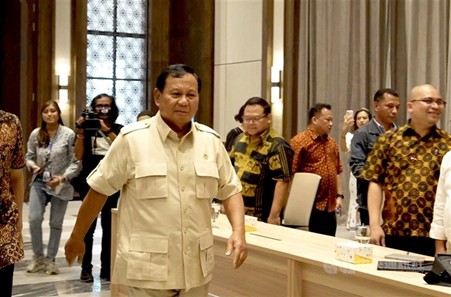
In his first overseas visit, President Prabowo Subianto reaffirmed Indonesia’s relationship with China, rehashing Indonesia’s stance with regard to Resolution 2758 and supporting China’s efforts to achieve a peaceful reunification with Taiwan. These are consistent with his predecessor’s policy, which also subscribed tosupported the One China policy.
Indonesia and China have extensive economic relations. In 2024, Indonesia received the highest amou
At the same time, Indonesia seeks to m
Trade volume between Indonesia and Taiwan in 2024 was US$10.8 billion, far below that with China. Meanwhile, Taiwan’s investment in Indonesia, by 2024, reachedamounted to US$184 million, primarily in the tech sector.
At the same time, people-to-people relations have also improved; Taiwan hosts students who attend many top-ranked Taiwanese universities that charge lower tuition costs than European and American universities do. Taiwan is also home to Indonesian migrant workers. In 2025, the number of Indonesian migrant workers reached 313,000, up from 2024, making it one of the top sending countries for three years in a row.
Indonesia’s Stance
With the ongoing push to reinterpret the Resolution, Indonesia may soon find its position precarious, albeit marginally, especially if the geopolitical tension involving China worsens.
It would be challenging to expect countries with strong political, economic and sociocultural links to China to revise their position. They might, nonetheless, face a dilemma in which they are forced to choose between China and those seeking to reinterpret the Resolution.
The difficult position does not emanate from diplomatic or non-diplomatic relations but from pragmatic considerations.
Since Prabowo took office, his foreign policy has demonstrated Indonesia’s intent to get closer to China. In January 2025, Indonesia officially joined BRICS, despite the previous administration’s intent to join the Organisation for Economic Co-operation and Development (OECD) instead for its economic benefit.
By aligning closer with the Global South, especially Russia and China, Prabowo might have intensified the previous administration’s inclination to grow closer to these countries. A case in point: despite violent riots spreading across Indonesian cities in late August, Prabowo still made an effort to attend the 2025 China Victory Parade a few days later.
Furthermore, a leaked conversation between Prabowo and Minister of Defence Sjafrie Sjamsoeddin pointed towards the former’s commitment to mainta
Conclusion
These signs suggest that, under Prabowo’s leadership, Indonesia aims to consistently adhere to the One China policy, despite Taiwan’s efforts to rally international support. This seems to be motivated more by pragmatic considerations than a strict observation of an international norm.
Indeed, Indonesia’s position is intertwined with China’s that it is almost impossible to imagine a scenario whereby Indonesian policymakers would seek to revise this. However, this does not mean that the country cannot extend its diplomatic hands and support to Taiwan, albeit with certain constraints. Despite the awkwardness that the One China policy creates, Indonesia would always welcome cooperation with Taiwan, such as through the NSP umbrella. Finally, amid growing tensions between Japan and China over Taiwan, Prabowo will likely be pragmatic and avoid meddling in China’s internal affairs. Although the call to revisit Resolution 2758 might come in the future, Indonesia will certainly approach the subject wit
