Introduction
The 17th Sabah state election was held on 29 November 2025. A total of 596 candidates from 23 political parties and 74 independent candidates were vying for 73 seats.
The fiercely contested election concluded with the Gabungan Rakyat Sabah (GRS) coalition emerging with the largest number of seats (29 seats), allowing its chairman, Hajiji Noor, to be sworn in as chief minister for a second term. GRS formed the state administration with its coalition partners, the United Progressive Kinabalu Organisation (UPKO), Pakatan Harapan (PH) and several independent assemblymen.
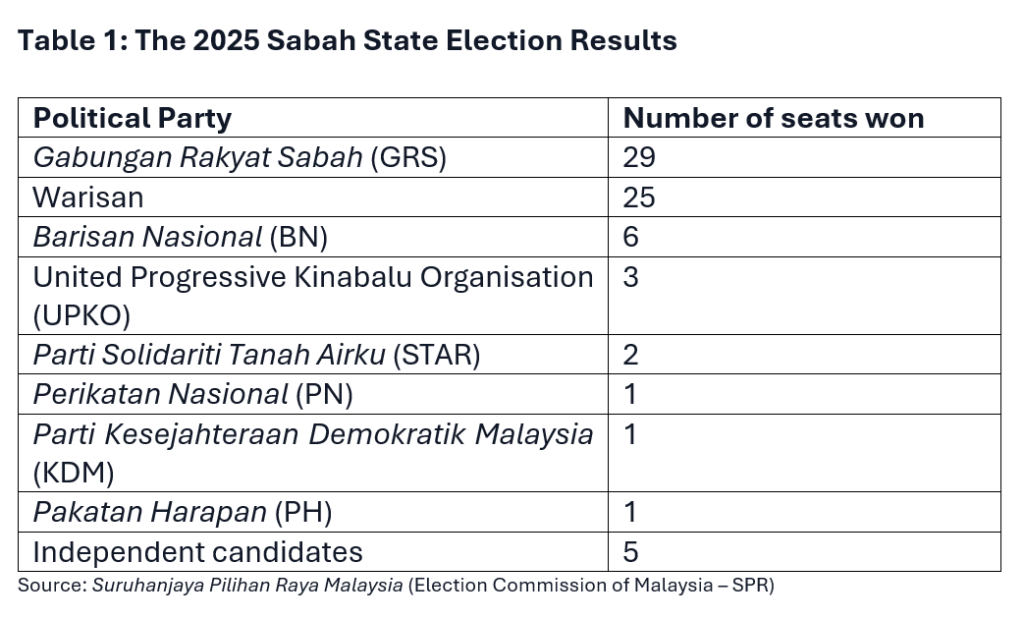
The most unexpected election result is the Democratic Action Party’s (DAP) crushing defeat, which was totally wiped out in all eight seats it contested, including the Chinese majority seats.
The Chinese votes were always regarded as the “fixed deposit” for DAP, which was contesting under its PH coalition, the political vehicle of Prime Minister Anwar Ibrahim.
This article will explain and analyse why the Sabah Chinese decided to switch allegiance and voted for Warisan instead.
Pre-Election Drama
The state election was due by November 2025, and the state assembly was only dissolved towards the end of its term. This delay was largely shaped by an alleged mining corruption case, the recurring flood and the social injustice controversy involving the death of a secondary school student, all of which threatened to disrupt the chief minister’s position. These constraints left him with only a narrow window to call an election that would be to his advantage.
Meanwhile, the collaborative arrangement between GRS-PH and PH-BN created its own complications, particularly over seat allocations, which remained a major headache for Hajiji as chief minister and GRS chairman. Ultimately, the Sabah State Legislative Assembly was dissolved on 6 October 2025.
Results in the Chinese Majority Seats
Out of the 73 seats contested, there are five Chinese majority seats, namely Luyang (65%), Likas (65.9%), Api-Api (45%), Elopura (41.3%) and Sri Tanjung (55.8%). All these seats were won by Warisan candidates in the 2025 state election, which were previously won by DAP and PKR in the 2020 polls.
This marks the first time since 2004 that DAP has had no representation in the Sabah State Legislative Assembly.
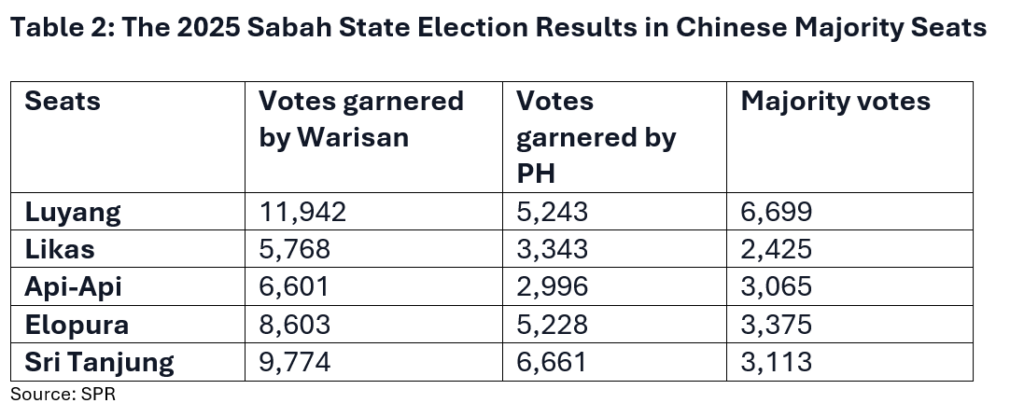

Figure 1 demonstrates clearly that there has been a sharp decline of support in all seats contested by DAP and PKR candidates (under the PH umbrella) in Chinese majority areas.
Factors Affecting the Chinese Voters
There are five main factors affecting the Chinese voters’ inclination in this election.
First, the rise of state nationalism. The strong “Sabah for Sabahans” sentiment has made many urban Chinese far more critical of candidates’ accessibility, responsiveness and perceived commitment to local issues. In reality, this has been expressed as a preference for local parties and leaders as well as a growing wariness towards what is seen as “anti-Peninsular Malaysia political party sentiment” and ability.
Against this backdrop, the campaign style of federal DAP leaders in Sabah appears to have backfired. When the Minister of Housing and Local Government, Nga Kor Ming, indicated his intention to “adopt” Tawau, it was widely read as patronising. His remark reinforced the perception that Peninsular-based parties regard themselves as more “superior” or authoritative over Sabah’s local leadership, fuelling resentment among Sabahans, including those of ethnic Chinese.
Second, the Malaysian Agreement 1963 (MA63) issue. Sabah’s 40% entitlement to federal revenue has become a key grievance among the locals. However, DAP remained silent on the subject and even appeared to support an appeal against the court decision, which further agitated many local voters.
Sabahans have long sought the restoration of this entitlement under the constitution and increasingly believe that only local parties can be trusted to defend and fight for these rights. For many, the 40% entitlement is not an abstract legal entitlement but a concrete foundation to strengthen state finances and accelerate long-overdue improvements to the state’s infrastructure.
Third, the overall disappointing performance of DAP. As part of the PH-led federal government, DAP had previously campaigned strongly on issues such as recognition of the United Examination Certificate (UEC) and anti-corruption reforms. However, it is now widely perceived as a “silent party” that no longer champions the Chinese community’s concerns as it once did.
Instead, many Chinese voters feel that DAP has compromised on major issues that it previously stood for, sparking a sense of disillusionment and weakening its credibility among its traditional supporters.
Fourth, internal conflicts within DAP. Factionalism within the party contributed to the erosion of support. DAP’s decision to drop an incumbent state assemblyman and a former organising secretary from the candidate line-up led these two and other followers to leave the party and join the opposition, inevitably splitting the DAP vote.
At the same time, DAP’s organisational structure in Sabah appeared weak. DAP Sabah state chairman, who was the incumbent assemblyman for Luyang, shifted to contest in Likas in an attempt to “save” the seat, while his own protégé was parachuted into Luyang. This strategy backfired, leading to the loss of both seats to Warisan.
These developments reflected PH and DAP’s misreading of the political temperature in Sabah, as they assumed that Chinese voters would continue to support DAP regardless of the candidate
Fifth, governance and corruption concerns. Allegations and conspiracies surrounding the Sabah mining bribery case – a scandal linked to Anwar’s senior political secretary and former aide that broke in the final week of the campaign – only reinforced negative perceptions of the PH coalition overall. This deepened voters’ mistrust and strengthened the determination of some Chinese to vote against the coalition.
Last but not least, the presence of an alternative political party. Warisan’s performance indicated that Chinese voters were no longer confined to choosing between PH, BN or GRS.
Warisan is increasingly regarded as a more credible and effective advocate for Sabah’s autonomy and rights, as well as for issues like anti-corruption, the 40% federal revenue entitlement and the full implementation of MA63. This has given Chinese voters a local option to vote for, one that is aligned more closely with their preferences.
Conclusion
While the Sabah state election might not directly determine the outcome of Malaysia’s upcoming general election, which must be held by February 2028, it serves as an early referendum on Anwar’s leadership and the performance of the unity government.
What is particularly striking is the shift among Chinese voters, long regarded as the backbone of DAP and PH. The results signal that the Chinese electorate can no longer be treated as a “fixed deposit”. If these warning signs are ignored, PH and DAP may face serious headwinds in the upcoming state elections in Sarawak and Johor. The outcome in Sabah also presents a stress test for the stability of the federal unity government and raises the question of whether its current model will remai