
Prelude
In a 2014 interview with The Malaysian Insider, cultural activist Eddin Khoo of PUSAKA said that the Malays would go mad without their culture.
“Culture and sanity go together; any society that has no culture has no sense of self, and any society that has no sense of self has no soul and hence i
Sometime in late August this year, a video of a Kuda Kepang performance went viral on social media and instant messaging apps such as WhatsApp. The reactions were swift and intense.
For some God-fearing Malays, the performance confirmed long-standing views that many traditional Malay arts are heretical, base or remnants of an uneducated working-class culture.
There were also Malays who kept silent, feeling that the practice was neither right nor wrong, but they may be lacking the knowledge and language of culture and religion.
Then there were other Malays, including cultural enthusiasts like me, who viewed the episode with bemusement—aware that dismantling a traditional healing practi
This essay is the writer’s thoughts on how the Kuda Kepang performance is not just about religious orthodoxy but also a people’s anxiety about urbanisation, economics and the erosion of the Malay identity.
Controversy, Yet Again
Immediately, the Johor Islamic Religious Department (JAINJ) and the police were instructed to probe and take action on the performance believed to contain non-Islamic practices in Parit Raja, Batu Pahat.
A few days later, JAINJ announced that they would draft guidelines that ensure no syncretic elements would be engendered in cultural performances, sports and Malay martial arts, or silat. Many Malays concurred with the authorities: the traditional art of Kuda Kepang should be abolished, as it involves a communion with the spirit world through trances.
In the last 20 years, there have been more calls by Muslim preachers and communities to monitor the “unIslamic” practices that Kuda Kepang seemingly embodies and practices.
This is not a new thing. Carol Laderman, Teren Sevea and KM Endicott have noted the increasing influence of Islam in rural Malay communities back in the early 20th century, where more and more bomoh (shamans), pawang (masters), and dukun (witch doctors) had to adjust their healing practices to something more palatable to the religious community. The alternative was to move away somewhere else. However, even with such an unsavoury prospect, the practice of Malay magic was still open. What was performed in Johor recently was not dissimilar to earlier practices of Malay magic. However, the backlash was more potent owing to its stark contras
Magical Performance
But what is a Kuda Kepang performance really about?
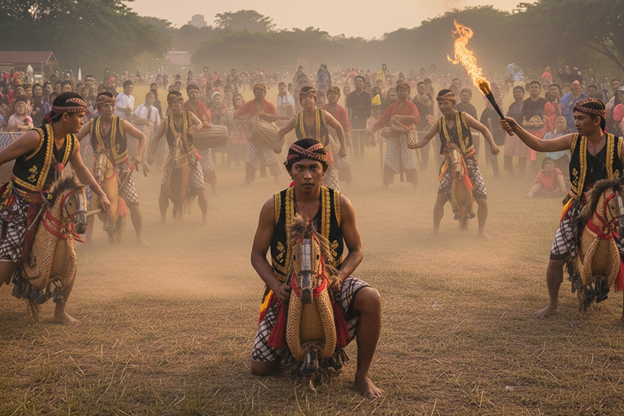
It is a hobbyhorse trance dance introduced by Javanese immigrants to Singapore (and Johor) that has been localised by local Malay practitioners and become a unique expression of the Malay identity.
Kuda Kepang, which has its roots in Java, Indonesia, is a colourful, sensual and fascinating performance to observe.
It is more than the popular folklore of seeing men eating glass and falling into trances; it is about a celebration of and an ode to the saints of Java – the Wali Songo – who came to spread Islam in the island’s interiors. The public gets to see the performances at weddings, special performances brought in by cultural groups such as Pusaka and when the community sees fit to hold them.
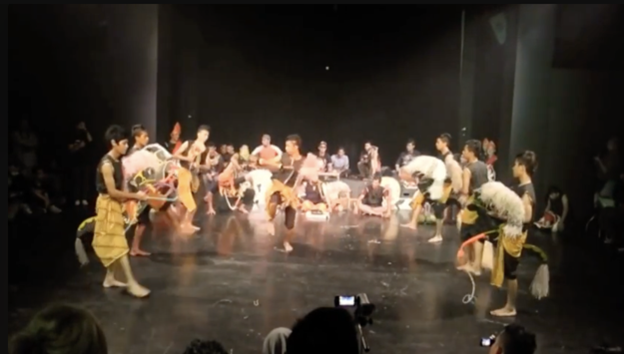
The performance incorporates trance in its performance. It serves many functions, such as entertainment, an expression of camaraderie as well as a cleansing ritual.
On the latter, indeed, Kuda Kepang “was performed to cleanse the village of evil spirits. It is an effort to engage the spirits, both malevolent and benevolent, to acknowledge their presence in an attempt to rationalize the interaction of the real and the nether existence. Also, it is to exhibit the prowess of the shaman to interact with a different level of mystical existence. When performing as a ritual for thanksgiving or to exorcise evil spirits or negative energy from the village, the dance involves the invocation of spirits from the nether world, thus focusing on its mystical and metaphysical aspects. As such, the trance aspect of the dance becomes the integral focal point and core element of the performance.”
The trance part of the performance agitates the public: does this not mean involving the spirits and allowing them to take possession of the body, which is all wrong in the name of Islam? That it has been said that performers ingest drugs and other substances to get into this state is another no-no.
My goal is not to expound on the rights and wrongs, or discuss Islamic jurisprudence (fiqh) as well as the policing of Kuda Kepang. I am more curious about how this will (and has) impact the Malays of this country.
The Urban Myth of Home
When IMAN Research started publishing its findings in the Malaysian media sometime around late 2023, many corporate-type Malays – and also Islamic-thinking Malays – asked why the Ordinary Malay turned to traditional performing arts and healing practices.
According to them, these practices were based on khurafat (superstitions), old-fashioned, unscientific and rather provincial. All these probably encouraged them to assume why the average Malay was poor and backwards.
In 2024, 79.2% of Malaysia’s total population lived in urban areas and cities. This figure is expected to increase, as people from rural areas migrate to urban areas due to employment opportunities and as the economy continues to shift from agriculture to industry and services.
The urbanisation rate in Malaysia had increased from 28.4% in 1970 to 75.1% in 2020, contributed by natural population, migration and demarcation.
Malays were also more likely to migrate to urban areas than Indians and Chinese. “Over the period of 1991 to 2020, the migration rate of Malay ethnic was the highest except in the early 1990’s [sic] and 2001. According to Peng (2012), large numbers of Malays moving to the more developed areas were due to the implementation of the New Economic Policy (NEP) which aimed at restructuring society to eliminate the identification of race with location and occupation, and the creation of a Bumiputera Commercial and Industrial Community.”
Many Malays came from somewhere, i.e. kampung (villages). For young professionals and working-class Malays, entering the concrete jungle that is Kuala Lumpur – where very few relatives and friends from their homes are – is a jarring experience.
Even if they had fantasised about moving to the city in pursuit of wealth and work, the Klang Valley is almost a different country. It heaves with people from all around the world – expatriates, refugees, migrant workers – and opportunities abound, but it is still very unsettling for the newborn urban settler.
So, what do they do? They turn to traditions they practised at home to find comfort and solace as they endeavour to belong in their new homes, which is not easy due to competition with migrant workers and those who come from other rural areas as well.
Vanishing Magic
The move
One example would be the angkat rumah (house lifting) tradition, where family members, friends and members of the village would literally carry the house to a new location. The reasons for doing so are many, but in most cases, it is a much-beloved home of a family who want the house they grew up in in the new area they reside in now.
Just like angkat rumah, Malay performing arts or healing traditions are a source of comfort as well, though whether the people believe the spell (jampi) works or not is another question altogether.
The more modern family, who is first-generation urban, look at former rituals as old fashioned, the more they link them to hardship and poverty; thus, their association with kampung. Meanwhile, the older generation living in rural areas bewail the loss of a heritage.
Let us not go far. In The Malay Settlement: A Vanishing World?, the authors remarked on how modernisation caused a loss of Malay carpentry skills in Malay settlements and that artisans would lose these skills in the local Malay community, which will result in the loss of their cultural identity.
“The concept of culture has shaped the Malays’ minds and souls, influenced by religious interests, culture, and traditions. According to Kling (2000), these factors have shaped the Malays’ character and identity. Urbanisation has destroyed the Malay community’s cultural wealth.”
Reflections
Is it bad? To believe and follow syncretic beliefs?
I personally find Malay magic (or, quite honestly, any variant of it, whether Thai, Indian, Chinese or others) to be colourful and fascinating. While as a Muslim I am to acquiesce to Muslim healing rituals, such orthodoxy is too minimalist of healing for me. No limes, no incens
These “tools” have roles to play in he
The Malay community is increasingly becoming more polarised: it is not just economics and class but also clashing religious ideologies—urbane Islam, Wahhabi vs Sufism etc., which could constitute another essay altogether.
If we go back to the topic above, the policing and “restructuring” of Kuda Kepang and other Malay performing arts – all done in order to incorporate Islamic practices and obliterate syncretic rituals – will be one of the channels that may just destroy the Malay identity.
After all, Kuda Kepang and its other siblings are about “communal psychic therapy rather than the healing of individual illness. This is the healing of the angin (vibes) rather than any physiological or psychosomatic illness.”
And it is also about a community, and village, be it in a rural or urban area. And yes, a country.
