
Latest Developments
On Monday evening, Iran launched an attack on the United States’ Al Udeid base in Qatar. This came after Iranian nuclear sites were hit by US missiles on the weekend.
In retaliation, Iran had three options: 1) attacking American assets in the region; 2) maintaining attacks on Israel and; 3) closing the Straits of Hormuz. All three options were not only considered but were also actioned, causing a day of panic and uncertainty.
In a dramatic turn of events, US President Donald Trump announced a few hours after Iran’s attack that a ceasefire was brokered and that Israel and Iran would cease its 12-day war. It is still unclear how, when and who mediated this and whether it will hold, seeing Israel’s own inability to maintain a ceasefire in Gaza and Lebanon.
Trump is driven by a disturbing wish to bring Iran into a wider war. He made US assets stationed in countries such as Iraq, Qatar, Oman and others targets for Iran.
Tehran made good on its promise to retaliate by attacking the US air base in Doha. But it appears to be an orchestrated move, with the Iranian government assuring Qatar that it was not against them. Iran had also warned both the American and Qatari governments well in advance of the attack.
Though symbolic, it was still risky, as it does put a strain on Iran’s ties with its most important ally in the region.
Qatar and Iran are close, united by a complex and difficult relationship with other Arab nations, particularly Saudi Arabia. Qatar has already responded to Iran’s attack by saying that it reserves the right to defend itself and is consulting with other members of the Gulf Cooperation Council (GCC).
This takes the conflict to a new phase and may result in increased tensions in the region. Trump has announced US military capabilities and appears unafraid to use them, seeing how he attacked Iran without congressional approval. There are also reports that the US attack had failed to destroy the nuclear facility in Fordow. It is not unlikely that the US will respond by sending more missiles into Iran.
Trump has indicated that Iran’s attack will be regarded as symbolic, similarly to its attack on a US base in Iraq in 2020 following the assassination of its top military leader, Major General Qasem Soleimani. The best scenario is that there will be no retaliation, but Trump’s mercurial tendencies keep the suspense alive.
It would be surprising if Qatar got involved directly to conduct its own military action against Iran, but it is likely that relations between Doha and Tehran will be somewhat strained.
Anwar’s Calls
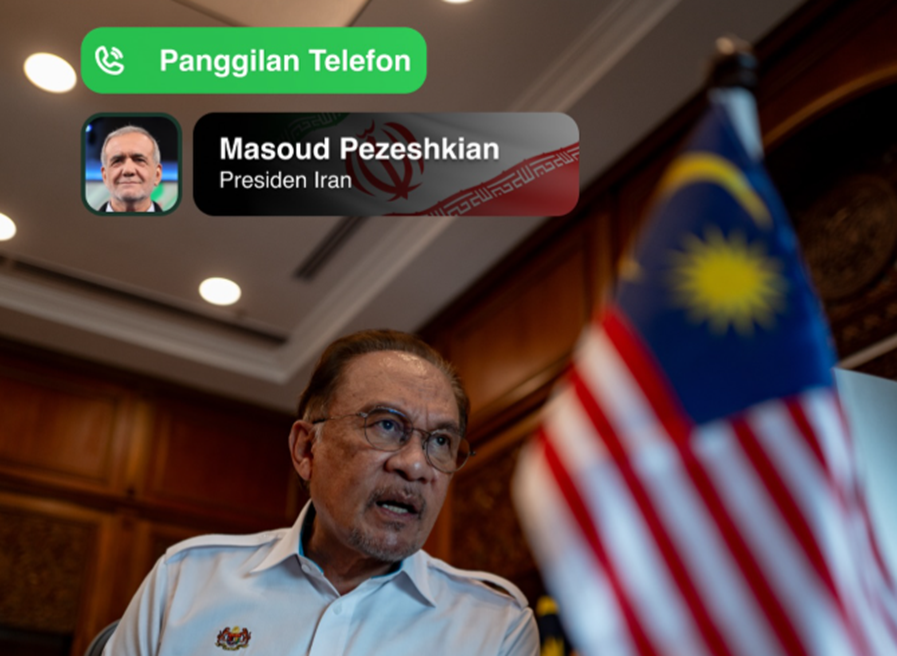
With these increased tensions, Iran may rely on other allies beyond the Middle East. Early this week, Malaysian Prime Minister Anw
Pezeshkian also urged Anwar to persuade the rest of the Muslim world to pledge support to Iran and to not listen to the anti-Iran narrative that is prevalent—particularly with regards to its nuclear programme.
Anwar also conversed with Sheikh Tamim Bin Hamad Al Thani, the Emir of Qatar, to pledge support for the mediating role Qatar can and will play between Iran, Israel and the United States, despite Qatar being the indirect target of Iran’s attacks against American assets.
Anwar’s phone calls and speed at responding to the developing events point towards his intention to play a bigger role in the Middle East and the Islamic world. He is indeed well placed—Malaysia enjoys cordial relations with the Arab world as well as Iran and thus could act as a bridge towards reconciliation.
But Malaysia also has a vested interest in a peaceful solution to the conflict, especially economically. Soon after the United States launched its missiles against Iran, the Iranian Parliament passed a bill to close the Straits of Hormuz.
This is a key waterway that sees the flow of the world’s oil, in addition to trade and ships. It has never been closed in the past, but it has been subject to disruption due to conflict and neighbouring wars.
Its closure would result in a chaotic situation and wil
Iran may want to evoke a similar moment through its closure of the Straits of Hormuz, though this
Malaysia, however, might be placed in a difficult position. On the one hand, it might want to support Iran and to show Muslim unity against US-Israeli aggression. On the other hand, it needs to keep its trade on track.
Regime Change?
There have also been calls for regime change in Iran, and there is an ongoing narrative that prolonged action against Tehran will result in the collapse of the Islamic republic.
Israel and the United States have been backing Reza Pahlavi, the son of the former Shah of Iran who was toppled in the 1979 Revolution. He has come forth as a candidate for transitional power and has voiced his desire to see Iran become a democratic, secular state.
While he has few real supporters, he has the right backers, namely Washington and the Israel lobby.
Malaysia has probably no interest in seeing regime change effected in such a way—imposed upon rather than genuinely placed. Furthermore, Malaysia has no obvious connections with these royalists and will be more comfortable with the current Iranian government remaining in its place.
As such, Malaysia is well placed to play a stronger mediating role between Iran and the Arab world. It shows itself to be an able broker—with access to both Tehran, Doha and possibly Riyadh. With the nuclear deal between Iran and the West in such a balance, Iran will need to rely on its eastern partners more.
Furthermore, Trump has proven to be unpredictable, erratic and unreliable. He has asserted his support for Israel by showing his willingness to attack without congressional approval.
Iran can rely on the support of allies such as Russia and China. However, Russia is occupied in Ukraine, while China may only involve itself in a limited capacity but not to the same extent as the United States. As such, this will pave the way for a need for Iran to bridge its gap with the wider Muslim world and call upon old allies to play a larger role.
