Prelude
The disastrous flash floods in Sumatra still left some unanswered questions.
The three most affected provinces, namely Aceh, North Sumatra and West Sumatra, have been targets of the Indonesian government’s Desa Tangguh Bencana (Resilient Village – Destana) programme since 2014. The government has propagated programmes like Destana to empower rural communities in utilising local wisdom as the foundation for disaster mitigation.
Wawan Budianto, a disaster management specialist interviewed a decade ago, emphasised that effective mitigation in disasters must be initiated by communities.
“Local communities possess the cultural knowledge and skills required to respond to disasters. However, sustaining the ancestral wisdom that passed down through generations has proven to be a major challenge,” said Wawan.
Wawan’s apprehension was reflected in the scale and spread of the recent flash floods, questioning the effectiveness of programmes like Destana and indicating the locals’ failure to draw strength from their traditional wisdom as well as knowledge.
Recurrence
As argued previously, the Sumatra flash floods were the combination of t
The social, cultural and emotional impacts of this major catastrophe will remain with local communities for years.
Many videos circulating online highlight the disaster’s emotional toll on the victims. This author had the privilege of speaking to two such individuals.
Rina (using her pseudonym) recalled the moment when the water suddenly and overwhelmingly surged into her house. Her walls cracked within seconds, and she spared not another one to flee without carrying anything.
Erik, also not using his real name, was not at home when the disaster struck. However, he began panicking after being bombarded by multiple WhatsApp messages informing him that his family was still at home as the water level rose.
These experiences are traumatic not only because of the psychological scar that lasts well after the water receded but also because this disaster washed away their vital assets: the houses.
Houses carry a deep sociocultural meaning for the people of West Sumatra. Indeed, they serve as a shelter and the foundation on which family life and social stability rest upon. Hence, when the victims’ houses were erased from existence, the impacts went beyond just the financial dimension.
Both Rina and Erik expressed regret over abandoning traditional stilted houses in favour of modern designs. Their experiences point to an inconvenient truth teased above: that the scale of destruction was not merely caused by the climate crisis but also architectural neglect and misguided development choices.
Galodo and the Fading Tradition
West Sumatra is home to the Minangkabau people, who have a specific term for flash floods akin to the one that recently struck: galodo.
Galodo is deeply associated with the
In the Minangkabau tradition, galodo was not perceived as a disaster but as a reminder from nature, a warning that there exists an imbalance in the area where the flood struck. It was understood as a test from nature but also an opportunity to learn new knowledge, prompting local communities to adhere to a more sustainable way of life.
This is because the Minangkabau have an ancient principle: “alam takambang jadi guru”, which translates into “nature is our teacher”. This philosophy is a deep ecological wisdom: that humans should learn from nature and utilise its resources wisely.
However, galodo has become a more frequent phenomenon in the past few decades. Deforestation, mainly committed by palm oil companies, paved the way for galodo to strike more often.
If the Minangkabau people have incorporated galodo as a phenomenon in life, would they not have devised ways to manage the problem?
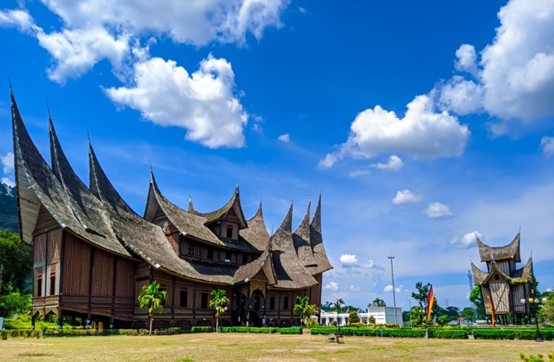
A manifestation of the alam takambang jadi guru principle is the traditional adoption of rumah gadang, the Minangkabau’s stilted house that also serves as an ancestral bastion.
Rumah gadang is built from robust timber, bamboo and palm fibre, making it more resilient against natural disasters such as earthquakes and floods.
However, something stronger than flash floods struck—the wave of modernisation. The Minangkabau people began to abandon ancestral knowledge that used to se
An example of this cultural shift is how the Minangkabau have increasingly moved into houses made of steel, brick and concrete. Despite being advertised as robust and durable, houses made by these materials were still destroyed by the recent flash floods.
Cultural Identity
A rumah gadang is more than just a building; it embodies the Minangkabau’s sociocultural system and reflects its matrilineal culture.
Beyond its cultural significance, it also serves as a sophisticated form of environmental adaptation. Experts argue that its stilted design functions as a natural mitigation against environmental hazards and disasters, such as the 6.1 magnitude earthquake that struck West Pasaman regency in February 2022. Century-old rumah gadangwithstood the shake while surrounding houses made of concrete collapsed.
Anthropologists believe that the rumah gadang structure is even more resilient in facing the flash floods compared to modern housing designs. There are some reasons for this.
Firstly, a rumah gadang’s posts and beams are made using flexible yet robust timber, allowing the structure to move dynamically in response to external forces, reducing the risk of collapse.
Secondly, its main pillars are made from strong local tropical woods that are resistant to rot, moisture, and termites, increasing the building’s lifespan and stability.
Thirdly, the open space beneath the house structure allows water to flow freely with minimal obstruction, reducing hydraulic pressure and preventing erosion around the foundation of the buildings.
Part of being an Indonesian is to accept that one lives in an environment vulnerable to natural disasters. Over centuries, however, Indonesians have adopted ways and measures to mitigate or at least minimise the impacts of disasters.
For the Minangkabau, rumah gadang represents a form of local wisdom that has evolved into a practical engineering solution for the massively changing environment, offering protection against earthquakes, seasonal flash floods and even wild animals.
Therefore, it is only natural that a return to this way of life should be seriously considered, especially in this age of the climate crisis where natural disasters are becoming more frequent.
Reflections
The recent galodo in Sumatra should serve as an alarm that perhaps the modern housing scheme may not be ideal or sufficient in the age of climate crisis. There needs to be a reconsideration of adopting local traditions like rumah gadang as a form of our mitigation of natural disasters.
A return to rumah gadang is not about reminiscing about old memories in the past but also about connecting heritage with contemporary needs.
As a disaster-prone area, West Sumatra has no option but to attain the equilibrium between modernisation and local knowledge in order to ensure that the future housing system aligns with environmental awareness and cultural foundations.
Communities, local government and architects should collaborate to develop hybrid housing models inspired by rumah gadang which have stilt structures using certified timber, earthquake-resistant joints and most crucially, water-flow-friendly layouts.
Educational institutions should integrate the indigenous architecture into their curriculum, and locals must be encouraged to preserve the skills to build ancestral building before they disappears entirely. Finally, by embracing the fading principle of alam takambang jadi guru, communities would be able to build stronger resilience against disasters not only in the architectural domain but also in the cultural and ecological.