The Executive’s New Direct Executor
Greater military involvement in Indonesia’s civilian affairs has induced a degree of anxiety owing to past power abuses during Soeharto’s dwifungsi (dual function) era.
Post-Reformasi, the government passed the Indonesian Armed Forces Law No 34 of 2004, officially limiting the military’s role in civilian domain. Following this, the officers of Tentara Nasional Indonesia (TNI) had limited roles in civilian affairs, with their involvement only allowed in specific situations defined as military operations other than war (OMSP).
However, trends since the Joko “Jokowi” Widodo administration, which have been continued by the sitting President Prabowo Subianto, as well as the revision to the military law have put TNI on an entirely different course.
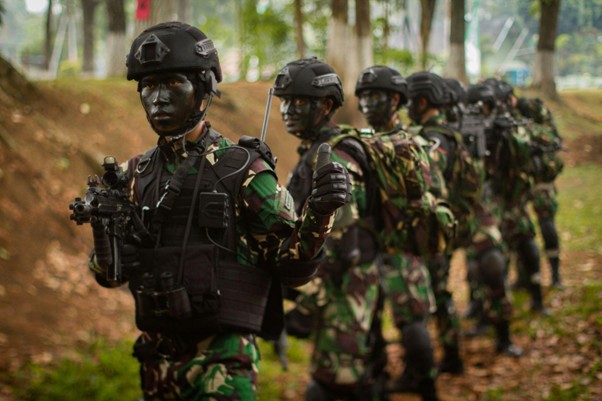
Today, TNI has a marked presence in at least four key programmes—the Red and White Village Cooperative (KDMP), Free Nutritious Meal (MBG), Sekolah Rakyat (the People’s School) and counterterrorism, the last of which is traditionally the purview of Kepolisian Negara Republik Indonesia (the National Police of Indonesia – Polri).
Whereas TNI used to be confined to traditional security affairs, its latest involvement in these programmes suggests it has evolved from an instrument of national defense into a direct executor of executive political programmes.
The central issue here is not administrative efficiency or the technical effectiveness of policy delivery – a key premise in TNI’s involvement – but the increasingly overt normalisation of militarisation in civilian governance.
The problem is, without legal limits and strong democratic oversight, this change could slowly but surely weaken civilian supremacy and the quality of Indonesia’s democracy, the very foundation that put Jokowi and Prabowo in office in the first place.
Further militarisation of civilian domain could occur under the pretext of strengthening strategic government programmes.
This has been the result of direct presidential directives. In the MBG programme, Prabowo instructed TNI to organise and support distribution as well as transportation of food packages. With KDMP, the president ordered military participation in the establishment (including construction) and operational support of these state-backed cooperatives. Meanwhile, TNI is tasked to assist in such areas as character building and imparting discipline in the People’s Schools—soldiers have been reported tasked with teaching marching drills, how to wear proper attire and regimented daily routines to students.
Military in Civilian Space
This growing normalisation of military presence in non-security sectors marks a subtle but consequential shift in Indonesia’s civil-military balance that warrants further scrutiny owing to Indonesia’s complicated past.
Last year’s revision of the TNI Law also gave the president an expansive discretion in determining the scope of OMSP, allowing Prabowo to designate any operation as OMSP without clear rules, thus making it hard to tell where civilian control ends and military power begins.
This seems to be a continuation of Jokowi’s administration, during which OMSP were often deployed through unofficial ways such as verbal orders and military actions that were later made official through agreements with civilian agencies.
During this period, only two OMSP directives were regulated through formal presidential regulations, while two others were issued verbally and at least nine were pursued through inter-agency MoUs led by the military.
This pattern signalled a shift away from institutionalised civilian control toward more ad hoc and hidden forms of executive-military coordination.
Moreover, the Prabowo administration has adopted the emergency normalisation paradigm and resorted to the vilification of outsider groups to tap on TNI’s strict and organised structure in delivering his key programmes with minimal bureaucratic friction or institutional resistance.
The question is if this will be Prabowo’s approach for the remainder of his presidency and, if re-elected, whether he will pursue the same path in his second term, in which case it could cause a significant reshaping of Indonesia’s governance method.
This is especially the risk if there is no robust civilian public watchdog system. As governance becomes increasingly militarised, democratic ideals would soon be supplanted by security imperatives.
The concept of “garrison state”, which was proposed during the World War II, postulates the danger to societies that are progressively structured around security requirements, where “the specialist of violence are the most powerful group in the society.”
In contemporary times, populist governments also display a tendency to flirt with militarisation, as populist leaders often frame politics as a struggle against existential threats, thus justifying their co-optation of military force.
In Indonesia’s case, prolonged militarisation would also increasingly push out civic participation and public accountability, casting a gloomy outlook to the state of democracy.
Blurred Lines
Increased military presence could also be observed in the counterterrorism domain, as the jurisdictional line between the law enforcement and defence agencies blurs.
In a new presidential decree draft under discussion, TNI is given not only preventive role but also enforcement and recovery, two areas that traditionally fall under the aegis of the criminal justice system.
If military personnel are deployed to intervene in a terrorist operation or arrest suspected terrorist, the coercive function it performs shifts from the realm of national defence to law enforcement. These two distinct realms rest on fundamentally different logics, procedures and accountability standards.
This ambiguity becomes even more problematic given that Indonesia’s Anti-Terrorism Law has long established Polri as the primary actor in enforcement through mechanisms of investigation, arrest and evidentiary process before the court. TNI’s entry into the same operational space without clear authority makes it almost certain that there will be overlapping jurisdiction.
Such overlap is not merely an administrative complication; it raises the core question of accountability. Who bears responsibility in cases of procedural error, excessive use of force or human rights violations during counterterrorism operations?
In the realm of law enforcement, every action taken by state agents must be subject to criminal procedure and judicial oversight, safeguards that are not embedded with a military chain of command.
Combat Mindsets in a Civil Society
Doctrinal differences between TNI and Polri further underscore the urgency of maintaining this separation of roles. Military personnel are trained to neutralise enemies, but police officers approach suspects as legal subjects whose rights and safety must be protected.
When a combat-oriented mindset is applied in domestic law enforcement setting, the likelihood of excessive force increases, particularly in situations that could otherwise be managed through investigative and judicial means.
Records from internal conflict areas illustrate how overly militarised security approaches have often resulted in misidentification, the stigmatisation of civilians and violence outside due legal process.
At the same time, expanding TNI’s role risks disrupting the institutional ecosystem of counterterrorism governance that Indonesia has sought to build in the post-Reformasi era.
Polri, the National Counterterrorism Agency (BNPT) and various CSOs have built a good rapport over the years collaborating in prevention and deradicalisation projects. Introducing TNI as a principal enforcement actor without precise coordination design may shift policy emphasis toward coercive responses alone, overlooking the reality that terrorism is the outcome of long-term radicalisation processes that take root in social, educational and digital environments.
The blurring of responsibilities between the military and the police, therefore, is not only a legal-formal issue but also reflects a broader paradigmatic shift from a criminal justice approach toward a predominantly security-driven approach. This bears significant implications for civilian supremacy and democratic accountability in Indonesia’s national security governance.
Conclusion
Greater military involvement in civilian affairs and counterterrorism signals a shift in Indonesia’s power dynamics. It took an event as radical as Reformasi to remove the military from governance last time—the question is if this new wave of militarisation is a permanent fixture or simply a temporary feature of the Prabowo’s administration.
What begins as a practical response to policy or security challenges may slowly reshape institutional boundaries and weaken civilian oversight. For this reason, clear legal limits and strong democratic control remain essential to ensure that Indonesia’s governance continues to reflect the democratic principles established post-Reformasi.