
The Exclusion of the Palestinian Voice
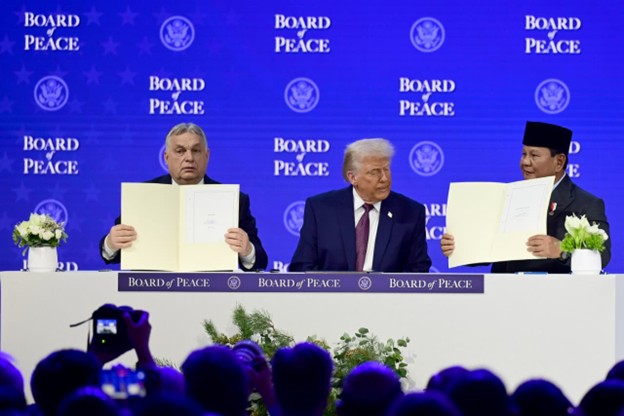
Indonesia’s decision to join the Board of Peace (BoP), initiated by President Donald Trump, has been defended by President Prabowo Subianto as pragmatic diplomacy aimed at promoting peace in Gaza.
In reality, it exposes something far more consequential than a single policy choice. It reveals a foreign policy increasingly defined by short-term calculations, access-seeking and symbolic politics rather than by principle, strategy, or moral clarity. What is presented as engagement is, in fact, a normative retreat.
Nowhere is this clearer than in the gap between Indonesia’s ambition and its leverage. Indonesia risks failing the Palestinians and in particular the Gazans despite its constitutional pledge to support the independence of oppressed nations.
In this regard, the BoP claims to offer a framework for post-war stabilisation, but it is structurally excluding Palestinian representation. A peace initiative that excludes the very people whose lives and futures are at stake is not an oversight but a political decision reaffirming the old adage of “might is right”.
By joining such an arrangement without protest or conditions, is Indonesia ready to accept the criticism that it is willing to enforce peace in Gaza without the involvement of the Palestinians? Surely Prabowo’s attempt at securing diplomatic proximity to powerful actors should not come at the expense of Palestinian independence?
Humanitarian Aid?
Prabowo has attempted to justify this position through humanitarian rhetoric, emphasising aid delivery and claims of reduced suffering.
This framing is not merely inadequate but also misleading. Humanitarian access is often used in situations of occupation and asymmetric violence to evade international scrutiny while the systems that support violence are left intact.
Crucially, this narrative ignores the reality that Israel has systematically weaponised aid and frequently blocked access as a tactic of war despite diplomatic entreaties. There is no guarantee that Indonesia’s presence in the BoP would deter Tel Aviv from repeating such violations.
Aid that flows without responsibility does not signal development but risks sending signals that Indonesia is accommodating Trump’s interests and his allies’. Prabowo’s aid narrative could end up legitimising a political grouping that preserves the causes of violence by confusing relief with justice.
The Fragmentation of Global Governance
The institutional implications of the BoP further underscore the weak direction of Prabowo’s foreign policy vision. The initiative has emerged as an alternative body that sidesteps the United Nations, taking shape as a parallel forum where participation is selective and decisions rest largely on political discretion.
This, of course, contravenes Prabowo’s vocal commitment towards multilateralism. Endorsing an ad hoc mechanism (the BoP) designed to bypass existing institutions (the United Nations) does not strengthen global governance but fragments it. For a country that has long promoted international law and is also subject to it, this marks an inconsistency in foreign policy posturing.
What makes this particularly head-scratching is Indonesia’s lack of leverage within the initiative. Unlike major powers, Indonesia possesses neither the economic stick to sanction violations nor the military carrot to guarantee security.
Without diplomatic relations with Israel, Jakarta holds no bilateral cards to play; it cannot threaten to withdraw an ambassador or freeze trade assets it does not have. Consequently, Indonesia is relegated to the role of a “rule-taker” rather than a “rule-maker” in the BoP. Indonesia also holds neither a veto power nor the economic weight to steer its agenda.
Status Affirmation and the High Table
However, symbolism matters. Joining the BoP may not be the one political currency that ushers Prabowo to an election victory in 2029, but it lends values to his effort in crafting an image as a statesman and boosts his international standing.
For Prabowo, participation in the BoP serves a different purpose: status affirmation. Being seated at the high table provides visual proof of Indonesia’s (and his own) elevation from a peripheral observer to a central player
Nevertheless, pursuing this may further erode Indonesia’s diplomatic identity. For decades, Indonesia’s foreign policy settled on a clear normative foundation, articulated through the principle of bebas aktif (independent and active) and embodied in its leadership of the postcolonial world. Under the current president, this tradition is no longer an identity, as foreign policy becomes transactional and personality-driven. The result is not flexibility but drift.
The danger of this deviation from tradition extends beyond Gaza. By aligning with a neo-imperial project driven by the preferences of a single great power, Jakarta’s credibility across the Global South weakens. Many developing states continue to rely on multilateral institutions as a safeguard against arbitrary power. Indonesia’s
Defenders of Prabowo’s approach frame this manoeuvre through a rationalist lens, echoing Lichbach & Zuckerman’s logic of utility maximisation. The logic is seductive: the utility of being inside the room shaping the conversation implies higher payoffs than the costs of shouting from the outside.
History shows that peace imposed without justice does not endure, and reconstruction without accountability entrenches grievance. If the BoP were serious about ending the conflict, it would prioritise restraint of violence, legal accountability and political inclusion.
On the contrary, Israel has resumed its indiscriminate bombing campaigns in Gaza, rendering any talk of “post-war stabilisation” premature and absurd. Curiously, despite this escalation, Indonesia has not demanded that the BoP enforce a halt to the violence.
Even though his decision has been met with criticism, including from the Majelis Ulama Indonesia (MUI), CSOs, experts and NGOs, Prabowo has not sought to reverse or suspend Indonesia’s participation in the BoP. Instead, he has invited MUI, Islamic organisations, as well as former ministers and vice ministers of foreign affairs to join him in consultation meetings.
In doing so, the government has essentially shifted the responsibility onto respected figures such as religious leaders, former ministers and experts to validate Indonesia’s decision to join the BoP. This is critical especially to rally public support, which has been rather cold. The policy itself remained
Way Forward
Indonesia still has a choice, but that choice requires political courage. A principled foreign policy would insist on Palestinian representation, openly challenge the normalisation of impunity and draw clear boundaries around participation in the BoP. Most importantly, it would recognise that withdrawing legitimacy from a flawed process is sometimes more powerful than lending it.
Indonesia, however, has thus far shown little inclination to exercise that option.
What is at stake is not merely Indonesia’s position on Gaza, but its role in the world. Indonesia risks becoming a state that attends every forum yet stands for nothing, that speaks the language of peace while accommodating injustice. This is a serious erosion of the country’s diplomatic legacy.
Peace is not built through access, ceremony or proximity to power. It is built through the willingness to confront power in defence of law and human dignity. Until Prabowo’s foreign policy recovers that willingness, Indonesia’s global presence will continue to grow louder and emptier at the same time.

