Introduction
In January 2026, the Indonesian government announced that the country had achieved rice self-sufficiency, with national production exceeding domestic consumption and no imports required for public needs.
President Prabowo Subianto framed the achievement as a strategic win and urged that the momentum be extended to other food commodities.
This domestic milestone somehow coincided with a broader global reassessment of how food is produced and sustained under growing ecological and geopolitical pressures. In the 179th FAO council meeting held on 1-5 December 2025, member states released FAO’s new flagship publication entitled “The State of the World’s Land and Water Resources for Food and Agriculture 2025” (SOLAW 2025).
The global conversation captured in this literature is highly relevant for Indonesia. Despite being endowed with vast natural resources, Indonesia faces mounting pressures on its land and water systems. While rice self-sufficiency target is achieved, Indonesia’s land resources are undergoing rapid degradation.
Multiple Pressures
Although the deforestation rate has decreased in the last 10 years, the rate at which Indonesia’s forests are disappearing is still alarming, with 175,400 hectares lost in 2024 alone. In addition, urban expansion is also shrinking agricultural land, particularly on Ja
Peatland degradation adds another layer of problem. Drained peatland areas induce vulnerability to Indon
Beyond ecological stress, the challenges are worsened by fragmented governance. Such institutional silos often manifest in overlapping land permits, where large-scale industrial concessions frequently clash with protected forest areas or smallholder farmlands. The sl
Furthermore, the lack of transparency in top-down initiatives like the Food Estate programme highlights a disconnect between central production targets and community-based food systems.
The consequences are visible on the ground—agrarian conflicts persist across Indonesia. Despite the enactment of Undang-Undang Pokok Agraria Tahun 1960 (Basic Agrarian Law 1960), the reality has moved in the opposite direction compared to the initial aims, which is to secure justice for farmers. Data shows that 17.25 million farming families control less than 0.5 hectares, with many earning barely Rp50,000 per day.
These multiple layers of pressure illustrate why high production alone is not sufficient to secure Indonesia’s food future. Achieving self-sufficiency by increasing production – if done despite land degradation, governance fragmentation or social exclusion – risks undermining the very systems that sustain agriculture.
This is where the FAO’s call to “produce more and better” in SOLAW 2025 becomes relevant for Indonesia.
Tech for the Modern Field
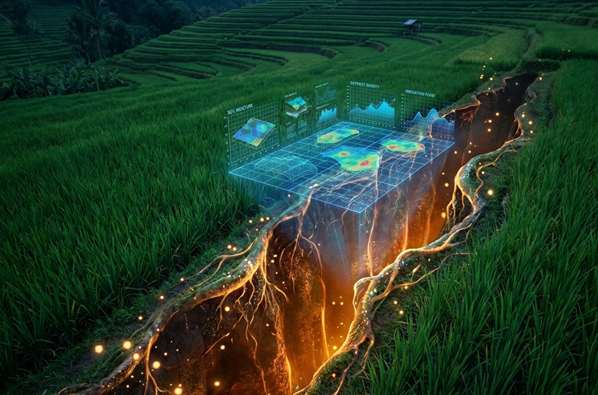
Indonesia cannot rely on land expansion to meet future food needs. The only viable path forward is to increase productivity from existing land through innovation. In this vein, Indonesia should leverage the momentum provided by FAO to adopt precision agriculture more rigorously.
The practice of precision agriculture allows farmers to apply fertilisers, pesticides, and water only where and when they are needed. In the process, it reduces input costs, prevents soil degradation and minimises the risk of water pollution. Laboratory tests, thus, play an important role in expanding this practice.
Precision agriculture also means tailoring Indonesia’s diverse landscapes to climate-smart farming needs. In drought-prone areas, for instance, this means the utilisation of water-saving technologies such as drip irrigation or rainwater harvesting. In flood-prone regions, meanwhile, it relates to involving the raised-bed farming method or adaptive crop varieties.
Thus, accurate and integrated digital soil and water maps, information on soil nutrients, moisture le
One Map, One Nation: The Data Imperative
Currently, several ministries have developed their own spatial datasets. Different scales, boundaries and definitions often lead to mismatched maps, administrative disputes, and inconsistent planning decisions. Therefore, it is imperative that the government come up with a unified national database that integrates land, soil, and water information across ministries and levels of government.
A national integrated database would allow ministries, provincial governments and local authorities to work from a single source of information, not multiple ones that confuse or contradict each other. This integrated database would help identify priority areas for agricultural intensification. In addition, it ensures that food production does not encroach on critical ecosystems, because land-use decisions would be based on clear, harmonised and scientifically validated spatial information.
Integrating Crops and Livestock
Once precision in input use and data systems is established, Indonesia can move toward a more circular agricultural model. By recycling nutrients locally, farmers can reduce dependency on external inputs while improving soil health.
Integrated crop-livestock systems also diversify income sources and increase resilience to climate and market shocks. These integrated systems are particularly relevant for Indonesia—when managed carefully, such systems can raise productivity per hectare without expanding farmland while maintaining ecological functions.
In mixed crop-cattle systems, for example, manure from cattle can be returned to maize, rice or forage fields, reducing fertiliser costs while improving soil structure as well as water-holding capacity.
In oil palm or other perennial crop systems, controlled and managed cattle grazing can utilise undergrowth vegetation, returning nutrients to the soil through manure deposition.
Rice-duck integration is another similar system that offer the same benefits. Ducks help control pests and weeds, thus decreasing the need for chemical pesticide. Duck excreta also enrich paddy soils. On the other side, rice farmers gain an additional source of protein and income from ducks and duck eggs.
By recycling nutrients locally, farmers can reduce dependency on external inputs while improving soil health and nutrient balance. Integrated crop-livestock systems also diversify income sources and increase resilience, as farmers are not dependent on a single commodity.
Policy and Incentives
The transition toward “producing b
Beyond acce
For small farmers, the main barriers are not a lack of willingness to innovate but limited access to capital, data and technical infrastructure. Thus, public investment must be revitalised not only to launch new technology but also to strengthen services that help farmers interpret data, adapt practices to local conditions and organise collectively.
This is where the private sector can play a complementary role. Agritech firms can accelerate the deployment of precision tools and other related technologies. In this scenario, public-private partnerships are necessary.
However, these public-private partnerships must be carefully designed. Farmers must be involved in the decision-making process rather than playing the role of passive recipients. This way, farmers will develop a sense of ownership over the new agricultural practices explored above.
Indonesia’s rice self-sufficiency in 2025 is an important achievement, but it should not be understood as the final measure of food security success. Producing more rice alone does not guarantee resilience if the gains are achieved through degrading land and water resources. The message from SOLAW 2025 is also clear in that the world’s food challenges will be solved not by expanding land, but by managing what we already have. In other words, there is a need to be better, smarter and fairer in our agricultural practices. This is the momentum for Indonesia to turn this insight into policy to unlock its land potential and safeguard its food future.