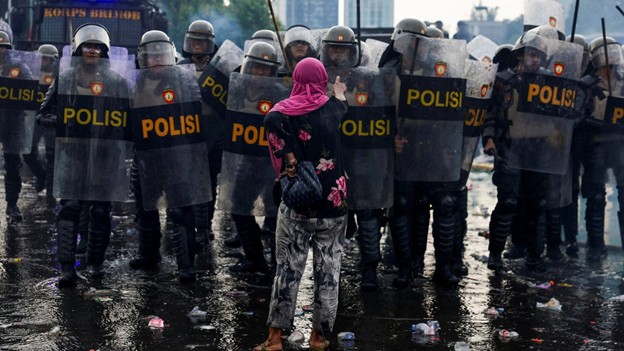
The Woman in Pink
On 28 August 2025, social media was awash with pictures and videos of a woman, wearing a pink headscarf, marching steadily against fully armoured police. Behind her were hundreds of protesters, demanding an end to the unfair privileges accorded to the House of Representatives (DPR) members.
Following the wave of riots at the end of August 2025, the colours pink, green and blue painted the social media in filtered photographs.
These colours became the trinity symbol of protests and movements in Indonesia: women, the working class and civil resistance. Among the thousands of protesters, the mothers were taking the forefront in challenging the state’s violence, thus establishing themselves as the manifestation of this trinity symbol.
This is a notable development. After decades of domestication propaganda during the New Order, maternal activism has now occupied the central stage of politics in Indonesia, representing resistance.
A video shows how the woman in pink was casually holding the megaphone, cursing and challenging the riot police, “Come here, yesterday you brought tear gas. Your eyes are blind, who are you defending?”
After delivering the provoking speech, Ana, the woman, constantly reminded other protesters to retreat if the police shot tear gas.
She rose to become one of the most visible
Within the span of two weeks, mothers in Yogyakarta staged another protest by banging pots in public areas while demanding to temporarily stop and evaluate the Makan Bergizi Gratis (Free Nutritious Meal – MBG) programme that has caused food poisoning to thousands of students.
Their demand was clear: for the state as well as food producers to care for the students’ wellbeing and provide healthy meals.
As a movement, Kenduri Suara Ibu Indonesia has grown into an organic and massive discussion that derived from the daily experience of motherhood and “kitchenhood”. Pots and soup ladles did not merely serve as tools but also as instruments of resistance against Prabowo’s bedazzlingly militarised food programme.
Dismantling “State Ibuism”
Women-led resistance campaign brought a distinctive contour to Indonesia’s political dynamic. Historically, such movements were restrained during the New Order, where the regime reduced women’s position and agency to domestic roles, later defined as “State Ibuism” by scholars.
State Ibuism emerged from Soeharto’s own ideology, which framed women’s primary role as housewives, presenting this role as an utmost necessity within the New Order’s patriarchal national development framework. This constituted a form of misogyny-as-nation-building propaganda.
The New Order regime also appointed women to select positions, such as Minister for Women, Minister of S
During the 1950s, Gerakan Wanita Indonesia (Indonesian Women’s Movement – GERWANI) was known internationally for its progressive views. However, it became the unfortunate subject of state suppression, propaganda and eradication, a process that saw the participation of such organisations as Dharma Wanita and Pemberdayaan Kesejahteraan Keluarga (Family Welfare and Empowerment – PKK).
It has been argued that the propaganda against Gerwani was more effective than Joseph Goebbels’ campaign against the Jews during World War II. Women who spoke up against injustice risked being labelled as GERWANI or members of Partai Komunis Indonesia (Communist Party of Indonesia – PKI). It was an antagonisation against outspoken women, a tactic that was also used to justify the horrifying torture these women experienced during incarceration.
Spectre of this propaganda still haunts today. Women activists still experience forms of repression and violence to silence them. However, such have not stopped women, including mothers, from participating in the democratic political process.
This begs the question: what drives them to stage resistance, and why do their voices matter?
Why Mothers Lead
Why does maternal identity become a starting point, even an identity tied to their acts?
Maternal activism could be defined as “a process in which a woman or a group of women use the figure of the mother in order to make claims on behalf of their sons or daughters and demand social change.”
What makes this unique is that it is derived from a shared concern for the wellbeing of others. Maternal compassion works to an extent of caring not only for their son and daughters but also for those vulnerable.
Cases in point include Sumarsih of Aksi Kamisan, Ana of the pink headscarf and the women of the Kartini Kendeng movement, Suara Ibu Peduli as well as those involved in the aforementioned Kenduri Suara Ibu Indonesia.
These mothers have lived the political and economic realities that shaped their relationship with the state, compelling them to draw strength by employing their care for family members and others.
Caring is pivotal in maternal activism, as it serves as a catalyst for broader movements. In a patriarchal setting, mothers occupy the role of primary and traditional caregivers who ensure the needs of family members are fulfilled, particularly in times of crisis.
When these needs are denied, mothers would feel compelled to fight for justice, which requires them to enter the political sphere. This signifies the
From Private Mourning to Public Justice
The New Order’s State Ibuism demanded that the role of mother be limited to traditional caregiver. However, maternal activism moulds the mothers’ experience of oppression into a political identity. These mothers showcase their pain, loss and grief to the streets for everyone to witness. In the process, their display of maternal pain and of mourning wronged victims remind the public that these victims had a name and had a place in that community.
Past cases of maternal activism exemplify this. Suara Ibu Peduli strategically placed domestic caregiving as a “casualty” of the prolonged monetary crisis before Reformasi. Eventually, the movement lent support to the wider demonstrations that demanded Soeharto’s removal from power.
Furthermore, the weekly Aksi Kamisan has emerged as a compassionate sanctuary for victims of human rights violations to fight for justice. Along with other activists, Sumarsih spends every Thursday in front of the Presidential Palace, holding a black umbrella that symbolises her unwavering faith that the killings of her son Wawan and his friends in the Semanggi I incident would encourage the upholding of rule of law and human rights. In doing so, Sumarsih and other mothers are showcasing their motherhood experience of care, compassion and grief.
Meanwhile, the women of Kartini Kendeng, who endured physical violence and threats from armed forces, buried their feet in cement blocks in front of the Presidential Palace as well. The did this to symbolise how the absence of state protection has led to their exploitation and their alienation from nature.
When care is transported from the private to the public sphere, it no longer remains an individual responsibility—nor is it exclusively placed upon mothers. Instead, care becomes a relational practice that connects private experience and survival to structural issues. In Indonesia’s case, as exemplified above, movements grounded in care underscore the state’s failure to protect those who are most vulnerable.
Bargaining with Patriarchy
Acknowledging the presence of oppression – by patriarchy and state violence – is the first step towards transforming care into empowerment. The marginal position of mothers and care is often overlooked by the system, but this only provides an avenue for activists to outsmart it.
For example, by demanding state intervention over the surging prices of milk during the 1998 crisis, Suara Ibu Peduli set an example of how a focus on domestic needs – rather than an outright criticism of the government – could further their agenda more effectively.
It also protected them. Such a demand allowed them to dodge the accusation that they were calling for Soeharto to step down. Besides, it also cemented their status as influential actors, their position as working-class citizens notwithstanding, during the country’s economic crisis.
Suara Ibu Peduli’s positioning and strategy enabled its activists to actively exercise democratic rights at a time of political turbulence. The strategy felt measured and outspoken in resisting the State Ibuism framing yet still subjective as the movement is derived from the activists’ experience as mothers.
Maternal activism is not merely altruistic traits defined by gendered expectations. Rather, it expands what counts as political. While it highlights mothers’ traditional caregiver role, at the same time, it is also prone to painting women as “hypervisible” citizens in need of protection. In essence, it exploits the domestic labels often ascribed to these women.
In this sense, the state’s positioning of its relationship with mothers is exactly what drives mothers to “bargain with patriarchy” in the first place. State Ibuism constrained women in domestic space. Thus, for these women to enter the public sphere, they have to exploit their traditional role by reclaiming their political rights and shifting what it means to be an ibu, a mother.
The emergence of “mothers politics” necessitates acknowledging the agency of Indonesian feminist movement. It is important to not view the activists merely as “mothers”; rather, they should be acknowledged as an intellectual group who pl
Identity is crucial in mothers politics, especially since care is considered an essential currency in their political activism. Understanding the injustices faced by others in their family – both in the past and in the foreseeable future – mothers “inherit” their family members’ struggles and translate them into their own purposes. Their very identity as mothers, thus, becomes political. When expressed in the public sphere, this care for family members g