
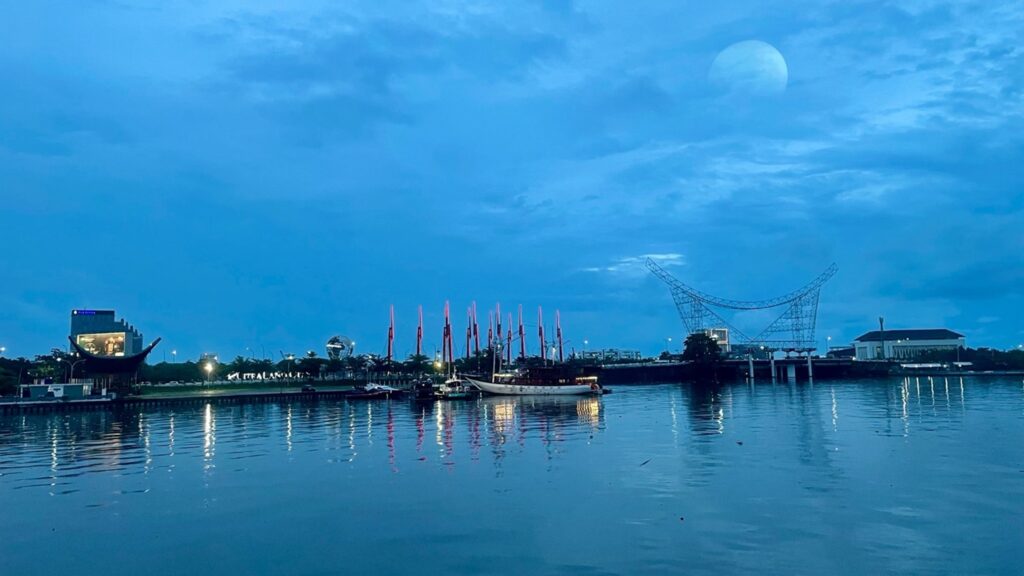
This month marks the fourth anniversary of my return to my hometown of Makassar (or Ujung Pandang, although KLIA2 has misspelt it as “Ujung Padang” for over a decade) after spending a significant portion of my life in Malaysia.
While Kuala Lumpur’s pandemic horrors made me immensely grateful for the opportunity to reconnect with family and return to my roots, one thing has remained constant in my mind from the moment I stepped foot
Makassar is no longer as green as I remember it.
I am guilty of making an unfair comparison between Makassar and Kuala Lumpur, Jakarta and – to a certain extent – Surabaya, my favourite city in the world. The green public spaces in Kuala Lumpur and Jakarta, for instance, are a sight to behold. Meanwhile, Surabaya’s greenery in the city proper, as well as its cleanliness, is unmatched. Of course, this is just my cursory observation as a former resident of these three cities. I am neither trained in urban planning nor an expert in the SDGs, thus, I asked my free Gemini to produce a simple comparison of the green spaces in all four cities.
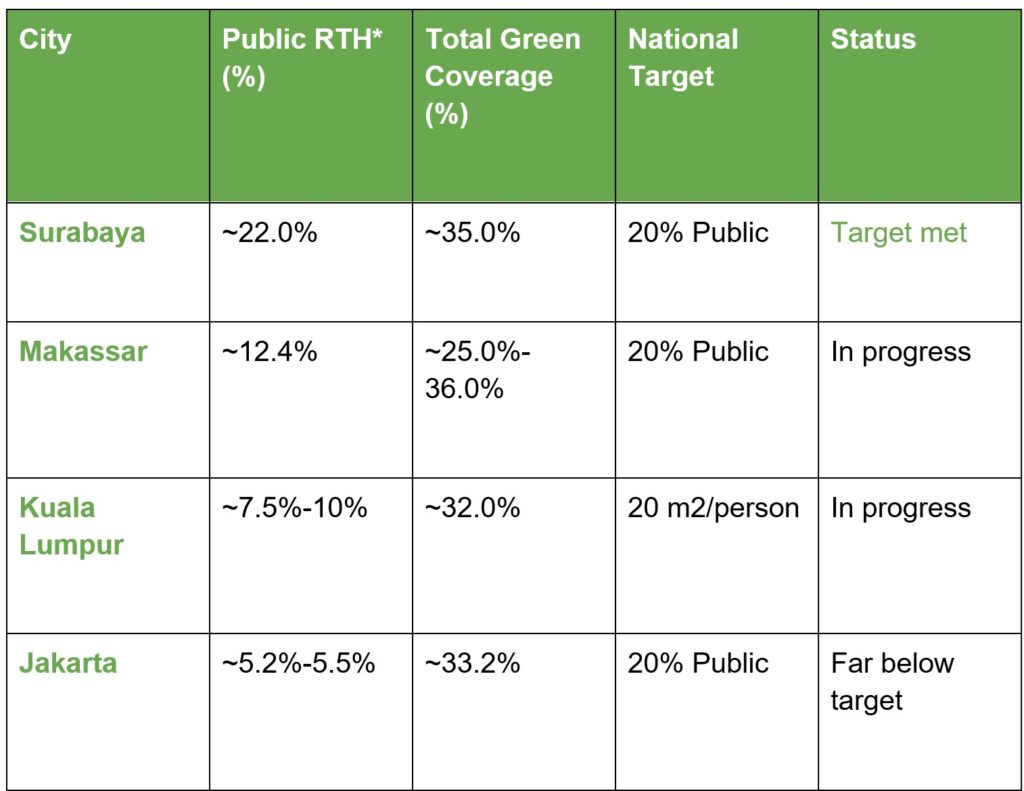
* RTH = Ruang terbuka hijau (open green space)
Source: data collated by Google Gemini
The data above already shows that Makassar, in the most optimistic estimation, is doing better than or has surpassed several, if not all, of the three other cities.
However, deeper analysis is required to unpack the nuances, such as what truly constitutes the total green space (usually satellite imagery and AI to track all sorts of vegetation, including rice fields and roadside trees). I would leave that bit to the actual urban planning and SDG experts.
What I want to focus on is that, while Makassar’s figures may seem higher, they may not necessarily translate into a better experience for someone who has lived in all four cities.
This is because, in my nostalgia, Makassar was a much more lush city.
The whole stretch of Pettarani road used to be covered by a tall green canopy, although today its shade is provided by a commercial flyover that can only be accessed if you pay a fee (compared to Kuala Lumpur’s DUKE, for example). At least 1,000 trees were felled to make way for the construction.
Makassar’s green parks also cannot compete with Kuala Lumpur’s Bukit Nanas or Jakarta’s Gelora Bung Karno (GBK), which are essentially urban forests. Comparably, Makassar has Taman Macan, Lapangan Karebosi, Taman Maccini Sombala, Celebes Garden and Taman Pakui Sayang. While these seem like a good variety at first glance, they just do not offer good isolation from urban noise, the thickness that gets you lost in thought or simply the beauty that inspires awe. It does not help that the last of these parks was the site of a recent infamous child kidnapping.
Universitas Hasanuddin and GOR Sudiang are also heavily forested, but they are out of reach for the majority of the population.
Meanwhile, the climate crisis has tightened its grip on the city. Makassar might as well be the location of Taylor Swift’s music video of “Cruel Summer”. During the rainy season, storms inundate large parts of the city, even areas that border the coastline. Needless to say, violent gusts rip down young and old trees alike. As if that is not enough, trees are also easily chopped down if they mess with power lines or threaten surrounding structures (in case of extreme weather), as well as to clear land for more construction. These only demonstrate the locals’ attitude towards this “stuff of life”.
Indeed, as an introverted treehugger, the disappearance of Makassar’s trees is a cause for anxiety to me, not only because of nature’s role in my mental health maintenance but also for what it symbolises: the city’s losing fight against unimpeded capitalism and the climate crisis.
In my adult life, as I struggle with adult stress, I have come to appreciate the pragmatic function of the greenery and green space. The KLCC Park was where I used to sit down on weekends to depressurise and read books, whilst I try to visit GBK whenever I am in Jakarta to reorient my thoughts.
I also do not understand why we still choose information overload from doomscrolling over calming ourselves under the cover of large trees in a park. I do not engage in social activities in such parks, but the simple presence of other human beings connecting with nature always gives me the reminder that the world is bigger than my troubles. To top it off, I have shared with my friends – to their consternation and chagrin – that I found God while driving my scooter past a large swathe of rice terrace in Bali.
Although deeply personal, I believe this is also an experience shared by others. My millennial cohort, especially, would understand. We are already stressing out from our work, personal and family struggles (dating ones, if you are single) at the time when prices go up. We keep telling ourselves (or our friends) to spend a huge sum for therapy or to take that “healing trip” when we do not even have the money. This is despite the therapeutic and recreational effects that public green spaces can offer to you, free of charge.
In fact, Johann Hari in his book Lost Connectio
On a larger scale, the functions of green spaces have also been acknowledged by the United Nations, which highlights their role in promoting physical health, mental wellbeing, social interactions and community engagement. SDG 11.7 even sets the target of providing inclusive public and green space for all by 2030.
If we take it to the extreme, we should remember how green spaces offer one of the few opportunities for exercising and decompressing during the pandemic (apart from grocery runs, in my case), highlighting the significance of parks and gardens in our urban life.
To be fair, the local administration has committed Makassar to becoming a Low Carbon City, although information about it remains scarce. There is also no clarity as to the progress in the city’s tree planting and greening processes.
Furthermore, the provincial government has claimed that its programme Gerakan Sulsel Menanam (South Sulawesi Planting Movement) successfully planted more than 6 million trees in 2024 alone. However, it is difficult to find data regarding how many trees have been planted in Indonesia’s biggest city in the east, or if this makes up for the loss of thousands of hectares of forest in the province.
Meanwhile, there is also an agenda to plant 2020 trees along the Tanjung Bunga area, but only as a restitution for the felling of at least 47 old trees for the revitalisation of Lapangan Karebosi. Similarly, further information regarding this initiative is difficult to find.
From the ecological perspective, it is not merely about planting more trees, as other variables must be factored in as well, including water, biodiversity, land space and others. Planting more trees, for example, is not a solution unless there is enough water to keep them alive. Again, I would leave this argument to experts of urban planning, SDG and ecology out there. Nonetheless, I feel compelled to highlight what the current situation actually says about our general approach to the development vs environment debate.
Felling trees to make way for new development still reeks of the 19th-century capitalist mindset that does not suit this age of climate crisis. Indeed, Jason Hickel in Less is More points out that the insatiable hunger for growth in a capitalist economic system is not sustainable where there is a scarcity of lands, minerals and forests to exploit. Only disasters lie at the end of the line.
For instance, Sumatera’s recent floods of biblical magnitude are only a reminder of the downside of unchecked capitalism. Do we really want to wait for disasters of such a degree to hit us in Makassar and other parts of Sulawesi before we rethink our attitude towards growth?
Extractive activities may bring more wealth to some but ultimately not welfare to all.
To me, the troubling part is that we, or my generation at least, have all received the necessary education about the dangers of deforestation and the importance of green space since we were in elementary school. That this knowledge is successfully imparted in some but not others is puzzling, perhaps even suggesting that there are more gaps in our education system than we realise.
It is also challenging to inspire an attitude change if the locals’ metric for success is still very much
Perhaps Makassar’s tradition as a city of traders, being the biggest port in Indonesia’s east, also plays a part in shaping the locals’ worldview.
In such a society, the regard for the environment and nature may not be as important unless they can bring in more money.
So how do we go about in what appears to be Makassar’s losing fight against capitalism and the climate crisis?
There is value in investing in high-quality public parks that could elevate the life quality of everyone in the city. The challenge is we need more land, but I do not see why Makassar’s philanthropists, sultans and crazy rich cannot find a way to navigate this.
For one, Makassar is home to many abandoned and dilapidated shoplots. The idea is simple: buy these properties, tear them down and build a park on the land. They can name these new parks after themselves or dedicate them to causes they believe in to boost their profile, which could prove useful in the next cycle of regional elections.
This is an era where we shamelessly glorify the ultra-rich, so it follows that heavy expectations and responsibilities are placed on this group as well, especially if they are already making money off the working class. Plus, Makassar needs more trees than shoplots anyway.
Linked to that is the potential of converting these green spaces into new sites of the experience economy, which is a popular phenomenon among today’s millennials and Gen Z.
Instead of encouraging the culture of “healing”, whereby people spend millions of rupiah to go to exotic destinations or attend Coldplay concerts in Singapore, people should be pushed towards spending time in public parks and “healing” themselves mentally and physically there. It also goes without saying that a trip, or even multiple ones, to a green space is a cheaper form of therapy than an hour in your counsellor’s room or a flight ticket to elsewhere.
The fact that even stray cats in front of Jakarta’s FX Sudirman can be a new destination of mini-tourism suggests that there is a vast potential to shape these parks as new sites of the experience economy.
The question is how to create a demand for high-quality green spaces among the people. Without a stronger demand, the public and private sectors would not be incentivised to invest resources in these unless they can bring in tangible benefits.
The solution, in part, lies in diversifying the activities that the public can do in such spaces. Introverts like me are the easiest because we can just sit on a bench and get lost in our melancholic rumination. But what about families—can they have a picnic in Makassar’s current parks? For couples, can they date? For groups, can they engage in group sports or activities? Clearly, being green is not enough for these spaces—they must be ex
Some might think this is a bizarre proposal. Stripping down the environmental and aesthetic arguments, for me personally, perhaps I am more inspired by the longing to get back the city that I knew—cleaner, greener and safer.
Makassar was a resplendent city, especially after the morning rain. But as its greenery disappeared, so did a portion of its splendour.
No doubt it is encouraged by the psychological impulse to return to the element, to a simpler time, especially after spending a big portion of my adult life abroad and getting transformed in the process.
My transition back to Makassar was an internally violent process, one that was made harder by the lack of green space where I can process it mentally. But as much of its greenery has disappeared, it was harder for me to reclaim my identity that was shaped by the city that I k
