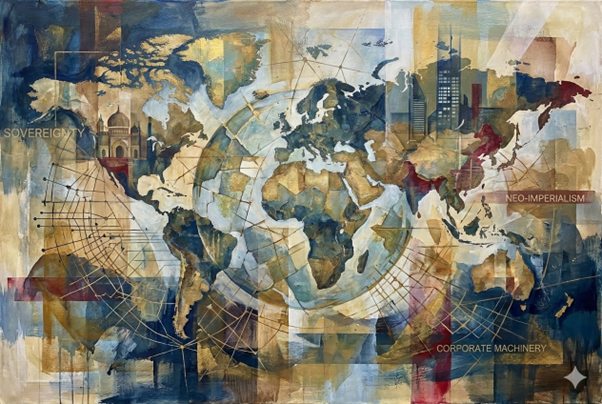
On 18 November 2025, a forum was organised by the Asia West East Centre (AsiaWE), in collaboration with the Peace, Dialogue and Xenophobia Studies (PEDIXS) Centre of the International Islamic University Malaysia (IIUM), the Policy and Area Studies Research Unit (PASRU), and stratsea.
Entitled “Forum on the World Order: Preserving Sovereignty, Eluding Neo-Imperialism”, the discussion brought forth ideas from several key thinkers within the region and was held at the Senate Hall of IIUM.
Presenters include Professor Dr Fauzi Abdul Hamid, Professor of Political Science, School of Distance Education at Universiti Sains Malaysia; Ms Farah Michelle Kimball, Senior Research Fellow of PEDIXS; Dr Meor Alif Meor Azalan, coordinator of PASRU-IIUM and; Professor Syed Farid Alatas, Co-founder and Director of AsiaWE, who also serves as Professor of Sociology at the National University of Singapore (NUS).
The forum began with the keynote by the Rector of IIUM Emeritus Professor Osman Bakar,an experienced and reputable scholar who specialises in the Philosophy of Science. Prof Osman touched on how the scientific revolution in Europe proved to be a turning point in history, in which the separation of the divine from the mundane affairs of the world became more prevalent and was thus accepted. This process was carried out through the scientific method, an observation of the physical world that was for the sake of deriving information—without acknowledgement of anything beyond the tangible.
The author of The History and Philosophy of Islamic Science (1999) and Classification of Knowledge in Islam: A Study in Islamic Schools of Epistemology (2019) called attention to how science was then used as a tool of Western imperialism. He argued that the periodisation of Occidental dominance over the world was in tandem with the advancement of the scientific method.
One can also make the argument that the classification of species within the animal kingdom brought a logic of the distinction between races, as espoused by Herbert Spencer, the British polymath who introduced the idea of “the survival of the fittest”. This distinction paved the way to widespread racism in the West, with the spillover effect being the assumed superiority of the categoriser over the categorised, the observer over the observed.
The next speaker was Professor Dr Fauzi Abdul Hamid. He began his presentation by offering prophecies of mass killings attributed to the Final Messenger of Islam, the Prophet Muhammad (PBUH). In Muslim: Book 41, Number 6903, Abu Hurairah reported Allah’s Messenger as saying:“The last Hour will not come unless there is much bloodshed. They said: What is harj? Thereupon he said: bloodshed.”
The word “Al-Harj” was referred to in a previous hadith. This backdrop was provided by Dr Fauzi as an indicator of the times we are living in, where the mass killing of children is deemed to be “normal”, even livestreamed on our handphones.
Moving on from this introduction, he talked about the current international geopolitical situation that sees the waning influence of the United States over global affairs. While the United States acknowledges that the days of hegemony are coming to an end, it seems that they are not giving up this primary position without a fight. This fight, however, pertains
As such, the Oxford graduate gave a bleak projection of the future in that the weaponisation of religion would persist, proving to be a point of division between people. He cited examples of outright racism influencing religious violence particularly pernicious because it is based on notions of superiority pertaining to God-given, unchanging physical features or phenotype.
This can be tied to incidences of the justification of racism in colonial history
The next presenter was Dr Meor Alif from PASRU. The London School of Economics (LSE) graduate laid the foundations for how we – as a political collective – have adopted the lexicon of warfare in our daily parlance. At the level of policy formulation, terms such as “deterrence”, “capacity building” and “vigilance” have become common—carrying with them connotations of power and domination. Titled “Languages of Power: Militarism, Malaysia, and a World Order Worth Unsubscribing To”, Dr Meor’s presentation highlighted the need to question these terms and to come up with alternative terminologies that are not derived from the dictionary of militarism.
He contends with enthusiasm that when there is an adoption of a vocabulary, there is an inheriting of a specific worldview. In this instance, the worldview is one which is bleak—often viewing reality as one of scarcity instead of abundance. He provided a list of books that shaped such a view, including A History of Militarism: Civilian and Military by Alfred Vagts, Post-Military Society by Martin Shaw, as well as Metaphors We Live By by George Lakoff and Mark Johnson.
Dr Meor ended by quoting the prominent philosopher of language, Ludwig Wittgenstein: “The limits of language are the limits of my world.” Indeed, it is a timely reminder of how language is crucial in constructing praxis.
With the title “The Global Economy of Genocide & the Erosion of Sovereignty”, Ms Farah Michelle Kimball’s talk revolved around the report provided by the UN Special Rapporteur, Francesca Albanese, on the “economy of genocide”. The report investigated how corporate machinery continues to sustain Israel’s settler-colonial project of displacement and replacement of the Palestinians in the occupied territory.
While political leaders and governments shirk their obligations, far too many corporate entities have made lucrative profits from Israel’s economy of illegal occupation, apa
Ms Kimball, taking on Albanese, reminded us that the complicity exposed in the report is just the tip of the iceberg; ending it will not happen without holding the private sector accountable, including its high-rolling executives. International law recognises varying degrees of responsibility—each requiring scrutiny and accountability, particularly in this case, where and when the self-determination of an entire people is at stake.
Next, Prof Farid Alatas talked about how colonialism and capitalism are intertwined. The control of capital opens the possibility of domination of one group of people over another. The Singapore-based academic pointed out – and in agreement with the towering Muslim historian Ibn Khaldun in his magnum opus The Muqaddimah – that governments are as a rule unjust. We cannot expect governments to have futuwwa (chivalry) for the very simple reason that vested interests are at play.
Prof Farid suggested a recentring of discussions on development to link it to the overarching theme of (neo)imperialism. In the modern world, coloniality does not come in the form of brute force or overt violence but through the seemingly “innocent” domain of academia. With intensity, he questioned how knowledge is produced in universities and how some structures of coloniality persist by way of the syllabi in the aforesaid institutions. As such, the co-Director of AsiaWE called for a change in the way the social sciences are taught in universities.
Moving on from this suggestion, it must be noted that the economy of new nations could only work within the terms of trade set down by the industrial countries; they lack the resources to build themselves up into sustainable nations. Independence did naught to dent the abiding physical dependence of new nations upon the old co
This is, of course, an imposition that persists to this day. This dependency is certainly one that is manufactured to keep the new “independent” nations in check and to continue the exploitation of resources in these countries. To rub salt into collective wounds, new nations inherited a network of modern services, such as education and healthcare. It is not an exaggeration to say that these services were designed to serve the needs of the colonialists, as well as the indigenous elite corps of functionaries who serviced the administration.
My understanding of this situation takes on Merryl Wyn Davies and Ziauddin Sardar’s Distorted Imagination: Lessons from the Rushdie Affair, especially regarding the impact of “brown sahibs” in perpetuating colonial control.
Who were these brown sahibs? They were descendants of the pre-colonial monarchies and feudal landlords—a progeny of colonial administrations, who set themselves as the “go-between” between the rulers and the ruled. Unfortunately, these individuals are still in our midst and are often in positions of authority in developing nations. The colonial powers had left the colonised world with a network of economic and intellectual resources designed to only serve the interests of the metropolitan colonial authority. This is our current reality.
After the presenters made their points, Professor Dr Nath Aldalala’a of IIUM was called upon as discussant. After integrating many of the idea
In my estimation, we can conclude that neo-imperialism is very much a reality of the time. It is the continuation of imperialist policies without direct political control, using economic, financial and cultural power to dominate other nations. It is characterised by the application of instruments – including financial trade agreements, financial aid and corporate influence – to maintain coercion, often to the detriment of a country’s own progress.
Any individual who questions how establishments gain legitimacy ought to question how the Universal Declaration of Human Rights (UDHR) became the effective power in determinin
Overall, the “Forum on the World Order: Preserving Sovereignty, Eluding Neo-Imperialism” was a success, as the objectives of the event were met. It is with great hope that such events will be carried out in the future and that the (co)organisers continue their good work in bringing forth conversations on neo-imperialism and decoloniality, with our plight in sight.