Introduction
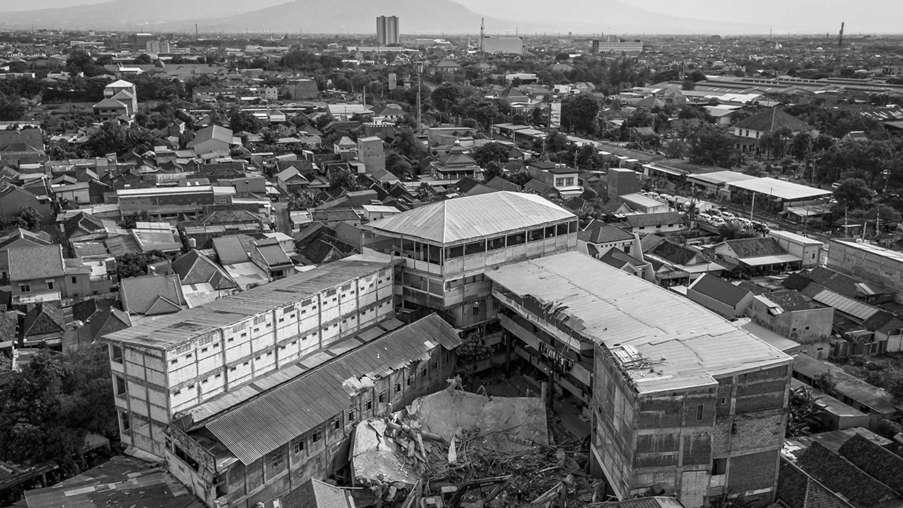
Late in the afternoon of 29September 2025, in Sidoarjo, East Java, a four-storey prayer hall of the Islamic boarding school (pesantren) Al-Asy’ary Al-Khoziny collapsed under its own weight, trapping 171 individuals under the rubble.
The pesantren is operated by a foundation under the umbrella of Nahdlatul Ulama, Indonesia’s largest Islamic mass organisation. It is one of the oldest pesantren in East Java, founded in the 1920s.
The tragedy immediately made international headlines, putting under scrutiny why and how the building – still under construction at the time – had suffered structural failure. Most experts now agree that haphazard building method
The prayer hall’s foundation had been laid only to withstand the weight of a one-storey-structure before someone in charge decided to tempt fate by adding three more. In fact, the concrete for the fourth floor had just been poured in the morning prior to the building’s collapse.
By the time evacuation attempts had officially ended on the 7 October, 104 out of the 172 trapped had been rescued, while the remaining 67 were declared dead from impact.
Most importantly, the widespread exposure of the tragedy and the highly charged emotions it produced unravelled a series of events that laid bare the visible cracks in Nahdlatul Ulama’s veneer, calling into doubt its hard-earned reputation for tolerance and moderation.
On the Defensive
As the search and rescue attempts were going on at Al Khoziny, an outpouring of grief and criticism flooded Indonesian social media. Appalled and distressed people were asking how and why the collapse had taken place.
Some pointed out that the construction of the new floors at Al Khoziny had lacked a building permit, leading to the revelation that most pesantren in Indonesia are built without any permit at all.
Many shared anecdotes about what life was like inside the pesantren: how students were mobilised to carry out construction work as part of their voluntary work for their school and how a culture of excessive subservience prevalent at the pesantren had been an enabling factor in the tragedy.
Then came the barrage of social media reels showing santri in obsequious postures, crawling on their knees as they filed past their kyai or religious teachers.
Some netizens openly remarked on the “anachronistic” and “feudal” nature of the traditions practised behind closed doors at more than 40,000 pesantren in Indonesia.
More damning still, others suggested that traditions in some pesantren, such as reverence for religious relics, were not in line with Qur’anic teachings.
Nevertheless, the Islamic institution is not without its defenders. After all, pesantren alumni likely number tens of millions in the country.
Many countered the criticisms by reasoning that it was normal for the students to perform community work, including construction, because their school fees were uncommonly low.
Mahfud MD, former Coordinating Minister for Political and Security Affairs, who is also a pesantren graduate, acknowledged there was “negligence” in the construction method at Al Khoziny. However, he also fairly asserted that those who had never been to a pesantren might not be best placed to understand its traditions.
In his podcast, he said pesantren operated on the simplicity and gotong royong (communal solidarity) principles, hence the community-based construction work.
“The kyai (of
But the stream of criticism against pesantren nationwide continued.
National television network Trans7 aired on 13 October 2025 a sensational programme on the traditions of pesantren, entitled, “Santri have to squa
The programme provoked the wrath of NU sympathisers, which in turn led to the online movement of the hashtag #BOIKOTTRANS7, eventually eliciting a public apology by the station.
Worse still, at a rally conducted in front of Trans7 headquarters in Jakarta, Muhammad Ainul Yakin Simatupang, Jakarta’s general chairman of GP Ansor (Nahdlatul Ulama’s youth organisation), threatened to “slit the throats” of those in TransTV’s employ for producing a programme which “denigrated NU ulama”.
In another instance, a YouTuber who goes by the name Stevans Young put out a tongue-in-cheek video in which he portrayed a dim-witted student with no knowledge of the outside world blindly obeying his teacher. The parody was interpreted by many as a jibe against the pesantren culture.
His video came to the attention of Banser, a paramilitary group under the auspices of GP Ansor. Its Jember members promptly paid Revaldo a home visit. They subsequently managed to extract a somewhat reluctant public apology from the Youtuber.
Public Reactions
Since there are 143 million social media users in Indonesia, making up 50.2% of the country’s total population, online sentiments have come to represent a pertinent gauge into public perceptions of trending issues.
DroneEmprit – an Indonesian big data and AI-based analytical system of the Internet – monitored public reactions online as the Al Khoziny incident and its fallout unfolded. It made some noteworthy observations.
Carried out between 6 and 19 October 2025, its data mining process encompassed 16,477 online media articles, 71,638 social media mentions and 35,831 sample chats.
Following the Al Khoziny tragedy, analysis of online media content about the pesantren culture was mostly positive, at 74%. However, a corresponding analysis of social media content produced the exact opposite result.
As many as 62% of Indonesian netizens reacted negatively to the pesantren culture as opposed to 23% positive, with the rest being neutral.
DroneEmprit maintained that the Al Khoziny tragedy opened up a Pandora’s box for pesantren and, by extension, Nahdlatul Ulama.
“Feodalisme” (feudalism) became a buzzword in online debates about pesantren as netizens criticised what they saw as ongoing feudal practices not in line with the times.
The tragedy, it observed, also had become a gateway for social critique of hitherto sensitive issues, such as the perception that sexual abuse is becoming a more frequent phenomenon in these institutions.
There was also an overwhelming sentiment that there were double standards in the way the nahdliyin (those identifying with Nahdlatul Ulama) responded to criticism against suggestions of negligence as an overwhelming factor in the Al Khoziny tragedy.
However, the upside for Nahdlatul Ulama remains that Indonesians in general were not against the pesantren as an institution. The public also largely took Nahdlatul Ulama’s side on the Trans7 controversy, as most people regarded the TV programme as a specious smear campaign.
Yet, despite all these, the fallout of the Al Khoziny incident is essentially a telltale sign of a potential shift for the vision of Islam in Indonesia and what it means for Nahdlatul Ulama at an existential level.
Reputation
Nahdlatul Ulama is reputed to be Indonesia’s – and indeed the world’s – largest Islamic organisation, although estimated figures of its membership vary. Based on a 2023 poll by Lembaga Survei Indonesia (LSI), 56.9% of Indonesians are affiliated with Nahdlatul Ulama, a significant jump from the 2010 figure (at 47%). Figures at the Ministry of Religious Affairs put the number of Nahdlatul Ulama members in 2019 to be around 91.2 million across Indonesia.
Judging by the public reaction to the Al Khoziny case, there appears to be a widespread desire to see institutional as well as practical reforms within the pesantren. Many of the victims’ family members have professed to be “traumatised” by the tragedy and insisted that a thorough investigation be carried out.
The case has also rendered the pesantren tradition as a focus of criticism and derision by Indonesian Muslims who do not associate with Nahdlatul Ulama, especially on social media.
If their frustrations with the institution of pesantren remain unaddressed, it will not be improbable that prospective santri parents may find themselves reluctant to send their children to Nadhlatul Ulama-affiliated pesantren.
Over time, this might gravely affect the organisation’s own system of regeneration, which heavily depends on its patronage over its numerous pesantren.
Safeguarding Legacy
As the predominant force of Islam in Indonesia, Nahdlatul Ulama is anything but simple or uniform, encompassing diverse traditions across the archipelago.
Its broad umbrella and respect for all the unique traditions within itself have always been its unifying factors. For many years, Nahdlatul Ulama’s vision for Islam remained dynamic and nameless, changing with the times.
Nahdlatul Ulama became a more progressive, tolerant and inclusive social force under the leadership of Abdurrahman Wahid between 1984 and 1999. Gus Dur, as he was popularly known, went on to become the fourth Indonesian president.
As the grandson of one of Nahdlatul Ulama’s founders, Hasyim Asy’ari, Gus Dur was known to promote the idea of Islam as the protector of minority groups and did his utmost to foster ecumenical ties with other faiths, a legacy which continues today, if to a lesser degree.
Gus Dur’s informal and egalitarian approach as president also lent Nahdlatul Ulama its “democratic” credential. Under his guidance, the organisation also became the vanguard against religious extremism in Indonesia.
As such, Nahdlatul Ulama made itself an indispensable partner in the government’s struggle against religious extremism, the culmination of which took place in 2015 when Nahdlatul Ulama came up with the term “Islam Nusantara” in its 33rd Congress in Jombang. It is defined as a fountain of universal blessings for Muslims and non-Muslims alike; one that is moderate, tolerant and inclusive.
However, with heightened public scrutiny on pesantren practices triggered by the Al Khoziny incident, especially those deemed anachronistic, Nahdlatul Ulama’s badge of modern and progressive Islam is inevitably called into question.
Future Endeavours
Questions now must be asked whether – in order to adapt – Nahdlatul Ulama must necessarily abandon its age-old traditions. The answer is it may not have to, although presentational changes seem unavoidable if Nahdlatul Ulama wishes to retain its progressive, tolerant and moving-with-the-times public image cultivated in the last two decades.
Negative public sentiments, as DroneEmprit findings show, are directed towards the lack of accountability and “feudal” infallibility attributed to pesantren practices and leaders, not the actual institution.
While the Trans7 controversy suggests that pesantren still finds great support among Indonesians, modern sensibilities have compelled them to rethink some of the practices within the institution.
The intransigence displayed by Nahdlatul Ulama-affiliated bodies like GP Ansor and Banser in the face of criticism proved to be counterproductive and self-harming for NU as it went against its image of being democratic and anti-reactionary.
Rather than relying on hard power to defend itself against Trans7, Banser could have filed a complaint against the station with Dewan Pers (Press Board) over the content of its programme.
This would have been more in line with Indonesian legal procedure in dealing with errant media outlets. It would also have shown that a Nahdlatul Ulama affiliate supported the rule of law, rather than resorting to brute force.
However, there are signs that NU is listening and learning. In the aftermath of the Al Khoziny tragedy, the school agreed to a police investigation into what had caused the collapse.
On the criticism against the practice of mobilising students to carry out construction work, for in
One germane plan would be to carry out vocational training in construction for pesantren students as part of their permanent curriculum. This will modernise the pesantren’s approach to education, enhancing it with practical studies without having to abolish community work participation by students.
Imbuing the pesantren curriculum with vocational training would definitely broaden its appeal. This could dispel the workforce perception that pesantren alumni typically lack the practical skills compatible with Indonesia’s industrial sector.
Vocational training can even be expanded to include agricultural, horticultural and culinary training, aligning its curriculum with President Prabowo Subianto’s policy push in those areas.
The Indonesian government, having promised funds to rebuild the collapsed wing of Al Khoziny, is patently eager to be of further assistance, something pesantren schools all over the country should capitalise on.
For example, the Ministry of Public Works recently held a six-day training scheme in construction techniques for 105 santri as part of its outreach to pesantren. The ministry has also rolled out similar training schemes for 2,500 students in 2025.
The biggest question for Nahdlatul Ulama, however, is how to police what is essentially a loose confederation of its affiliated organisations with the aim of presenting a coherent united front on most issues. For decades, each arm of the organisation has operated with a certain degree of autonomy. Yet, each arm of this vast organisation is undeniably a reflection of the whole.
A case in point is the recent Elham Yahya Luqman (Gus Elham) controversy, which revolves around the abuse of privileges by a religious teacher.
Gus Elham is a 24-year-old preacher from Kediri, East Java, who runs his own pesantren. As his honorific “Gus” indicates, he is the son of an established kyai and is part of Nahdlatul Ulama’s “religious blue bloodline” clans.
Elham came to notoriety when video clips showing him kissing underage girls in his congregation surfaced on social media. Drawing public outrage, he has since apologised publicly, though he maintained that it was a misunderstanding.
Sensing another public relations catastrophe, Nahdlatul Ulama’s Rais Aam Miftachul Akhyar, its highest-ranking spiritual leader, issued a condemnation of Elham’s conduct, calling it “grossly inappropriate and unbecoming” in a preacher, and even asked the authorities to “take commensurate measures according to the law”.
In Elham’s case, NU has once again shown its innate willingness to adapt to modern sensibilities and a reality dominated by raucous public opinions and the rule of social media in Indonesia.
The Al Khoziny tragedy has, in fact, become the necessary push for introspection and prospective growth of Nahdlatul Ulama to address issues of the day and modern challenges to its age-old traditions.
As Nahdlatul Ulama evolves with modernity, its survival will increasingly depend on whether it is capable of walking the tightrope between the traditions that make it unique and its ability to explain them in terms acceptable to the younger generations of Indonesians.