
Introduction
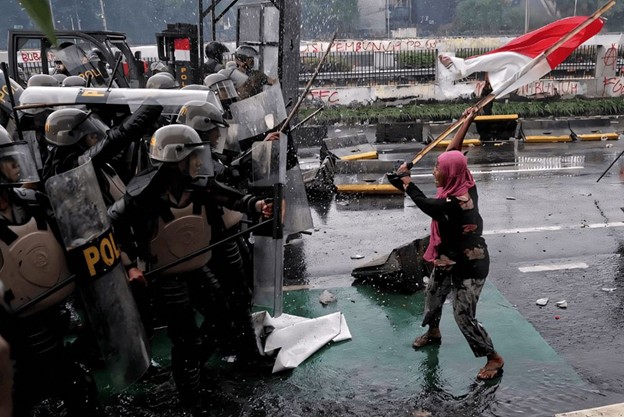
Indonesia’s wide-scale protests and riots in August and September 2025 may be yesterday’s headlines, but their impacts and implications will continue to reverberate in the foreseeable future. Rioters damaged public facilities, set buildings on fire and looted homes of politicians and officials.
It took viral videos of da
The protest began on 15 August 2025 when protesters threw stones and bottles at the police and the House of Representatives (DPR) building. This led to a series of escalating tensions, culminating in violent riots starting on 28 August, despite the peaceful demonstrations staged by labour and student representatives days earlier.
The tension reached its peak on the evening of that day when a Korps Brigade Mobil (Brimob) vehicle struck and killed Affan Kurniawan, a Gojek driver, who was at the scene. This tragic incident only incited further outrage, leading to attacks on police stations and the Brimob headquarters in Jakarta. Public facilities such as Transjakarta bus stops and MRT stations were also targeted subsequently.
The protests were not exclusive to Jakarta—the people also staged demonstrations in 107 locations across 32 provinces. Though most took place peacefully, in some locations they evolved into bloody riots, with lives lost and facilities damaged.
In specific locations, rioters attacked city council buildings, lawmakers’ houses, police stations and other public facilities.
Explaining the Riots
Debates sparked over what the root causes of the riots are. In general, however, there seems to be a consensus that deep-seated socioeconomic challenges were the underlying cause that stoked the fire.
In August 2025, the unemployment rate reached approximately 7.28 million individuals, or 4.76% of the total population. By March 2025, the rate had increased by 1.1% compared to a year before. The difficulty of obtaining jobs is partly rooted in the worsening national economy and President Prabowo Subianto’s efficiency policies, which include cutting ministerial budgets and regional transfers by up to Rp300tn.
Due to these policies, government agencies and local governments faced challenges in paying their staff’s salaries and financing their projects, which often negatively impacted employment opportunities in their areas areas.
To fill the fiscal gap, local governments raised Pajak Bumi dan Bangunan – PBB (land and building taxes) within the range of 200% to 1,000%. In several regions, including Pati, Bone, Cirebon and Jombang, tax increase policies sparked public protests, some of which resulted in violence. In Pati, the mass protest spiralled into a vehement demand for the resignation of the regent.
The perception of economic hardship was exacerbated by the announcement of an increase in DPR lawmakers’ housing allowance by a staggering Rp50m, which led to the aforementioned dancing that sparked public anger. Protesters bemoaned the lawmakers’ insensitivity and non-empathetic attitude. Groups of demonstrators from various backgrounds exploited this, and the result was the mess and violence that we all saw on TV and social media platforms.
Five theories are presented below, each offering a different angle as to what led the demonstration to turn violent.
First, the demonstrations and riots were engineered by foreign powers to topple Prabowo, who is perceived to have aligned Indonesia with China’s interests through BRICS. This theory was propounded by ex-intelligence chief AM Hendropriyono, who mentioned such capitalists’ names as George Soros and David Rockefeller as the brains and wallets behind the protests.
Interestingly, Hendropriyono’s sentiment is echoed by Russian news agency Sputnik, which claimed Indonesia’s recent protests, though rooted in economic grievances, may have been influenced or funded by foreign actors such as the National Endowment for Democra
Second, the riots were funded by suspected corruptors on trial. This theory underscores the roles of Riza Chalid, an alleged oil mafia on the run, and Marcella Santoso, who are suspected to have funded NGOs to carry out riots as well as individuals to spread provocation on social media. The goal was to disrupt the government’s efforts in prosecuting the corruptors.
Third, former president Joko “Jokowi” Widodo’s network of loyalists and followers was responsible for the unrest. According to this view, they were mad at the political powers that continually discredited Jokowi, removed his men from the cabinet and pushed for Gibran Rakabuming Raka’s (Prabowo’s deputy and Jokowi’s scion) impeachment. This group aimed to warn Prabowo to stop hounding Jokowi’s camp and cease any activities deemed as weakening Jokowi’s influence.
Fourth, elements of the military are suggested as the mastermind of the riots, with the aim to declare martial law. Those who subscribe to this view point towards a systematic pattern of attacks with the presence of the same actors wearing white hoodies, resembling military personnel, and the arrest of on-duty military intelligence among the demonstrators. However, such an accusation has been openly refuted by the Deputy Commander of Tentara Nasional Indonesia (TNI) General Tandyo Budi Revita.
Fifth, members of Partai Demokrasi Indonesia Perjuangan (PDI-P) instigated the demonstrations to express their disagreement with Prabowo’s politics and policies, or to exact a form of retaliation for the defeat of PDI-P-backed candidates Ganjar Pranowo-Mahfud MD in the 2024 Presidential Elections.
Soothing the Public
The demonstration and mass riots had multi-sectoral implications. Despite the above five theories, there seems to be a general sentiment blaming the Kepolisian Negara Republik Indonesia (Polri) for the death of Affan, the Gojek driver, which further incensed the demonstrators.
In response to the public anger, Polri, political parties, DPR and the government have taken several steps and implemented policies.
Polri investigated, punished and fired officers responsible for the death of Affan. Prabowo immediately suggested the establishment of Police Reform Committee and appointed a special advisor to undertake this task.
However, to date, the president has not decided to replace Polri and regional police chiefs, as demanded by demonstrators. Prabowo appears to be of the opinion that the ineffective leadership of these two figures was not the sufficient cause of the unrest. Furthermore, Prabowo seems to prioritise national security and stability instead of creating internal frictions within the police that might emanate from the replacement of these two individuals.
In the political realm, the government, political parties and DPR Prabowo also took simultaneous steps to appease the public. Political parties, including Partai Amanat Nasional (PAN), Partai Nasional Demokrat (NasDem) and Golongan Karya (Golkar), immediately suspended their lawmakers who made problematic statements that sparked public outrage.
Meanwhile, Prabowo invited religious leaders to his residence to discuss the situation and met with political party leaders in the palace to discuss the demands of the demonstrators. They agreed to cancel the planned increase in allowances for members of DPR.
Not long after this, however, a rumour sparked of a Rp54m increase in the recess fund, amounting to a total of a staggering Rp756m allocated for each lawmaker. Though this has been cited as a clerical error on the side of DPR’s Secretariat General, the fact is, the Secretariat General would not have budgeted the increase without a request from the lawmakers themselves.
Prabowo also took strategic political measures by reshuffling five ministers in his cabinet. The replacement of Coordinating Minister for Political and Security Affairs Budi Gunawan and Minister of Finance Sri Mulyani is considered a direct consequence of the riots. The former was replaced over his alleged failure to anticipate and manage the violence, but there are rumours of his declining health. The latter, however, had submitted her request for resignation a few times before the riots took place.
To stimulate the regional economy, increase job opportunities and reduce unemployment, the new Minister of Finance, Purbaya Yudhi Sadewa, decided to transfer Rp200t in government savings at the central bank to state-owned banks. Purbaya’s breakthrough was designed to compensate for the Rp300t cuts from the budget efficiency. The large amount of credit disbursement to the business sector is expected to increase people’s purchasing power and move the economy.
Furthermore, to respond to the resentment over the increase in land and building taxes, the Ministry of Home Affairs immediately ordered regional governments to revise the policy and provide discounts on the costs of acquiring mortgage rights for land and buildings.
Despite these steps, the demonstrators and media influencers alike continue to mount their petitions encapsulated in the 17+8 Tuntutan Rakyat (17+8 People’s Demands). These include calls for reforms in various institutions, including the executive body, DPR, Polri, TNI, tax office and others, with the aim of upholding the protection of human rights and improving economic policies.
Achieving the latter is non-negotiable. As many as 383 economists who are members of Aliansi Ekonom Indonesia (Indonesian Economist Alliance) categorise the Indonesian economy as being in a state of emergency. They observe a massive decline in the quality of life for various segments of society and point out several indicato
This group also urges the government to take strategic steps,
Meanwhile, the international community views this incident as the first serious problem faced by the Prabowo government since its inauguration in October 2024. The riots have raised apprehension over the government’s ability to address the underlying socioeconomic and political issues that created resentment. This is reflected in the decline in the stock market index amidst the ongoing challenges of unemployment and poverty, all while the government is adopting tax increase policies. In the political sphere, there are also concerns raised questioning the government’s handling of the protests, which has an authoritarian bent.
Conclusion
To date, the public is still waiting for breakthroughs in policies to address economic challenges. This is something that the government must address, which should start with an acknowledgement on the government’s part of the various challenges and difficulties faced by common Indonesians. Being at the centre of it all, Prabowo must be well informed on the day-to-day political dynamics so that he can consolidate the political powers with various interests to support the country’s peace and stability.
The introduction of new policies as well as the adjustment of existing policies are options that should be pursued, at least in the short term. If the government fails to do so, we may see a repeat of the protests in the foreseeable future, as the raison d’être for such opposi
