Prelude
Amidst the discriminatory laws against ethnic Chinese in Indonesia, a multiethnic kampungin Solo, Central Java, did not display the expected segregation of the New Order. This kampung survived the May 1998 riots, and its populationsmoothly bounced back from the traumatic, nationwide incidents.
It was only to be expected from the kampung’s harmonious community, with villagers rising to protect each other and drawing communal strength from their long-standing coexistence.
The kampung’s name is Balong.
“…kind of pointless, kind of confusing”
“That’s basically what the New Order government was aiming for—they clearly wanted to wipe out the Chinese culture, religion, customs and traditions,” said Sum, a 67-year-old Indonesian man who is serving in Tien Kok Sie, the oldest and most pivotal Chinese temple in Solo.
He brought me to the furthest room of the temple for the interview, offering a glimpse of the altars of Tao, Buddha and Confucius. Some people came to offer their prayers to the gods while we were talking in low voices.
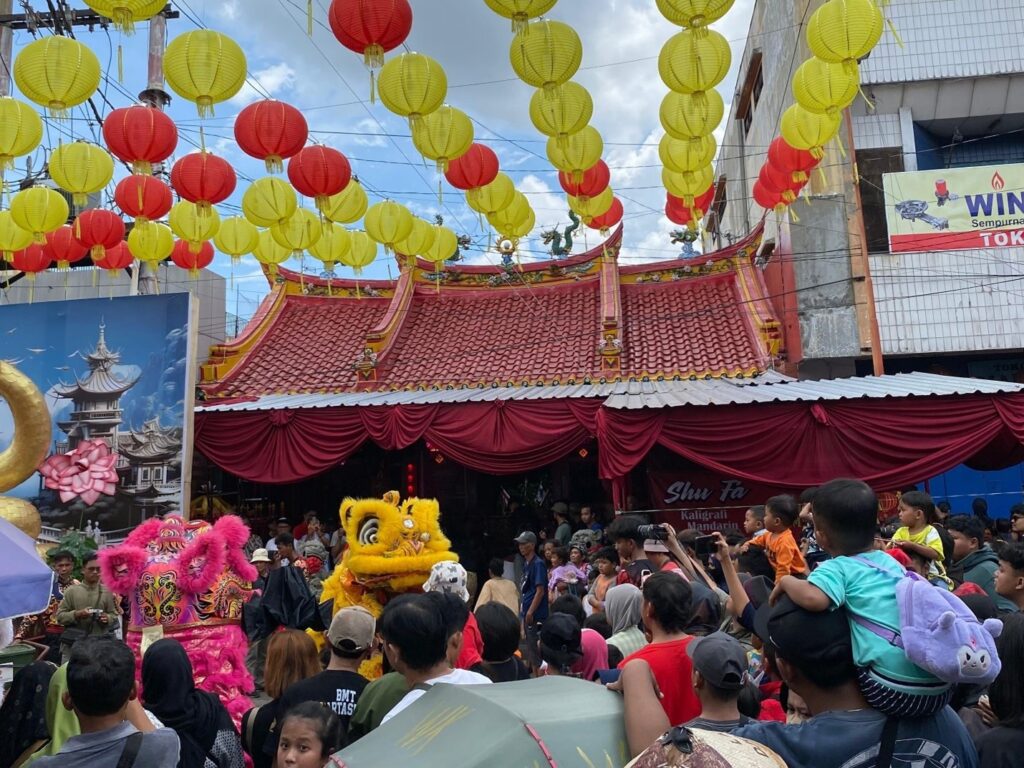
It was the first few weeks after the Imlek(Chinese New Year) celebrations in March 2025, the Year of the Snake.
In the midst of the thick smell of incense, his face turned stern. “What is even more… I do not know, the most strange and uncomfortable thing for us… Everyone born in my generation originally had their Chinese names. Like when I was in school – from kindergarten all the way to sixth grade – I used my Chinese name. Even my report cards had my Chinese name on them. But then, at the end of sixth grade, a new rule came out saying all Chinese had to change their names to ‘Indonesian’ ones,” he said.
Sum recalled how the New Order (1966–1998) enforced a set of laws discriminating against ethnic Chinese in Indonesia.
Post Gerakan 30 September (the 30September Movement – G30S) in 1965, Chinese traditions and customs – including the use and learning of Mandarin, religious rituals, and other cultural practices – were banned. The massive discrimination culminate
Although the “suggestion” was not mandatory, subtle pressures from the government were perceived as a necessity for the Chinese communities often to pledge loyalty. The term “Chinese communities” was used here and subsequently in reference to the various Chinese sub-ethnic groups in Indonesia; often distinguished by ancestral origin or family name though these lines are not always strictly defined.
However, instead of forcing the Chinese ethnic groups into becoming invisible, secondary citizens, these rules eventually accentuated their existence even more.
“The problem is, even after the names were changed – Indonesian names were what got printed on our ID cards – and even after religion (as a criterion) was taken away (from the ID cards), the question is: can you really change someone’s face? I mean, no matter what name you give someone – an Arab name, an Indian name, whatever – people will still look at you and immediately know you are Chinese. So, it all felt kind of pointless, kind of confusing,” Sum continued.
“But back then, the Chinese people just went along with it. We were not allowed to say no, so we said okay.”
Ari is a younger Chinese Indonesian residing in Balong. She explained the implications of the banning to the community. “For us Confucians, Chinese New Year is not just about culture—it is a religious celebration,” said the 33-year-old woman.
To accommodate the limitations to their cultural and religious practices, Indonesia’s Chinese communities ado
“We don’t want to be like them”
Being born after Suharto’s regime, I could not imagine how older generations of Chinese Indonesians restrained themselves to ensure social cohesion and avert further oppression. However, what the people in Balong told me seemed the opposite of designated discrimination.
Balong is the name of the kampungthat generally refers to the area around the Kapten Mulyadi Street in the Sudiroprajan Subdistrict, despite Sudiroprajan officially consisting of eight kampungs: Kepanjen, Balong, Mijen, Ngampil, Samaan, Ketandan, Limolasan and Balong Lengkong.
The spatial regulations by the Dutch colonial state designated this area as a settlement for lower-class Chinese and Javanese. Balong (balung in Javanese), which literally means “bones”, was built on a vacant land that was previously used as a dumping ground for cattle bones. This settlement gradually grew into a densely populated slum, where houses are tightly packed against one another.
Its houses are facing each other closely, separated by narrow alleys that only allow a single passing motorcycle. Houses next to each other some
As I walked down an alley, I saw the indistinguishable faces of Chinese and Javanese people nongkrong (hanging out) in front of their houses.
“Every day they live next to each other. The residents here are lower-middle class, and the Javanese and Chinese in the kampungare already mixed. Those residing in the kampungare close because their houses are facing each other; their walls stick to each other,” said Li, a middle-aged Javanese man living in Balong.
Balong’s Chinese population adhered to the New Order’s prohibition to celebrate Imlek. However, the banning did not limit their long-standing relationship with
The people in Balong chose to differentiate themselves from oth
“They could do whatever they want. We do not want to be like them. It does not affect us (the Javanese) when the Chinese celebrate their new year,” said As. She did not falter even once when expressing her attitude towards the segregated society in Solo as a result of the New Order’s discrimination.
The 56-year-old Javanese woman said firmly, “Why are we known for assimilation? Because they did not expect that our community would unite like this. You cannot differentiate who is Chinese and who is Javanese here.”
The N
However, in areas with low economic capital, such as Balong, ethnic differences do not pose a problem. Both ethnic groups are striving despite the labels that others place on their kampung, such as a “slum area” that has “concentrated poverty”. With both Chinese and Javanese groups hailing from below-average economic status, assimilation occ
“Who are the enemies?”
The New Order lasted for 32 years, and it ended with horrifying riots across the country in May 1998.
Solo was one of the cities that suffered the worst. The people of Balong were concerned about their safety as a multiethnic kampung, as rioters targeted Chinese or Chinese-owned buildings and businesses elsewhere.
During his dark time, Balong residents erected barriers to ward off provocateurs. “I spent a few days staying on guard. We had to guard ourselves because a large Chinese communities lived here. We were vulnerable,” Li reminisced about that period.
Recalling the event, As remained firm in her response. “During the riots in 1998 they were safe. This area was safe. ‘You dare to come here!’,” she mimicked the strong Javanese taunt she threw at the provocateurs.
Do was just a teenager when the riots occurred. As rioters came nearer to Balong, Do wanted to go outside to quench his curiosity over whatever was happening.
“A neighbour told me, ‘Don’t go out.’ I asked, ‘Why?’ He answered, ‘This is an ethnic problem.’ And I have the face of a Chinese person,” said Do.
It was unthinkable for Do, and indeed the people of Balong, that an ethnic conflict could occur. How could it ever happen? In their world of narrow alleys and interracial marriages, the people always felt safe and equal.
Do recalled how baffling the situation was for him 27 years ago. “It felt unsettling. No one knew the situation. Who were we fighting against? No one knew. Who were the enemies?”
Tien Kok Sie temple has been around for the past 280 years, almost as old as the city of Solo itself. It survived the colonial era, the War of Independence, the 1966 Great Flood and the repressive New Order. It also endured the May 1998 riots.
“While the riots targeted the Chinese communities, it never happened in Balong. We were always safe, including this temple. During the riots, becak (pedicab) drivers arranged their becak as a fort,” said Sum.
“A strong historical and emotional bond”
Balong stands out as a multiethnic kampung especially because the ethnic groups belong to the same economic class and protected each other during the May 1998 riot.
After Reformasi, successive presidents gradually lifted the restrictions upon the Chinese communities. Balong, which had never recognised segregation, easily reconnected with the cultural practices and traditions that were suspended in the three decades of Suharto’s regime.
“During Gus Dur’s presidency after Reformasi, the government acknowledged Confucianism as a religion, and the Chinese New Year became a national holiday. There is a lion dance group in this kampung, called Macan Putih. Macan Putih had been around since before the New Order,” said Bas, who was concerned about promoting the unique interracial relationships in the kampung to the wider society in Solo.
“When they resumed their activities, many people immediately wanted to become lion dance performers. I asked one of them why they wanted to be a lion dancer. He said, ‘When I was a kid, I used to watch my father as a lion dance performer.’ So, there is a strong historical and emotional bond,” the 52-year-old Javanese man concluded.
For the people of Balong, “strong historical and emotional bond” transcends any sense of racial diversity in the community. The spatial regulations enacted by the Dutch state and the New Order’s discriminative laws had shaped Balong into the multiethnic kampungit identifies with in the modern days.
This is a kampungthat was built on an abandoned dumping ground behind Pasar G
“What’s more important is to make this kampungprosperous,” said Do with a laugh, pretty much concluding the common goal they shared together.
* All names mentioned are aliases as ethical references to the sources.