
Electoral Ambitions vs Security Realities
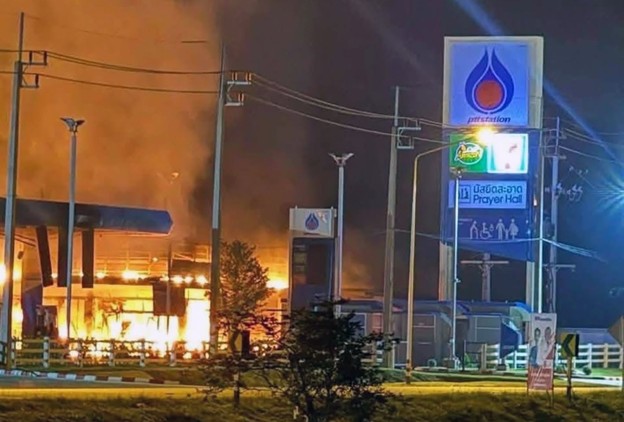
In the beginning of this year, 11 PTT petrol stations in Thailand’s southernmost border provinces came under simultaneous arson and bombing attacks in the wee hours of Sunday, 11 January 2026.
The country is currently undergoing preparations for a nationwide poll to elect local administration organisation officials.
Prime Minister Anutin Charnvirakul said the attacks might have been connected to the local elections in this region, which has a history of political violence. Success at the local level can shape national party strategies for the upcoming general election scheduled for 8 February.
But by afternoon, the National Security Council (NSC) issued a statement saying the spate of attacks had “disrupted the peaceful co-existence of people of all races and faiths in the region, and that it was a clear indication that the responsible party has no legitimacy and is not qualified to claim representation of the people of this area.”
NSC stopped short of directly blaming Barisan Revolusi Nasional Melayu Patani (BRN), the long-standing separatist movement that controls virtually all of the fighters on the ground. NSC has maintained that such violence undermined the ongoing peace process and has conveyed its concerns to BRN through the Malaysian government, the designated facilitator for the peace talks.
Official peace talks between Thailand and the Patani Malay separatist movements started in February 2013. The two sides have never moved beyond what they called “confidence-building measures”.
Divergent Visions
A leap of faith was taken at the high-level official meeting in December 2025, in Kuala Lumpur, when chief negotiators of the two sides, after nearly two years of no talks, discussed this flimsy notion of “end state”. It is a loaded term that is supposed to encapsulate how this century-old conflict should be resolved.
The previous government under Paetongtarn Shinawatra refused to engage in any official talks with BRN until the movement ceased violence on the ground. Moreover, her government insisted that BRN must send their military leaders to the table.
Technical representatives of the two sides came together from 6 to 8 January to continue with the discussion on the end state.
Thailand was not prepared to put all their cards on the table, but BRN spelt out in real terms what this notion means. For th
Obviously, the Thai representatives at the table did not have the kind of mandate to negotiate such a matter. It is way above the negotiators’ pay grade.
Demands for Autonomy
BRN went on to say that agreement on power and resource-sharing will have to be worked out between the two sides; the most disturbing clause is the right to secession. Until then, this historically contested regi
A Thai government official from
But there is no guarantee that Parliament would pass such a law, as it would be political suicide. Political and administrative powers in Thailand are extremely centralised.
Moreover, the Thai public in general is not sympathetic to the plight and grievances of the Malays of Patani.
Thailand suggested that the Southern Border Provinces Administrative Center (SBPAC), a bloated multi-agency body that focused on development – particularly pilot projects to be handed back to line ministries – could be an entry point for BRN. Needless to say, the January meeting ended badly.
The Signal
Three days later, 11 PTT petrol stations and the attached convenience stores across the region were attacked. All fingers pointed to BRN.
It is worth noting that BRN does not confirm or deny operations on the ground. BRN fighters operate on autopilot; combatants act independently of their political leaders, who intervene when they deem the fighters have violated ground rules or when coordinations are needed. Such an arrangement allows the movement’s political leaders and negotiators a plausible deniability.
Thai officials said that instead of reverting to violence to pres
They need to be certain if their model of governance is what the people want, Thai officials said.
The current wave of insurgency violence resurfaced in mid-2001 after a decade of relative calm but was not officially recognised until 4 January 2004, when scores of BRN combatants raided an army battalion and made off with about 350 pieces of military weaponry.
Civilian and soft targets, including public schools and sometimes Buddhist monks and teachers, were targeted in the early phase of this wave of insurgency until local civil society organisations and community leaders stepped up their criticisms against BRN, calling for greater respect for civility and rules of engagement.
Attacks against civilian targets have virtually disappeared but do happen once in a long while, usually as a stern warning to the Thai security forces. A case in point was the brief but dramatic spike in violence against civilian targets in May 2025, in response to the shooting death of Abdulroning Lateh, a key BRN leader from the military wing. As expected, Thai security forces denied killing Abdulroning.
While the attackers may not have been after body counts in these arson attacks, the 11 petrol stations are nevertheless civilian targets. A local political action group, The Patani, issued a statement calling on all sides to embrace humanitarian principles and to end attacks on civilian targets.
BRN sympathisers often cite economic injustices whenever private businesses come under attack. Artef Sohko, president of The Patani, said the corporate brands of these petrol stations and convenience stores may belong to PTT and 7-Eleven, but the people who suffer most from these attacks are the franchisees, not the corporations themselves. BRN said they felt the Thai side treated them as a “plaything”—throwing out some fancy words, like “end state”, but refusing to elaborate or act on it. They felt the current government resu
