search


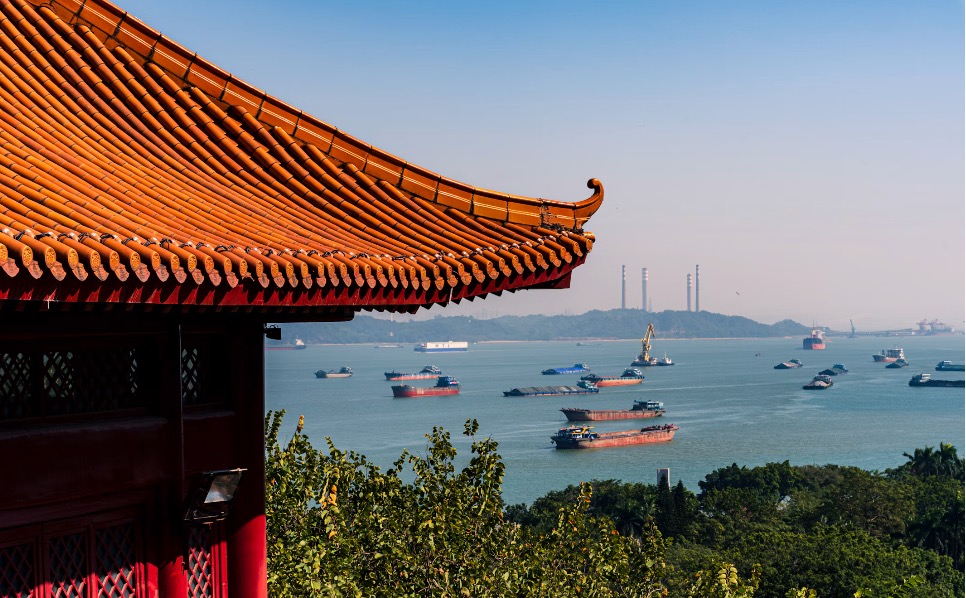
Who gets to define what "restraint" means in the South China Sea? Credit: Unsplash/Zheng Xue
The Illusion of Restraint
9 November 2026/5 Minutes of Reading
Introduction
Calls for restraint are not an option but mandatory for the peace and stability in the South China Sea, but what states should actually do to show restraint is always less clear.
This ambiguity allows coercive conduct to be presented as moderation and weakens the basis for holding states accountable for their behaviour at sea.
The distinction matters because regional stability depends on more than the absence of war. Repeated interference with fishing vessels and freedom of navigation, for example, can erode trust and make maritime access increasingly dependent on a stronger state’s tolerance. A confrontation may end without gunfire but still force a vessel to withdraw, interrupt a mission or endanger a crew.
Calling such conduct restrained can imply that it is acceptable simply because greater force was not used. For Southeast Asian states, the challenge is to prevent this narrow understanding from becoming the default measure of regional stability.
The Limits of Relative Restraint
An exchange at the 2026 18th South China Sea International Conference in Hanoi, Vietnam, illustrates the problem.
Discussing China’s conduct towards the Philippines, Professor Hu Bo of Peking University presented its use of water cannons, despite possessing much greater military and technological capabilities, as evidence of immense restraint.
China’s Ministry of Foreign Affairs used similar language in 2023, describing its coast guard’s actions as “professional, restrained and beyond reproach”.
The reasoning bears scrutiny because it makes unused capabilities the benchmark for judging actual behaviour.

Prof Hu Bo (Centre for Maritime Strategy Studies, Peking University, China) responding to an audience’s question on China’s restraints in the South China Sea during his panel session on the South China Sea Strategic Landscape: Power, Presence, and Positional Advantage. Credit: Author’s Collection
There is a valid concern behind this comparison. Choosing a less destructive instrument can reduce the likelihood of fatalities and armed escalation. Diplomacy, ideally, should encourage decisions that prevent a dangerous encounter from becoming a military confrontation.
However, this addresses only one dimension of restraint; It does not establish whether an action is justified, whether it endangers those targeted or whether it seeks to compel another party to abandon a lawful activity.
Avoiding escalation and avoiding coercion are different objectives. A state can carefully limit the intensity of an encounter while continuing to impose pressure.
Water cannons may be less destructive than gunfire, but their use can still be coercive and cause harm. They are often intended to force a vessel to change course or abandon its mission by intimidation.
A capability-based benchmark also creates an imbalance and the “restraint” illusion. The stronger an actor becomes, the wider the gap between what it does and what it could do.
Consequently, this gap can be offered as evidence of moderation, even when its conduct imposes substantial costs. Smaller states receive no equivalent reassurance from the fact that they were subjected to only a fraction of another state’s capabilities.
How Language Shapes the Dispute
For fisherfolk, what matters is whether they can work safely and earn a living. During discussions in Zambales, the Philippines, in February 2026, traditional fishers spoke of travelling further, spending more on fuel and catching fewer fish, while worrying about encounters with Chinese vessels.
Some had turned to odd jobs or construction work to supplement their declining income. For them, the absence of gunfire offers limited reassurance if they cannot safely reach their fishing grounds.
For personnel aboard government vessels, it is whether they can complete a lawful mission without injury or damage.
Knowing that the other side could have used greater force offers little reassurance when their own vessel has been damaged or forced to turn back. An encounter may end without gunfire, but those on the receiving end still bear its costs.

Calling such conduct restrained draws attention away from those costs. The state applying pressure receives credit for not doing something worse, while the disruption it has caused attracts less scrutiny.
Once that disruption becomes accepted as normal, efforts to resist it can be portrayed as provocative.
The effects also build over time. A fishing crew that repeatedly loses access to its fishing grounds may eventually stop returning. A coast guard vessel may complete one mission but face growing obstacles on the next.
None of these encounters needs to become a military clash for access to become less secure. Judging stability only by whether fighting breaks out would overlook these gradual changes and the pressure they place on those who depend on the sea.
Giving Restraint a Practical Standard
A regional foundation already exists.
The 2002 ASEAN-China Declaration on the Conduct of Parties (DOC) in the South China Sea links self-restraint to activities that complicate or escalate disputes as well as affect peace and stability. It also affirms peaceful dispute settlement and respect for international law, including the United Nations Convention on the Law of the Sea (UNCLOS).
This provides a broader starting point than simply comparing an action with a more destructive alternative.
However, the difficulty lies in turning broad commitments into standards that can be applied to contested encounters.
Parties disagree over jurisdiction, the purpose of particular missions and the sequence of events. Those disagreements cannot be resolved by repeating that everyone should exercise restraint. Nor should uncertainty become a reason to suspend scrutiny.
Assessments should distinguish verified conduct, competing legal claims and consequences for the people involved.
The target of concluding Code of Conduct (COC) negotiations by the end of 2026 gives this question particular urgency. A deadline can concentrate diplomatic attention, but agreement on a text does not necessarily establish agreement on what restraint requires in practice.
If parties can endorse the same language while continuing to justify incompatible forms of conduct, the code risks preserving the ambiguity it is meant to reduce.
For ASEAN Member States (AMS), the priority should be to secure commitments that constrain coercive behaviour, even when that behaviour stops short of armed conflict. Meeting the deadline would be a diplomatic achievement, but whether it improves conditions at sea would remain the more demanding test.
For the COC, three priorities follow. First, AMS and China should connect restraint to specific operational expectations. These should address dangerous manoeuvres, conduct that risks injury or disables vessels, and procedures for communicating during close encounters. Safety arrangements can be developed without requiring parties to abandon their positions on sovereignty.
Second, commitments need a credible process for documenting and reviewing incidents. Parties should work towards common reporting formats covering location, timing, communications, manoeuvres, injuries and damage, supported where possible by original recordings.
A designated review process should allow competing accounts to be examined and disagreements recorded. Agreement on every incident may be unattainable, but establishing an evidentiary record would make unsupported declarations of moderation harder to sustain.
Such a process will face political resistance, particularly where governments fear reputational costs or disclosure of operational information. A practical starting point would be agreed channels for preserving evidence and exchanging factual accounts, with safeguards for sensitive material.
These measures would not guarantee compliance. Their value would lie in making disputes about conduct more specific and creating a basis for corrective action, rather than allowing each encounter to disappear into competing accusations.
Third, AMS and China should assess restraint over time. Governments and maritime agencies should examine both immediate outcomes, such as injuries and vessel damage, and whether activities can continue safely over time.
Reports from crews and fishing communities can help establish these effects. Hotlines and operational dialogue are also valuable for managing immediate risks, but preventing a confrontation from escalating does not necessarily resolve the conduct that caused it. Both are necessary for lasting stability.
Conclusion
Calls for restraint will mean little to those at sea if the same pressures continue. For fishing crews and personnel aboard coast guard vessels, peace also means being able to carry out lawful activities without fear of injury or being forced to turn back.
As AMS and China work towards the COC this year, these everyday conditions should guide how they judge its success. An agreement would be a welcome step, but lasting stability depends on whether states change the behaviour that makes encounters dangerous in the first place.
The views expressed are those of the authors and do not necessarily reflect those of STRAT.O.SPHERE CONSULTING PTE LTD. This article is published under a Creative Commons Licence.
Republications minimally require: 1) credit authors and their institutions, and; 2) credit to STRAT.O.SPHERE CONSULTING PTE LTD and include a link back to either our home page or the article’s URL.