search

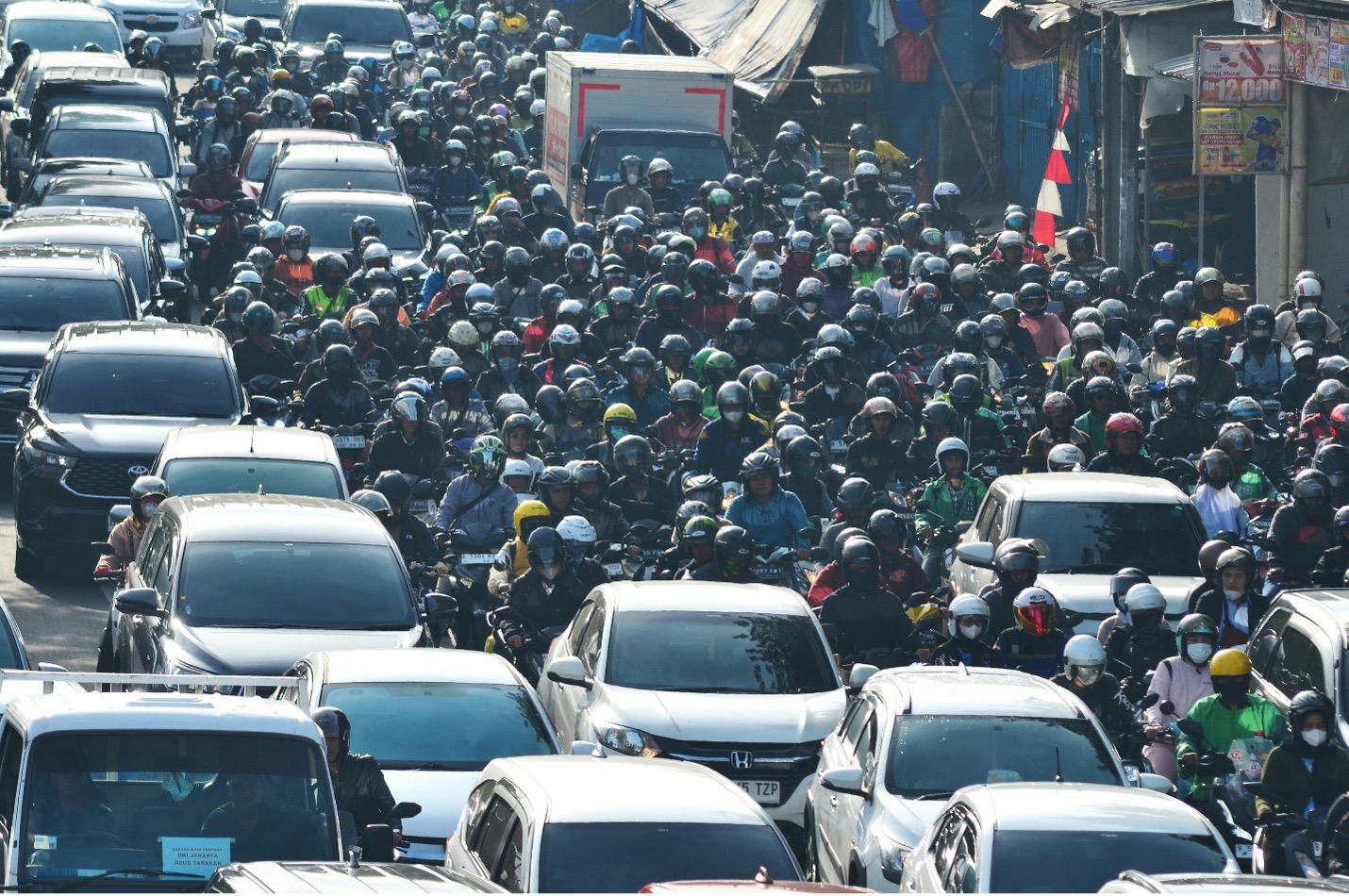
Jakarta’s road traffic on Monday, 6 January 2025, after the New Year holiday. Credit: Unsplash/Iqro Rinaldi
Highway Hierarchies: Rethinking Indonesia’s Toll Road Model
21 August 2026/6 Minutes of Reading
New Toll Roads
Indonesia announced in June 2026 that 10 new toll roads will begin operating at the end of the year, in anticipation of the Christmas-New Year’s holiday. These new lanes will add 201.12 km to the existing 3,128.3 km of toll roads throughout the country.
Minister of Public Works Dody Hanggodo announced this fresh infrastructure project, stating that “highway construction has always been strategic, not only for physical infrastructure but also to strengthen the national economic foundation.”
Indonesia’s toll road network has, by measurable indicators, strengthened the national economy. But a national economic foundation is only as strong as the breadth of its base. Whether or not Indonesia has accommodated this base is a question to be raised.
The Initial Phase
Indonesia’s highway system started with Bapak Pembangunan (Father of National Development) himself: Soeharto, the second president.
A developmentalist, he was an ardent pursuer of urbanisation. In the 1970s, Soeharto endorsed a proposal by his public works minister Sutami to build the Jagorawi Highway, which eventually became the first toll road in Indonesia.
Soeharto’s developmental philosophy is “accelerating existing wealth”. In his own words, “toll road systems are only applied to areas that have shown high development.”
This insinuates that, at its inception point, the main framework of toll road development in Indonesia was not intended for equity. Soeharto and Sutami proved to be quite a pair of trendsetters—subsequent administrations and presidents also have continued the construction of toll roads. However, this also means that roads and other infrastructure projects in Indonesia have been developed solely to boost economic growth, true to Soeharto’s vision.
This is evidenced by the inequitable construction of toll roads throughout different parts of the country. While Java enjoys greater connectivity, major islands outside Java are not yet afforded such privilege. Compared to the other four major islands in Indonesia, Java has over 1,782 km of toll roads, Sumatra 865 km, Kalimantan 97 km, Sulawesi 60 km and Papua none.
Highways for Whom?
Indonesia’s dream to achieve economic growth is still relevant today, with leaders championing the goal through rhetoric and policies alike. Despite this, such a goal may prove to be too narrow if the nation’s real socioeconomic conditions are not taken into account.
Indeed, toll roads generate real, measurable economic growth by reducing logistics costs, accelerating freight movement and connecting industrial zones to ports. However, these benefits are slanted towards specific groups that emerge as clear winners in this infrastructure. They include industry players, interchange-adjacent landowners and car-owning households.
As a matter of fact, Indonesian toll roads are exclusively reserved for four-wheeled vehicles (cars) or higher (e.g. trucks and buses), the latter of which are closely associated with logistics and transport services. In the country, car ownership remains concentrated among urban middle and upper classes. This concentration is not evenly distributed across the country either, with over half of Indonesia’s privately owned cars registered in three Javanese provinces.
This puts Indonesia in contrast with other countries like Malaysia, for example, where drivers and motorcyclists alike can access certain portions of highways but exit before they enter the toll segment.
Therefore, the infrastructure built to serve car and business owners is doubly concentrated by class and by geography.
This is despite the fact that, compared to car ownership, motorcycle ownership is much more prevalent in Indonesia (see figure 1). A suggestion has often been made, in the interest of equity, to allow motorcyclists the same access to toll roads as car users. The case has been argued and rebutted, with counterarguments often rooted in the concern over road safety (which has remained a public health challenge in Indonesia).
Often, sceptics of this proposal have ignored that the debate is not merely about allowing access to motorcyclists but about affording them the same privilege the state has granted car users. Outside toll roads, many roads in Indonesia – including provincial and arterial roads – are in poor condition, imposing an efficiency penalty on users and safety concerns. Budgets meant for repair and maintenance often experience cuts, even as construction of new toll roads continues.
Linked to that is the burden passed onto everyone – including those from lower economic classes (i.e. without access to toll roads) and individuals evicted to make way for toll roads – to pay for road maintenance and construction through taxes.
Land acquisitions for toll road construction affect many individuals. These individuals have spent generations building homes and attachment to the surrounding environment and neighbourhoods, but they are reduced to mere logistical calculations. Compensation paid to them has frequently fallen short with delayed, incomplete payments that are often calculated based on outdated market values, meaning the promised settlements do not reflect the true cost of what was taken.
Criticism over accessibility is also strengthened by the question of cost. Even among those with cars, the cost of access is not always manageable. Indonesia’s toll tariffs are among the highest in Southeast Asia, more expensive than Vietnam and Thailand despite having comparatively lower quality, creating yet another barrier for the middle class.
Figure 1. Car and motorcycle ownership across ASEAN
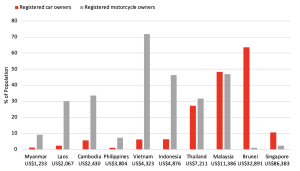
The Y-axis details the percentage of car/motorcycle-owning population, and the X-axis shows each country’s GDP in 2023. Source: World Bank and other sources.
Complicating the problem is the occasional shift in the official language which frames toll roads as an enabler of national connectivity. Framing toll roads as public connectivity infrastructure obscures the fact that they are structurally inaccessible to a large portion of the population, which, ironically, are the ones most in need of better connectivity.
This shift is most visible during peak highway usage periods, such as mudik Idul Fitri (homecoming for Eid al-Fitr) or the Christmas and New Year holiday week. The state often markets toll roads as the infrastructure that facilitates mass movement efficiently. Near every holiday season, the same ministry that builds toll roads solely for car users and business owners reframes them as public service to facilitate the mass movement of Indonesians returning to their hometowns. The imagery is national, collective and inclusive, implying that toll roads belong to everyone.
On a more granular level, even this idea of boosting economic growth seems open to challenge in the urban and rural dichotomy.
Indeed, urban areas enjoy greater access to toll roads, and thus, subsequently, trade activities are more efficient. The same cannot be said about traders in rural areas, especially in places bypassed by toll roads. With many rural dwellers engaged in agriculture or MSME, toll roads could disrupt their source of livelihood, such as through displacement (from toll road construction) or reduced number of visitors as drivers abandon arterial roads (i.e. as they prefer to access toll roads).
Consequently, affected areas see farmers lose a percentage of their output, while kiosks and restaurants that may have been operating for generations endure a decline in sales. Though new business hotspots may emerge at interchange zones and rest areas, these are dominated by national or multinational retail chains rather than local enterprises. The drivers moved and carried the economy along with them.
Rethinking Connectivity
Having considered the issues raised above, we can then mentally visualise the social hierarchy that Indonesia’s toll road model creates.
At its apex sit the businesses and logistics chains, beside which the upper and upper-middle- class groups’ car ownership translates directly into access. Below them are the lower-middle class, car owners burdened by cumulative toll tariffs or high petrol prices, or those without cars at all who are left to commute on public roads that suffer from poor condition and budget cuts. At the base, also bearing the costs while capturing the fewest benefits, are the individuals displaced from their land to make way for roads they cannot access, as well as the roadside MSME bypassed by traffic that no longer passes through.
Despite this, it is unfair to conclude that Indonesia’s toll road system has been built in bad faith. Every development policy is, at its foundation, an attempt to benefit the people.
Yet intent alone is not sufficient. Instances presented above show that toll roads have consistently favoured those who are already connected, mobile and wealthy, all while displacing and bypassing those who are not. Often framed as a vehicle for economic growth and, at times, an enabler of connectivity, Indonesian toll roads may still have a long way before they can achieve both adjectives adequately.
Tools for correction have already existed within Indonesia’s own policy architecture. Dana Desa (Village Fund) allocations demonstrate that the government can direct infrastructure investment toward underserved communities when it chooses to. Environmental assessment shows that mandatory pre-project assessment is already an established practice. An equivalent spatial equity assessment could be considered—embedding this into the approval process of future projects would not require new institutions, it would require political will to apply existing ones differently.
With 201 more kilometres of toll roads being prepared for operation by the end of 2026, Indonesia’s infrastructure planning requires a structural correction that makes equity impact assessment mandatory. Until the Indonesian infrastructure reflects the full breadth of people it claims to serve, the championed economic foundation will remain, at best, half-built.
The views expressed are those of the authors and do not necessarily reflect those of STRAT.O.SPHERE CONSULTING PTE LTD. This article is published under Creative Commons Licence.
Republications minimally require: 1) credit authors and their institutions, and; 2) credit to STRAT.O.SPHERE CONSULTING PTE LTD and include a link back to either our home page or the article’s URL.