
 search


A paradoxical scene emerges on Fridays in Makassar’s largest mosque. Credit: Unsplash/ilgmyzin
Sex and Prayer on a Friday
17 July 2026/10 Minutes of Reading
Trading, Religiously
For many Muslim men, the Friday prayer is a time for either spiritual rejuvenation, a long lunch break or simply a refreshing nap as the khatib delivers his sermon from the mosque podium.
In Makassar’s Al-Markaz Al-Islami, however, this weekly ritual instantly transforms into an uncanny experience where things that are supposedly normal look strange.
Here, the Friday prayer is not just a religious obligation but also an opportunity to traverse a space where the divine and the mundane fuse, creating a surreal experience that could be thought-provoking for keen observers but overwhelming for the uninitiated. As will be explored below, capitalism is the driving force behind this phenomenon.
First, a context: Al-Markaz is the biggest mosque in Makassar, if not in Indonesia’s east, boasting a maximum capacity of 10,000 congregants in a building spanning nearly 7,000 square metres. It is equipped with a vast courtyard that allows all sorts of outdoor activities to take place, including trade, sports and even an amusement park occasionally.
Commercial activities are rife outside the mosque proper.
On one side of the mosque, shop lots cover the entire area across the street, offering customers goods and services that range from perfume, coto Makassar (beef soup in peanut broth) to motorcycle wash. Within walking distance is one of Makassar’s famous traditional markets, Pasar Terong, always bustling with its army of buyers and traders negotiating the prices of commodities. Furthermore, in front of the mosque’s main gate is a crowded padel court that often competes with the mosque itself to attract visitors.
The mosque has essentially served as an “anchor” that invites more traffic into the area, creating a spillover effect to the surrounding MSME scene. While this positive correlation is true for the environment outside the mosque, the same is probably truer inside the mosque’s complex, giving birth to a scene that is both peculiar and interesting.
Anyone who performs Friday prayer in Al-Markaz can testify to this.
Friday Market
Every Friday, the shaded parts of this courtyard transform into a Friday market with various merchants selling all sorts of things, mirroring the situation outside the mosque’s outer wall.
I must confess that Al-Markaz’s market is a relatively new experience for me. I am, however, used to food vendors lining up the areas outside Kuala Lumpur’s Masjid Tabung Haji, Masjid Bukit Aman and Masjid Jamek Kampung Baru, among others. In fact, I was initially introduced to Al-Markaz’s Friday market because of its vast selection of local delicacies, sweet and savoury.
On my first visit, I was immediately drawn to a vendor selling coto Makassar, sop saudara (another beef soup) and – my personal favourite – pallu kaloa (spiced fish head in kluwek broth), the last of which is a dish that has sadly become a rarity in Makassar.
That a house of worship can satisfy my craving for this elusive dish is an irony that is not lost on me. Admittedly, there were times when I only went to Al-Markaz on Fridays to eat pallu kaloa afterwards, raising the question about my sincerity of performing prayer there—or why I prayed at all.
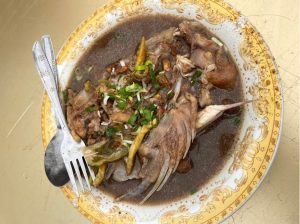
Pallu kaloa, arguably my late mother’s favourite. Credit: Author’s collection
But food stalls are far from being the main attraction of Al-Markaz’s Friday market. This transient commercial hub is populated by merchants offering a laundry list of specialised merchandise that stands in contrast with the sacred ground on which they are being sold.
Sundries
A few steps away from the pallu kaloa stall was a woman equipped with a mic and speaker selling rat poison.
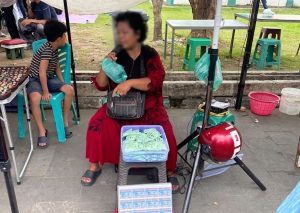
The rat poison merchant. Credit: Author’s collection—image blurred using Gemini
Hers might be a niche market, and yet the demand is certainly there. Makassar is infested with rats. One can drive around the city and easily encounter at least five dead rats on the road, highlighting the city’s struggle with hygiene and cleanliness.
She, however, directly targeted buyers with domestic rat problems, assuring potential buyers and passersby of the effectiveness of her merchandise.
Not far from her is a stall with a father and daughter demonstrating all kinds of wares, from electric fans, wrenches, electric lanterns and even guns that shoot water bullets. The little girl was showing onlookers how to hold the water guns, emphasising her dedication towards helping her father with his trade at such an early age. It was an image that was equally endearing and jarring.
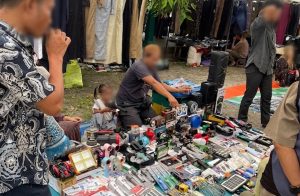
The father-and-daughter duo, with the girl toting a water gun. Credit: Author’s collection—image blurred using Gemini
If these imageries are too overwhelming, one might retreat from the mental acrobatics by browsing the clothing stalls that seem to dominate this Friday market. However, even this seems to offer only a short respite; these numerous stalls cater to a wide variety of tastes and needs, which means their merchandise does not normally sit nearby one another in a traditional department store.
Whether you are yearning for military-style parkas, knockoff sneakers, an assortment of agate rings (locals used to associate this with supernatural powers), cheap underwear or socks with rainbow markings that are easily mistaken as the pride stripes (it has one more colour than the LGBT version), the Friday market has it all. Seeing them all together in a shared space dissolves any sense of normalcy one could expect from such a market.
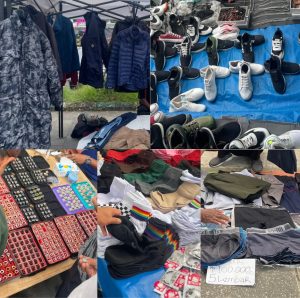
High fashion, Friday style. Credit: Author’s collection
The wide variety of wardrobes and apparel being sold demonstrates the burning vigour for trade embodied by these Makassarese merchants. In fact, the fashion articles on display are so diverse that on the day I was conducting my survey, I was reminded of the Devil Wears Prada 2 showing that I wanted to attend afterwards.
When Trade Meets Religion
This goes to show that Friday activities for Al-Markaz congregants extend beyond just the religious aspect of it. It is also an opportunity for commerce, socialising and even the time to embrace the mundane nature of our existence—a reminder that we cannot extricate the worldliness of our humanity even as we gather for a spiritual event and vice versa.
The fact that commercial activities could transform, expand or reduce (depending on how you approach it) the weekly spiritual engagement of Muslim men only emphasises the unique outcome when two seemingly antithetical forces collide.
One extreme example perhaps exemplifies this best.
Men’s underwear, water-bullet guns and rat poison are indeed curious items on sale on the mosque compound, but the most enigmatic products being offered are men’s vitality supplements and performance-enhancing aphrodisiacs.
These are sold in the form of herbal tonics or coffee packets, presented with suggestive names (e.g. Kuda Mesir/Egyptian Horse, Kopi Harimau/Tiger Coffee and Kopi Jantan/Virile Coffee) and come with even more suggestive packaging, often sexual.
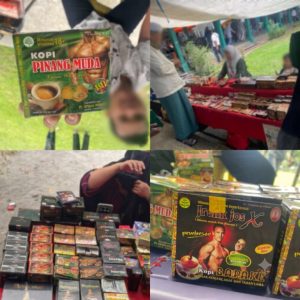
Traders selling supplements and aphrodisiacs openly on the mosque complex. Credit: Author’s collection—image blurred using Gemini
I noted multiple stalls engaging in the same trade, but what struck me the most was the people operating these stalls.
A plain-looking stall was manned by two men; they present no apparent psychological barrier to potential buyers, who are obviously also men. Another, however, was occupied by a lady and a boy no older than 12—the lady was attending to its sole customer, an elderly man that looked to be in his 60s.
Across from them was a stall handled by a lady clad in a burqa, proudly showing her wide array of herbal aphrodisiacs with packages that showed muscular men and beautiful women. Still another stall was staffed by two ladies in hijab, complete with an information board that described the physical and psychological benefits of their Malaysian brand in an implicit language.
This is the pinnacle of mind-bending experience that emerges when capitalism and religious rituals intersect. It is an uncanny experience, a strange phenomenon that is only found in the grounded reality of human lives, not in the ideals espoused by academic textbooks, religious tomes or sermons.
Seeing love potions and stimulants openly sold to congregants – who came to pray – gave me a strange sensation that I had not experienced elsewhere. Observing who sold them – and who bought them – instigated a sense of curiosity as to what transpired in their minds, the psychological barrier they might or might not encounter, and their use of language to navigate around the sensitive topic.
Patronising the Friday market at Al-Markaz is thus akin to stepping into an extradimensional region, where normal becomes strange, and convention turns into exception. Praying there on Fridays has become a cognitive dissonance.
Observations
But, in calling this a strange phenomenon, am I ascribing judgement to the entire situation?
This is the first point of observation that I drew. Due to the tradition of conservative Islam in Indonesia, it is natural for anyone to react more defensively and in reproach to the Friday market in Al-Markaz.
While commercial activities during Friday prayers are common, the peculiarity of some merchandise sold in Al-Markaz could easily dismay anyone influenced by conservatism. After all, the aphrodisiacs and supplements are sexual in nature; the military parkas and water guns invoke an image of violence; the rat poison is essentially a death instrument, and; attributing supernatural effects to agate rings is a form of idolatry.
An open debate that considers the socioeconomic as well as fiqh aspects of this phenomenon will be an interesting discourse. Alas, the combined effects of contracting democratic space and ingrained conservatism in Indonesia might discourage such a conversation from taking place.
This does not eliminate the fact that these items are sold openly on Al-Markaz’s courtyard. Herein lies the contradiction: conservative Islam might still be prevalent in Indonesia, but evidence from the Friday market suggests there are pockets of resistance against this perception of conservatism.
Onlookers might frown when their eyes land on these items, but if they have any reservations, they keep it to themselves. The merchants, on the other hand, might also hail from a conservative background, but financial imperatives might have forced them to engage in economic behaviour that is outside the purview of conservatism.
The consequence is what I have labelled as evidence against the narrative that Muslims are a monolithic entity. As I have argued in another Prophe-SEA piece, for far too long, Western-oriented perspective has painted Muslims as a one-dimensional community. The Friday market easily breaks that illusion: the interaction between capitalism and religious imperatives has created a whole new phenomenon that lies outside our traditional conception of Muslims.
Former British prime minister John Major once said, “We must condemn a little more, and understand a little less,” in response to an extreme criminal case in 1993. In today’s world, social media has propelled such an attitude to the forefront, encouraging individuals to criticise and belittle a situation in front of them without trying to comprehend the bigger picture.
However, our reaction to the Friday market should be the total opposite. This is the second observation I would like to draw, in the form of questions: why does this happen in the first place? Why do merchants sell items that feel out of place on a religious complex?
We should not dismiss the economics of it all. The fact that the Friday market remains exuberant today – with multiple merchants competing by selling the same products – suggests that there is a sustained demand for the merchandise in the first place. These products are also affordable, indicating they are catered to middle- and lower-class markets. If a research study were commissioned to investigate this phenomenon further, the economic class of the buyers would be an interesting factor to analyse.
Gender plays a role too. The Friday market beats with its masculine energy—thousands of male Muslims attend the Friday prayer and become the target customers afterwards. Hence, the merchandise on sale must match with the demography of these customers as well if the traders hope to make profit—from articles of clothing and accessories that invoke power to potions that make men feel more manly. In the aforementioned proposed study, perhaps it could explore the dynamics of single-gender market and its consequences.
Furthermore, the tension between vendors and the authorities is also noteworthy. Merchants – especially street vendors – often operate under challenging circumstances, constantly pressured between meeting daily targets and navigating Indonesia’s labyrinthine regulations. Many have had to face evictions or been subjected to physical violence when they are deemed to have conducted trade outside the bounds government’s regulations.
This is not to cast aspersion solely on the part of the authorities—merchants who trade illegally do impose inconveniences to the wider public, such as access to the city’s utility and infrastructure, or cause harm outright. The government, for instance, has previously stated that some vitality supplements and aphrodisiacs, akin to the ones sold at Al-Markaz, are dangerous to health. Under the looming gaze of the authorities, perhaps the merchants in Al-Markaz have come to regard their weekly affair as a safe haven from the government’s scrutiny.
Conclusion
Thousands of congregants pray on Fridays in Al-Markaz weekly, but in performing their religious obligation, they stimulate a capitalist engine that paved the way to the Friday market in the mosque’s courtyard. I have used the following saying to describe it to others: “from the parking lot, you turn right to enter the mosque, and you turn left to enter the market.”
The uncanny experience mentioned above is the product of this interaction between capitalism and religious activity. Friday markets are a common phenomenon elsewhere, but the merchandise sold in Al-Markaz has transformed this sense of familiarity into a strange encounter.
As a former street vendor that used to operate a stall on one of Makassar’s Car Free Day (CFD) spots, I understand the thrill – and dread – of trying to sell goods to passersby. People frown and stare when the merchandise is not to their taste, but if they approach and buy the goods, the seller will feel validated and immense relief.
The vendors in Al-Markaz are humans too, and economic circumstances – or lack of opportunities – might have forced them to resort to selling goods that some of us may find peculiar. The correct reaction is to confer them compassion, appreciate their effort at making money in the halal way and understand why they engage in these trades in the first place.
The views expressed are those of the authors and do not necessarily reflect those of STRAT.O.SPHERE CONSULTING PTE LTD.
Latest Articles
-
Horse-Trading, Yet Again
· September 14, 2026
-

Scholars: Sacred Politics and Religious Narratives in International Relations
· September 12, 2026
-

PeaceTech AI Lab: Initiative for AI and Peacebuilding
· September 12, 2026
-
Costing, Continuity and Outcomes: Malaysia’s New Youth Policy
· September 04, 2026