search

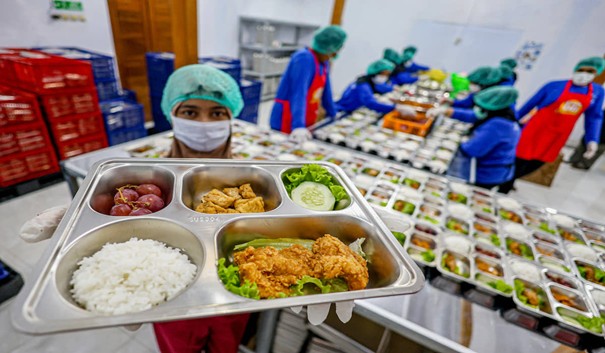
Prabowo’s signature policy—Makan Bergizi Gratis (Free Nutritious Meal). Credit: Antara
Political Championship: Indonesia’s New Power Play
January 30, 2026 / 9 minutes of reading
Introduction
Signature policies by Indonesian presidents – whether they are major infrastructure projects or socioeconomic programmes – always carry deeper political nuances than those that meet our eyes.
Dr Yuan Wang’s book The Railpolitik: Leadership and Agency in Sino-African Infrastructure Development examines why large Chinese-financed railway projects in African countries produce divergent political and economic outcomes, despite appearing similar in financing models, technology, and external partners.
She advances a leader-centred theory of political agency to explain these different outcomes, challenging dominant views that emphasise China’s strategic interests or African institutional weakness. Her concept of “political championship” maintains that the success or failure of infrastructure projects depends largely on whether national leaders actively champion them.
Political champions invest personal authority, manage bureaucratic coordination, negotiate with Chinese actors and sustain support across electoral cycles. Where such leadership is absent or inconsistent, projects face cost overruns, delays, weak integration into national development strategies or long-term underperformance.
Beyond railways, Wang situates infrastructure as a political process rather than a purely technical or financial one, shaped by domestic power struggles, leadership priorities and state-society relations.
The question is this: what happens when we apply this theoretical framework to Indonesia’s own Jakarta-Bandung high-speed rail (HSR) Whoosh, a major infrastructure project initiated by former president Joko “Jokowi” Widodo?
Valuable Lessons
In Wang’s framework, a political champion is a national leader who personally commits political capital, intervenes to overcome bureaucratic resistance, aligns domestic institutions and sustains support for an infrastructure project despite controversy or risk.
Jokowi’s approach to Whoosh fit this pattern in several major ways.
First, Jokowi made infrastructure the signature agenda of his presidency and personally endorsed Whoosh as a symbol of Indonesia’s modernisation. He overruled internal scepticism within ministries and state-owned enterprises (SOEs), fast-tracked permits and repeatedly reaffirmed the project even as its cost inflated and timelines slipped.
Second, Jokowi intervened directly to manage coordination problems among SOEs, local governments and Chinese partners. When financing difficulties emerged, particularly after the project departed from its original “no state budget” promise, he authorised policy adjustments and state guarantees to keep the project alive, a classic act of political championship to prevent project collapse.
Third, like Kenya in The Railpolitik, Jokowi’s championship was shaped by political incentives. The Whoosh project functioned as a legacy project (much like the relocation of the national capital to Ibu Kota Nusantara [Nusantara Capital City – IKN], the country’s megaproject of unprecedented level), intended to demonstrate delivery capacity and technological advancement before the end of his second term. This helps explain why support persisted despite public criticism over debt, land acquisition and cost overruns.
Ongoing discussion about extending the Whoosh line to Surabaya has gained traction under the current administration, with the government conducting feasibility studies and promoting the project. The state railway operator has also taken a cue from a presidential directive that modern railway infrastructure should not be stopped and that expansion should proceed, underscoring top executive involvement in steering the project’s trajectory rather than leaving it purely to technical planning bodies.
This reflects continued high-level commitment to a major strategic project beyond its original scope, a hallmark of political championship where leaders persistently push forward ambitious infrastructure agendas.
However, the Whoosh case also exposes the limits of political championship. Despite its successful launch, the project’s weak feasibility studies, pessimistic ridership projections and opaque decision-making reduced long-term economic clarity.
These also echo Wang’s warning that political championship prioritises project delivery over sustainability. Political champions often have to navigate non-technical areas to sustain legitimacy and momentum, especially when expansion threatens communities or sensitive ecosystems.
Thus, there is a growing need for robust environmental and social safeguards should the extension line to Surabaya proceed, as the project’s success increasingly depends on how well the sitting president addresses broader public and ecological impacts.
For now, President Prabowo Subianto appears to be practicing the political championship concept in the realm of infrastructure. Early in his administration, he inaugurated dozens of electricity projects, signalling a leadership push on critical infrastructure to underpin national growth. He also inaugurated the upgrade of the Balikpapan oil refinery, a multibillion-dollar project aimed at boosting refining capacity and reducing imports, demonstrating the president’s direct backing of a flagship energy infrastructure programme.
Recently, Prabowo has also reaffirmed a strong commitment to the IKN project, allocating US$32 billion to ensure the continuity of the project’s key phases, such as legislative and judicial buildings. His first official visit to the IKN site signalled this project’s symbolic and strategic importance, and such sustained executive endorsement in the face of budget constraints shows active leader intervention beyond bureaucratic momentum.
But how about his “true” flagship programmes, such as Makan Bergizi Gratis (Free Nutritious Meal – MBG) and Koperasi Desa Merah Putih (Red and White Village Cooperative – KDMP)?
Another Type of Championship
Arguably, the MBG programme is alsoshaped by the concept of political championship, though it represents a different type of championship from the infrastructure-heavy cases discussed in The Railpolitik. Juxtaposing it against Wang’s framework, the programme clearly reflects leader-driven political agency in several respects.
First, MBG is unmistakably Prabowo’s signature policy. He elevated it from a campaign promise into a core governing priority immediately upon taking office, framing it as central to national resilience, human capital development and long-term competitiveness. This mirrors political championship’s defining feature: a leader who personally defines the project as politically and symbolically essential, rather than delegating it to technocrats.
Second, the programme has faced sustained criticism over fiscal cost, implementation capacity, and opportunity cost, yet Prabowo has consistently defended it and pushed for rapid rollout. Such persistence aligns strongly with political championship, where leaders override scepticism and accept political risk to keep a priority project alive.
Third, the programme requires coordination across ministries (education, health, social affairs and finance), subnational governments, and suppliers. Prabowo’s decision to create special task forces and fast-track budget reallocations shows active executive intervention to align the state apparatus, another hallmark of political championship.
Lastly, as with Jokowi’s Whoosh, the MBG programme is closely tied to political incentives. It delivers visible, immediate benefits to households and children, reinforcing political legitimacy while also serving as a long-term legacy project aimed at shaping Indonesia’s future workforce.
Where MBG diverges from Wang’s original framework is that it is not a single, discrete infrastructure project but a recurrent, nationwide social programme. This raises a critical issue Wang also hints at: that the concept of political championship is effective at launching and scaling initiatives, but sustainability ultimately depends on robust institutions, strong fiscal discipline, and effective policy monitoring.
Conversely, KDMP is a stronger example of Prabowo’s policy that reflects the concept of political championship in the socioeconomicdomain. There are arguably several reasons for that.
First, Prabowo has attached his personal authority and agenda directly to this programme. He initiated the policy through a presidential instruction to rapidly establish cooperatives in 80,000 villages across Indonesia. This shows executive prioritisation well beyond normal bureaucratic processes.
The cooperatives are part of Prabowo’s broader Asta Cita national agenda, especially the rural development and poverty alleviation pillar, demonstrating that KDMP is not an outlier programme but a core strategic initiative of his administration.
Second, the programme involves multiple ministries, state agencies, subnational governments and even regional-owned enterprises (e.g. logistics and distribution support), with the president actively coordinating implementation. This kind of inter-institutional mobilisation is a key aspect of political championship, where a leader aligns the state apparatus to achieve an ambitious national priority.
Third, the programme is pitched as a transformative economic empowerment tool – from controlling supply chains to stabilising prices and absorbing agricultural products – and is tied to the narrative of inclusive prosperity and rural upliftment. That gives it not just a technical economic role but political and ideological significance for Prabowo’s leadership narrative, similar to how Chinese-funded railways in The Railpolitik serve broader symbolic and political functions.
In the end, the mass launch events, large numerical targets (tens of thousands of cooperatives), and prominent presidential involvement create visibility and public awareness akin to flagship infrastructure projects championed by leaders in Africa with high political agency.
In line with Wang’s logic, political championship can apply to any large, politically salient state initiative where sustained high-level leadership shapes outcomes. MBG and KDMP fit this criterion, even if they are not infrastructure projects.
Budget 2026: Shielding the Policies
Unlike previous year’s state budget, which Prabowo inherited from his predecessor, this year’s is the first one truly crafted and defended by his administration. This means the government’s resource allocation is a direct reflection of his priorities and political will, a key signature of political championship where leaders use budgeting not just as technical planning but as a strategic tool to realise their agenda.
The budget signals selective expansionary intervention that protects flagship programmes (e.g. MBG, KDMP, Sekolah Rakyat as well as food and energy estates) despite tight fiscal constraints. Should cuts occur, these initiatives are politically shielded because they are central to the president’s narrative and objectives. That is exactly what political championship entails: leadership proactively defending core projects against competing budgetary pressures.
These flagship policies have visible social impacts (children’s nutrition, cooperative empowerment, schooling in underdeveloped areas as well as food and energy resilience). They also carry symbolic value, cast as state commitments to public welfare and national strength. Furthermore, they mirror how African leaders in The Railpolitik frame infrastructure projects not as narrow technical endeavours but as national development symbols that warrant continuous top-level advocacy and coordination.
The continued prioritisation of flagship programmes reveals a political calculus as well: protecting signature policies to maintain legitimacy and fulfil core campaign promises, while asking other sectors to adapt. This reflects political championship’s blend of strategic commitment and risk management.
These patterns show that, much like the expansive railway infrastructure under Jokowi, Prabowo’s leadership exhibits agency that shapes both policy direction and political narratives, anchoring national development in a set of centrally championed programmes.
Taken together, Indonesia’s recent policy trajectory suggests that political championship has become a defining feature of executive governance across administrations.
Under Jokowi, it enabled the realisation of ambitious infrastructure projects such as Whoosh, albeit with notable trade-offs in sustainability and transparency.
Under Prabowo, the same logic is being extended beyond infrastructure into broader socio-economic ecosystems – ranging from MBG to KDMP – and reinforced through deliberate budgetary protection.
As Wang cautions, political championship is powerful in mobilising state capacity and delivering visible outcomes. However, its long-term success will ultimately hinge on effective institutionalisation, sound fiscal discipline and comprehensive policy learning that extends beyond individual leadership.
The views expressed are those of the authors and do not necessarily reflect those of STRAT.O.SPHERE CONSULTING PTE LTD.
This article is published under a Creative Commons Licence. Republications minimally require 1) credit authors and their institutions, and 2) credit to STRAT.O.SPHERE CONSULTING PTE LTD and include a link back to either our home page or the article URL.