Prelude
People often see the Baduy as an indigenous tribe left behind in modern life, yet their daily practices reveal how far ahead they truly are.
While urbanites are struggling to implement the Sustainable Development Goals (SDGs) in their daily lives, the Baduy have led a truly sustainable way of living in nature.
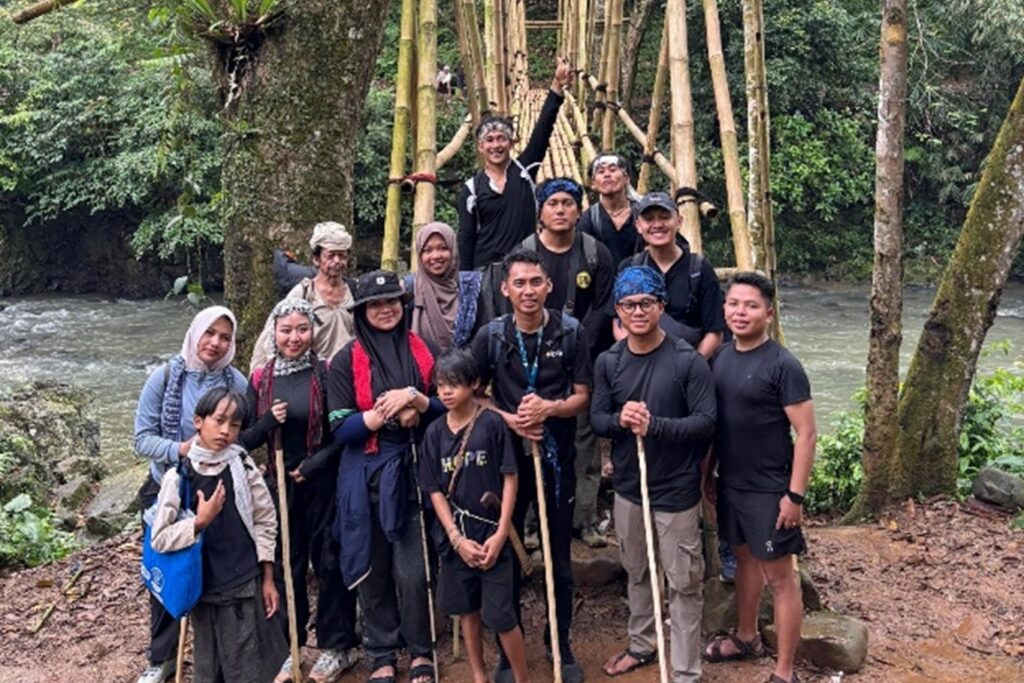
This is a reflection that came to me during a visit to Cibeo, a village of Badui Dalam (Inner Baduy) in Kanekes, Lebak, Banten, on 4 October 2025. Safri – a member of the Baduy community – welcomed us upon our arrival at the entrance to Kanekes. We walked about 7.5 kilometres within five hours to reach Cibeo.
Upon arrival, when we wanted to take a shower, Safri suggested that we bathe and wash in the river behind the house. For women, there is a special pond in the middle of the forest, enclosed by wooden walls for privac
“We are forbidden from using chemical products by our customary law to protect the environment,” Safri explained while showing me the pond.
This means all chemical-based cleaning products – such as soap, detergent, shampoo and toothpaste – are forbidden here because these are polluting the environment. To as
The extent of their distaste towards anything polluting can be witnessed from the sky atop the village. While cities are lit by streetlamps and skyscrapers, Cibeo is illuminated by the Milky Way that is visible in its clear sky. Even the Baduy’s air and sky are clean.
The Baduy and the SDGs
The Baduy’s prohibition of chemical products has led me to explore how their practices are closely aligned with the SDGs, the attainment of which is still elusive for many countries, including Indonesia.
Out of the 167 countries that have committed to the SDGs, Indonesia ranks 78th in terms of achievements of these goals; this means there is still a long way to go for the country to fulfil all the SDGs by 2030.
Sadly, according to the 2024 SDGs Report, indicators for SDGs 11 (“Make cities and human settlements inclusive, safe, resilient and sustainable”) and 15 (“Life on Land”) are off track, not only in Indonesia but almost everywhere in the world. The report concludes that it would be nearly impossible to achieve the goals by 2030.
These setbacks stem from ongoing issues such as deforestation, land degradation a
To me, these problems are difficult to solve in urban settings. Even when regulations exist, actions often contradict them. There are many reasons for this: urban areas tend to pursue economic growth without balancing it with environmental capacity, land-use limits and proper monitoring.
In contrast, in the Baduy village, we can see how their life and nature ar
One of the Baduy uttered something remarkable: “Gunung teu meunang dilebur, lebak teu meunang diruksak.” (Mountains must never be destroyed, and rivers must always be kept clean.)
Their high respect towards nature demonstrates that the Baduy have exceeded other people, especially the urbanites, in the attainment of the SDGs. Pikukuh Karuhun, which guides their way of life, is only orally transmitted through generations, but this has facilitated their success in achieving a balanced and sustainable way of life.
Their community is inclusive, safe and sustainable. Conflicts among the Baduy are rare. Their houses may be made from bamboo, but they stand strong. There are no cases of thievery, as everyone strictly obeys Pikukuh Sapuluh or Dasa Sila, the 10 prohibitions in life. Among these are moal mibanda pangaboga nu lian (not taking other people’s property) and moal linyok moal bohong (not denying and not lying).
The Baduy also protect the forests in line with the SDGs. While global efforts to protect terrestrial and biodiversity areas tend to stagnate, deforestation in the Baduy territory is strictly prohibited by customary law. Their economic activities are always balanced with environmental sustainability.
This is demonstrated by the fact that no one can clear their forest to build settlements or farmland without permission. Even when a piece of land is cultivated, only a quarter of the land may be used to maintain soil fertility.
When opening farmland, they must follow customary rules in terms of where and how. They are forbidden to use any chemical fertilisers, and obligations such as this must be upheld until the harvest season.
Furthermore, the Baduy also have their own version of leweung titipan (forbidden forest) that is considered sacred and that no one, including themselves, is allowed to enter.
The Baduy are also not dependent on fossil fuel, as they avoid using vehicles, relying solely on walking (barefoot) across villages, hills, rivers and mountains. They refuse to take public transportation even when travelling to distant places. Safri himself shared that he had walked to Jakarta 42 times—always barefoot, never wearing sandals.
The Baduy are embodying the spirit of the SDGs without having to understand the technical jargon and lofty aspirations that the concept engenders. As an indigenous tribe, Badui Dalam hold tightly to principles of their customary law, a violation of which is considered a serious matter. Although it is expressed in spiritual terms, Pikukuh Karuhun is what has led to the Baduy’s success in preserving their ecosystem.
Spirit of Laws
For the Baduy, Pikukuh Karuhunis not merely about a set of rules; it constitutes the core of their spiritual and social identities. It governs how they live, work and interact with humans, the earth, and spiritual powers. By following it, the Baduy believe they will be protected by Batara Tunggal, the supreme power in their belief system.
A violation of the law earns the offender a reprimand by the Puun (village leader) in a traditional ceremony. In a worst-case scenario, an offender may be expelled from the village. Safri, for example, has received two warnings for planting galangal, which is considered a violation of the use of land.
Despite this, it is important to note that the Baduy are still subjects of Indonesia’s legal framework, and as such, they are entitled to citizenship and the right to vote. However, they also have an autonomy to self-govern, as specified in Law No 6/2014 on Villages.
As outsiders, some of us may wonder why they choose to live under such a strict customary law. When asked, they simply said that these rules allow them to live peacefully and in harmony. They also considered being a part of Badui Dalam an honour.
“I’m proud to be a Badui Dalam. I never want to be expelled from this village,” Safri said.
What’s Next?
All of the above serve as clear evidence that the local wisdom upheld by the Baduy genuinely protects the environment. They respect the trees, rivers and forests as integral parts of life itself.
Translating such wisdom into urban and rural contexts is crucial, even if it cannot be replicated in the same form. We can start with small actionable steps such as using public transportation, reducing waste, choosing eco-friendly products, and saving electricity and water.
As per the Baduy’s wisdom, every aspect of life must be balanced with environmental imperatives. This means that housing development plans in urban areas must consider ecological impact, and industries must adopt sustainable management of resources and waste, among others.
In the context of SDGs 11 and 15, the Baduy remind us that policies alone mean nothing without
Conclusion
The Baduy is more than a tribe; it is a complex community with a vast culture that adopts a green ecosystem and upholds solidarity. They teach us what it truly means to live in harmony with nature, balancing simplicity, morality and sustainability. Their way of life reminds us that the future of environmental protection does not solely lie in technology or policy but in the wisdom of communities that have never forgotten how to live while revering nature.