
Pragmatic
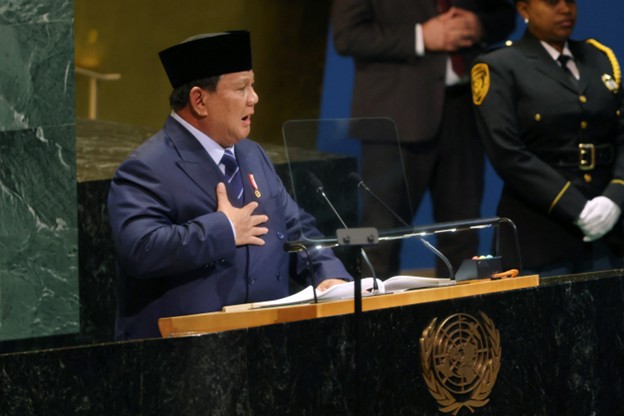
President Prabowo Subianto’s first year in office has tested the limits of Indonesia’s diplomatic reach, despite questions about its coherence.
The country’s foreign policy now operates in an international environment more volatile than any since the 1997 Asian Financial Crisis. Great-power rivalries have intensified, the regional order has become increasingly fragmented, and middle powers have struggled to assert their agency.
Indonesia has answered this uncertainty not with a clear doctrine but with pragmatic activism that seeks advantage wherever it can be found. The question is whether this opportunism represents adaptation or drift.
Jakarta’s conduct during Prabowo’s first year shows a steady replacement of long-standing principles with transactional reasoning. The government has entered forums that once stood at the opposite poles of world politics.
By joining BRICS while simultaneously applying for an OECD membership, Indonesia has signalled a preference for participation over persuasion. Each move delivers tactical flexibility. Nevertheless, the sum of these engagements reveals an absence of hierarchy among goals.
From Participating to Positioning
In other words, diplomacy has become a quest for position rather than a pursuit of purpose.
This shift is clear in how Indonesia manages its great power relations. Prabowo’s decision to make China his first foreign trip destination after inauguration was not merely about timing but also signalling a degree of dependence. Beijing’s role as Indonesia’s main investor and trading partner now threatens ASEAN centrality, as growing economic reliance narrows Jakarta’s capacity to lead the regional agenda and steers diplomacy away from regional cooperation.
Engagement with Washington continues but is increasingly commercial, centred on defence procurement and tariff talks rather than strategic dialogue. The United States remains a partner of necessity – not of vision – as cooperation serves sh
Between the two giants, Prabowo has pursued tactical balance without strategic design.
What Indonesia practices today could be described as selective alignment. The government builds ties issue by issue, shifting partners according to material interest.
In defence, Jakarta turns to France for prestige procurement. In infrastructure, it looks to China for capital. In multilateral arenas, it speaks of inclusivity but rarely articulates what that means.
This pattern may signify that we have entered the era of multipolar bargaining, yet it departs from Indonesia’s earlier identity as a middle power that mediated rather than traded. The moral authority once derived from non-alignment has shifted into cautious neutrality.
The Erosion of Regional Leadership
This pragmatic turn has had the most severe impact on regional diplomacy.
ASEAN, once the anchor of Indonesia’s international posture, now functions mainly as a ceremonial reference point. Prabowo’s government participates fully but rarely takes the lead.
Plans for the region’s Myanmar conundrum, the South China Sea and economic integration have proceeded without Indonesian initiative. Even during its ASEAN chairmanship, Jakarta’s diplomacy on Myanmar produced little movement beyond procedural engagement, despite the lauded initiative to introduce the Five-Point Consensus and extensive consultations.
Enduring commitment to the Consensus should not be mistaken for progressive steps in this subject, and, as a result, ASEAN’s and Indonesia’s credibilities take a hit. The perceived decline in ASEAN centrality is not the resul
Leadership has been replaced by attendance, and consensus by convenience. Indonesia’s neighbours quietly observe this absence, adjusting by pursuing their own hedging strategies rather than waiting for Jakarta to set direction. The idea of Indonesia as a first among equals has quietly dissolved into the background noise of regional diplomacy—a reality underlined by calls for Jakarta to reclaim the leadership it once embodied within ASEAN.
Indonesia’s approach to global crises follows the same logic. The president’s appearance at the Gaza peace conference was intended to be diplomatically safe; however, questions have arisen about whether his statement carries substance.
His call for balance between Palestinian independence and Israeli security echoed international platitudes rather than Indonesia’s traditional support for justice and decolonisation. The phrasing implies a false symmetry between occupier and occupied, weakening Indonesia’s commitment to anti-colonial solidarity. At home, it unsettled parts of the public who see any reference to “Israeli security” as a break from Indonesia’s historic support for Palestine and the moral idiom of the Global South.
It also confirmed that Jakarta now values acceptability over advocacy. While middle powers such as Brazil, Turkey and South Africa redefine their roles through moral entrepreneurship – mediating conflicts, advocating reform of global governance and pursuing justice in Gaza – Indonesia has chosen silence. The country that once shaped the moral vocabulary of the Global South now sounds unsure of its convictions, losing credibility among emerging powers and letting others set the normative agenda. This hesitation limits Jakarta’s capacity to shape norms, weakens its leverage in multilateral arenas and erodes its claim to post-colonial agency.
Centralisation without Coherence
Behind these choices lies a deeper structural change. The foreign ministry, once the guardian of professional diplomacy, has been overshadowed by the very president. Policy direction now flows from the palace, where a small inner circle of advisers shapes decisions. The absence of a full-time, autonomous foreign minister has weakened coherence across portfo
This centralisation has already shown its costs, from inconsistent messaging between the palace and the foreign ministry over Indonesia’s stance on Gaza to overlapping presidential announcements on defence partnerships that left diplomats struggling to maintain policy clarity.
With Prabowo at its helm, Indonesia’s external behaviour reflects individual preferences more than institutional planning. In this sense, Prabowo’s foreign policy is not incoherent by accident but by design. It concentrates authority in one office and measures success through visibility rather than results.
To its supporters, this concentration represents efficiency. They argue that Indonesia must move quickly in a competitive region and that a strong presidency ensures unity of voice.
However, unity without deliberation produces fragility. When diplomacy becomes an extension of personal command, it loses continuity. Partners find it difficult to read Jakarta’s intentions because they depend on the president’s shifting calculus rather than on stable commitments. Influence that relies on charisma tends to fade when attention shifts elsewhere.
International confidence is cumulative, not theatrical. It grows through predictability, not surprise.
Strategic transactionalism, the hallmark of Prabowo’s first year, has advantages in a fragmented order. It enables Indonesia to navigate rivalries, attract investment and maintain flexibility, but it also carries two long-term costs.
The first is conceptual. By reducing foreign policy to bargaining, Indonesia abandons the intellectual framework that once gave its diplomacy coherence. Without a guiding set of ideas, future governments risk drifting from one tactical alignment to another, eroding predictability and weakening the country’s credibility as a strategic partner.
The second is reputational. When every engagement is treated as a transaction, others respond in kind, and subsequently, trust erodes. Indonesia risks being seen as a country that is always available but rarely reliable. Over time, this perception will make partners reluctant to invest political or economic capital in deeper cooperation. It also undermines Jakarta’s ability to lead or broker consensus in regional affairs, where credibility depends as much on consistency as on capability.
The irony is that this instrumentalism emerges just as Indonesia’s objective weight appears to be increasing. Its economy continues to expand, and its diplomatic reach has widened through new memberships and partnerships. Yet, these gains remain shallow, constrained by limited institutional capacity and a lack of strategic coherence.
Material power alone does not translate into influence without an anchoring narrative. For decades, Indonesia’s global relevance came from its ability to turn its limitations into a philosophy of conduct. The language of moderation, dialogue and respect for sovereignty made it a moral middle power. Today, that narrative has thinned. Jakarta’s speeches sound fluent but empty, full of participation but short on authorship.
Conclusion
Foreign leaders and observers often describe Prabowo’s diplomacy as restless or hyperactive, but the more accurate word may be absorptive. Indonesia is absorbing the logic of other powers rather than articulating its own distinct perspective. Its leaders invoke independence yet mimic the transactionalism they claim to balance. The longer this continues, the more Indonesia’s foreign policy risks resembling a mirror rather than a compass.
In its second year, the government must decide whether to remain a flexible participant or recover its identity as a strategic actor. A coherent policy can still be pragmatic if it has clear priorities such as defence modernisation that supports regional stability, partnerships that reduce dependency and engagement that protects equality and restraint. These aims require discipline to prevent pragmatism from drifting.
Indonesia’s strength lies in its ability to bridge divided powers. To reclaim that role, Prabowo must restore institutional authority and return diplomacy to a process rather than a personality-driven approach. Continuity beyond electoral cycles will make foreign policy durable and presidential strength more credible.
One year on, Prabowo has shown that Indonesia can move quickly in every direction but not yet that it knows where it is going. The past year, indeed, brought visibility and applause, but there will be expectations for Prabowo henceforth to insert substance into his calls, petitions and speeches. A diplomacy built on transactions may endure turbulence but will not shape it. Indonesia must move from flexibility to authorship or risk remaining active yet weightless, present in every room yet absent from every decision. The test for Prabowo’s next years is not whether Indonesia can be everywhere, but whether it can be consequential anywhere.
