search

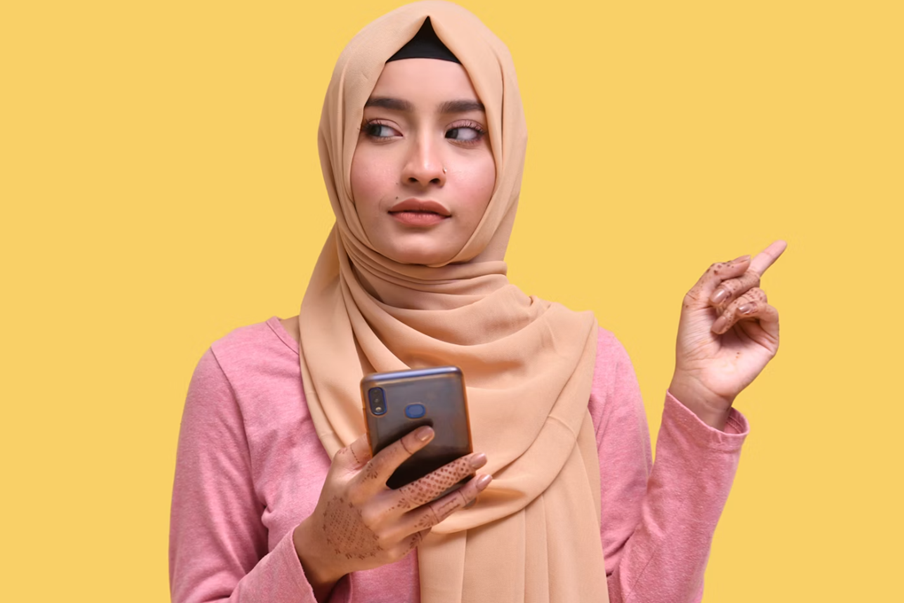
Young women in Canada and Malaysia are susceptible to far-right narratives spreading online. Credit: Fotos/Unsplash
Echo Chambers, Algorithms and Young Women
- August 22, 2025
- 7 minutes of reading
Introduction
Around the world, far-right groups have found social media to be a surprisingly effective hangout spot, and no less so in Canada and Malaysia.
Among the challenges emanating from it is this: young women in both counties are being nudged, sometimes subtly and sometimes more obviously, into digital spaces where divisive or conservative messages circulate freely.
From TikTok reels to Instagram posts and threads on X, these platforms are fertile ground for building identity, sparking discontent and, sometimes, swaying political feeling.
Imagine scrolling through TikTok and YouTube only to be bombarded by content that speaks about identity, tradition or “what’s wrong with the youth of today”.
This is not accidental: across both Canada and Malaysia, far-right or conservative narratives are carefully tailored to tap into identity-based insecurities. At first, it is harmless enough; users watch a few videos about culture, lifestyle or relationships.
Soon, though, the tone shifts. Posts start to hint at feminism as being “out of control” or that traditional values are being “eroded”. Maybe a meme comes up about protecting the nation, or a short video that romanticises a stricter moral code.
This comparative look digs into how these dynamics play out differently or similarly in Canada and Malaysia.
Table 1. Canada and Malaysia: Quick Comparison
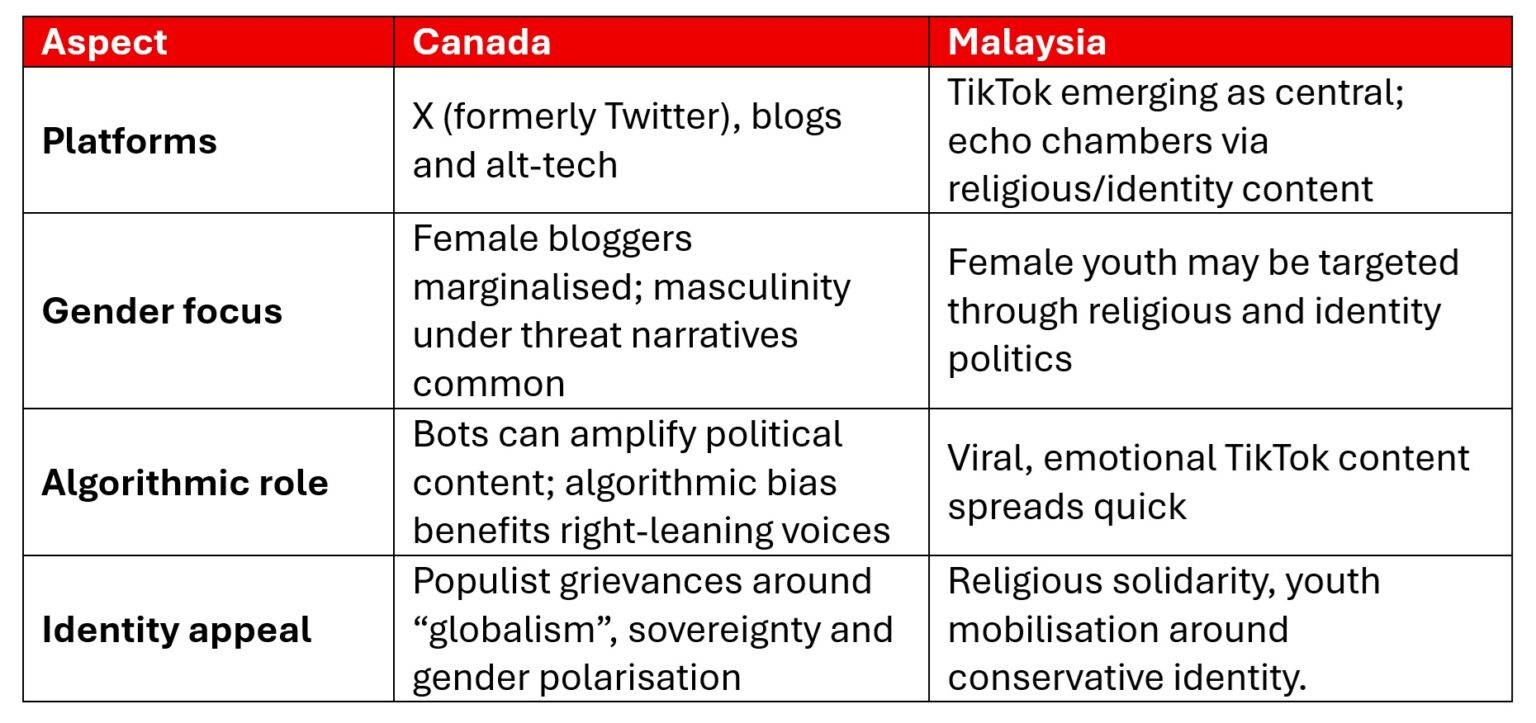
Canada: Fragmented Feeds, Polarising Posts
In Canada, the digital frontier has become a prime arena for far-right voices. Online communities form around shared grievances – targeting Muslims or political elites, for example – with disinformation flowing more freely than in traditional media.
The result? A fast-spreading network of ideology that slips past old editorial checks.
As the 2025 federal election drew near, X was flooded with pro-Conservative content. Bot-like accounts reposted non-stop, amplifying misleading narratives and shaping what young people saw in their feeds. It was a digital echo chamber in motion.
Gender plays a role in this story. Disinformation often carries with it a low cost and high emotional punch, especially when it taps into fragile ideas such as threatened masculinity or critiques of feminism. One in five Canadian men think feminism does more harm than good, and one in three sense masculinity itself is under siege.
That kind of messaging? It can land differently with young women who are navigating gender norms.
On top of that, female conservative bloggers in Canada face tough opponents. Their ideas are often dismissed or met with subtle – and sometimes not-so-subtle – sexism. Hence, when mainstream spaces feel dismissive or outright hostile, digital alt-right spaces – even those in the far-right – can look like more accepting places to share identity or to just simply vent.
In Canada, gender-based discrimination – content that rattles conventional notions of masculinity or portrays feminism as dangerous – is more than just simple fringe commentary. It is increasingly deployed strategically, sometimes even by state-sponsored actors, as a way to erode trust in democratic values or institutions.
What makes this especially dangerous is how it plays to the subconscious emotional layers of young audiences. For a young woman navigating gender identity in a politically tense climate, these messages can feel more like common sense than propaganda.
Malaysia
In Malaysia, it is less about overt far-right labels and more about conservative currents that are flowing just under the surface of the society.
As youth have finally earned their voting rights at the age of 18, many have surprisingly turned towards Perikatan Nasional (PN) and the Islamist Parti Islam Se-Malaysia (PAS)—two groups that lean heavily on religious identity and conservative values.
For young women, especially, the groups’ messaging reflects deeply personal debates pertaining to belief, modernity and community.
Online, this plays out through fragmented media spheres. Instead of one central news source, people inhabit digital bubbles that reinforce their worldviews and, by extension, their fears – or hopes – about the “other”. These bubbles may feel supportive, even though they really are just echo chambers.
Platforms like TikTok have become especially influential. During Malaysia’s last general election, TikTok rapidly turned into a hotspot for hate speech, pushing out polarising ideas in seconds. With catchy videos and viral hooks, the platform blurred the line between persuasion and pure entertainment, making extreme ideas feel easy to watch and share.
Researchers observed a sharp rise in hate speech on social media – a jump from about 55,000 to nearly 99,563 instances in key periods – often targeting ethnic and religious groups, including veiled references to non-Muslims or politically disfavoured communities. These are more than provocative posts: they are echo chambers that wrap viewers in self-reinforcing shots of bigotry.
For young women, these narratives are not just political; they are being framed as moral and personal truths.
Gender and Algorithms
In both countries, far-right outreach does not always start with “Hey!! Female youth!!” – but it often mirrors the angst and identity puzzles young women face.
Conversations in the so-called “manosphere” – the anti-feminist corners of the internet – show how discussions around feminism and gender can morph into broader, divisive ideology. If a platform edges one towards a rigid way of thinking, it sets the stage for shared narratives about purity, tradition or protection to take hold.
When algorithms are added into the mix, everything accelerates. When platforms show users similar content to things they have clicked on, youth can easily get trapped in feeds that reinforce a narrow worldview. Platform mechanics such as sharing, liking and reposting build momentum around content that is provocative, even if that very content is inaccurate or extreme.
Social platforms are designed to keep users watching, so if a user lingers on a post about “traditional roles” or a nationalist rally, the algorithm feeds them more of the same.
A young Canadian who watches one video questioning feminism might soon see a stream of anti-feminist commentary. In Malaysia, a youth who engages with religious-political clips may be served increasingly hardline content.
So why does this matter? Over time, it is not just about exposure but about normalisation. When these ideas show up in a user’s feed day after day, they stop feeling extreme and become part of the user’s online identity and how they see the world. When that happens, far-right groups do not need to recruit or influence an individual outright, as the user would have already absorbed the worldview the groups are promoting.
Towards Better Responses
If online spaces are shaping how young people see themselves, then fixing the problem has to be just as layered and personal.
First, we need to build digital literacy that speaks directly to gendered influence. Canada already has initiatives such as Media Literacy Week, teaching young people how to spot fake news and misleading posts. These programmes could go further by addressing how gender-based narratives work, showing young women how an emotional appeal about tradition, morality or feminism can be used to steer beliefs in subtle ways.
Second, platforms must be held accountable. Social media companies are aware that the algorithms amplify polarising content, yet global monitoring is uneven. Research has shown moderation standards are often stronger in English-speaking countries than in regions such as Southeast Asia. In Malaysia, this means harmful content in Malay or other local dialects can spread unchecked. Stronger, localised moderation policies – and more transparency about how political content is handled – are crucial.
Third, there should be space created for young women. When women with conservative or religious leanings feel dismissed in mainstream forums, they may turn to far-right or hyper-conservative spaces where their views are validated, even if wrapped in extremist ideology. Offering alternative online communities where women can explore identity and politics without ridicule can undercut the allure of these echo chambers.
Conclusion
In the end, this is not just about “fighting extremism”. It is about making sure young women have the tools, spaces and confidence to shape their own beliefs, without an algorithm or an unseen network deciding for them.
Whether in Canada or Malaysia, the far-right thrives by shaping identity through culture, gender and belief. Teaching young women how to spot online manipulation, fairer platform policies and inclusive online spaces can make it harder for those narratives to take root. The goal is simple: keep the choice – and the voice – in the hands of the young women themselves.
The views expressed are those of the authors and do not necessarily reflect those of STRAT.O.SPHERE CONSULTING PTE LTD.
This article is published under a Creative Commons Licence. Republications minimally require 1) credit authors and their institutions, and 2) credit to STRAT.O.SPHERE CONSULTING PTE LTD and include a link back to either our home page or the article URL.