search

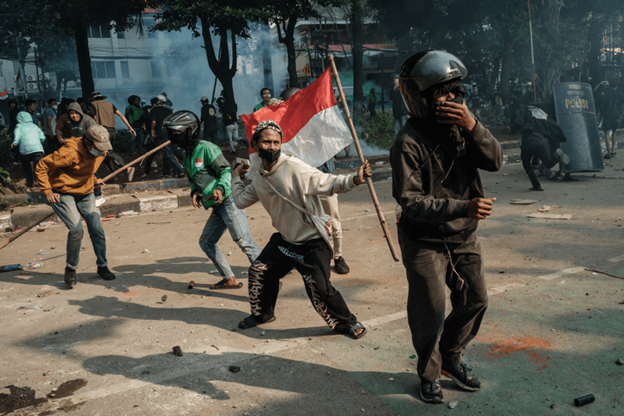
A violent clash in Jakarta, 29 August 2025. Credit: Yasuyoshi Chiba/AFP via Getty Images
After the Riots
- November 6, 2025
- 7 minutes of reading
Introduction
In Indonesia, owning a smartphone and paying for pricey internet data no longer mean you have the democratic right to express your voice. After the August-September 2025 riots, it has become clear that the government and digital platforms are shaping what can and cannot be said online.
Public space is already scarce offline. Parks, libraries and other civic spaces are limited and poorly maintained. For many, the digital realm has become the alternative public square to voice out their opinions, sadness and anger, or just an avenue to share pictures or videos of whatever is in front of them.
Ironically, Indonesia’s once‑vibrant digital public square has become increasingly narrow, restricted and suffocating. What was once perceived as a free online platform now feels more like a heavily surveilled space.
In this environment, citizens must assume they could be watched at any time—a realisation that harks back to the grim projections in Jeremy Bentham’s panopticon concept or the Orwellian dystopia.
While internet access and social media were once expected to empower dissent, this function may have lost its meaning. A case in point: during the riots, a key component of social media platforms was shut down by the authorities.
TikTok, Arrest and Ambiguity
Take the case of TikTok. In the wake of the demonstrations, TikTok abruptly restricted its LIVE feature. Officially, the company claimed it wanted to ensure the people’s safety after some protests turned violent.
Yet the timing was telling: the decision came just before TikTok executives met with Deputy Minister of Communication and Digital Affairs Angga Raka Prabowo. Both sides denied any link, but experts quickly pointed out how the restriction aligned neatly with the state’s interests.
Ironically, TikTok LIVE had become a powerful tool for real-time citizen reporting during the protests. Its temporary shutdown cost the protestors one of the most, if not the most, effective ways to document and amplify what was happening on the ground.
What was presented as a voluntary platform policy looks a lot like political censorship in disguise. In fact, some netizens (including the writer) reported being shadowbanned when uploading content containing criticism of the country’s sociopolitical situation.
Censorship did not stop at the platform level. The state itself stepped in, using vague legal instruments to repress dissent.
The arrest of activist Muhammad Fakhrurrozi – better known as Paul – in Yogyakarta on 27 September is one example. He was taken in without a clear arrest warrant. Others were charged under Article 160 of the new Criminal Code on “incitement”, a catch-all provision that criminalises posts deemed provocative.
Here lies the danger: incitement is so broadly defined that nearly any critical statement can be reframed as a threat to public order. Instead of protecting public debate, the law is exercised as a tool to constrict it.
Watching from the Shadows
Surveillance is also a major concern. Between 25 August and 8 September, Tim Advokasi untuk Demokrasi (the Advocacy Team for Democracy – TAUD) recorded 369 complaints of digital monitoring, including allegations that the Cyber Police could access WhatsApp statuses in Semarang, Central Java. If true, this is not only a violation of privacy—it is an intrusion into an intimate communication space, carried out without a clear legal basis.
The demonstrations also brought CCTV into focus. After the death of Affan Kurniawan sparked the riots in Jakarta, the CCTV footage of the incident became central to its investigation. Indonesia’s Komisi Nasional Hak Asasi Manusia (National Commission on Human Rights – Komnas HAM) used the feed to pursue accountability.
However, public CCTV access was suddenly cut off during the protests in several cities, including Yogyakarta and Solo. For example, a public traffic camera in Solo on 1 September reportedly went dark as demonstrators gathered at the city council building. Authorities said the online CCTV feed suffered “blackouts” coinciding with protests.
Meanwhile, the public CCTV in Yogyakarta on 1 September still showed a quiet Malioboro Square despite a planned protest. Officials blamed technical overload for the access issues. In both cases, citizens found that the city’s video feeds could be cut off just when they were most needed.
This selective interruption raises the suspicion that surveillance tools are available to authorities to monitor citizens but not to citizens when seeking justice.
These developments also strengthen the perception that digital monitoring tools have been turned toward mass surveillance. Facebook, TikTok and even private messaging groups have been swept for evidence of dissent. Platforms have quietly cooperated; the government has pressured social media companies to block hundreds of accounts deemed “inciting”—again, without public justification.
In effect, these surveillance practices have shrunk the digital commons. Indonesia’s Undang-Undang Perlindungan Data Pribadi (Personal Data Protection Law – UU PDP) regulates companies but does not impose a specific limit on government spying. Without independent oversight or transparency, citizens have no way to know when their online activities are being examined.
This uncertainty fuels self-censorship: the knowledge that “anyone can be criminalised” under these “rubber” laws is intended to instill a chilling effect on speech.
Rights on Paper, Restrictions in Practice
On paper, Indonesians are not powerless. Article 28E(3) of the 1945 Constitution protects the right to associate, assemble and express opinions. Article 28F guarantees the right to communicate and obtain information. Internationally, Indonesia is bound by Article 19 of the International Covenant on Civil and Political Rights (ICCPR), which affirms freedom of expression.
Yet rights on paper mean little if laws are weaponised against citizens. The new Criminal Code revives old authoritarian legacies, while Undang-Undang Informasi dan Transaksi Elektronik (Electronic Information and Transactions Law – UU ITE) remains infamous for muzzling critics. UU PDP, as mentioned, focuses largely on regulating private companies, leaving state surveillance practices unchecked.
Reflecting on Europe’s Best Practices
Indonesia’s approach stands in stark contrast to European legal standards on surveillance. The Court of Justice of the European Union (CJEU) has repeatedly struck down blanket data retention, ruling that mass, indiscriminate surveillance is inherently incompatible with human rights.
For example, CJEU has ruled that general and indiscriminate retention of communication data is unlawful under the European Union’s Charter of Fundamental Human Rights.
By contrast, in the European Union, targeted surveillance of specific suspects is allowed only under strict conditions, with judicial authorisation and independent oversight. On top of that, any emergency measures (such as monitoring during a security threat) must be carefully proportionate and time-limited.
Indonesia’s laws lack comparable safeguards. There is no requirement for warrants or public reporting when the Cyber Police scan social media groups or messengers. Surveillance powers can be triggered broadly, with limited accountability. As a result, the boundary between general and targeted monitoring has effectively eroded.
In theory an agency might pursue one “provocateur”, but in practice, whole networks of activists and bystanders come under watch by the legal apparatus. Without checks on how the state collects and uses communications data, every citizen’s life is under a default presumption of surveillance.
Living in the Panopticon
The philosopher Bentham imagined the “panopticon” as a prison design where one guard could observe many prisoners without them knowing when they were being watched. George Orwell later reimagined it in 1984 as a totalitarian dystopia. Both visions are now instructive.
After the riots, Indonesia’s digital public space increasingly resembles a panopticon. Citizens self-censor, uncertain of when – or if – they are being monitored. WhatsApp, TikTok, CCTV and other platforms become potential instruments of state control. At the same time, regulations such as UU ITE cast anxiety on those who dare to speak out against the state.
The result is a chilling effect indeed. Instead of debating, citizens hesitate. Instead of documenting, they delete. And instead of pushing boundaries, they retreat. The public space shrinks—not only physically, but also psychologically.
Towards What Future?
What emerged from the recent protests is not only a decline in democratic rights but also a deeper question of what Indonesia’s digital public space is going to be in the future. Is it still a commons where citizens can gather, speak and disagree? Or is it morphing into a state-managed arena where expression is conditional, monitored and even policed?
What remains is a stark choice of futures. If Indonesia’s democracy is to prosper, its citizens need a genuinely open online common.
That would require reversing the current trend: ensuring that surveillance is transparent and targeted (not all-encompassing) and that legal provisions protect, not punish, peaceful speech.
So far, however, developments seem to point towards the opposite direction. The price of speaking out online has risen, and the space for civil society has shrunk. As some civil society groups warned, when people must calculate whether their next text or livestream might land them in trouble, the promise of the Internet as a public square is lost. In short, without reforms and vigilance, Indonesia’s digital realm risks becoming a self-reinforcing panopticon—in name only a public space, but in effect a controlled arena of expression.
The views expressed are those of the authors and do not necessarily reflect those of STRAT.O.SPHERE CONSULTING PTE LTD.
This article is published under a Creative Commons Licence. Republications minimally require 1) credit authors and their institutions, and 2) credit to STRAT.O.SPHERE CONSULTING PTE LTD and include a link back to either our home page or the article URL.