search


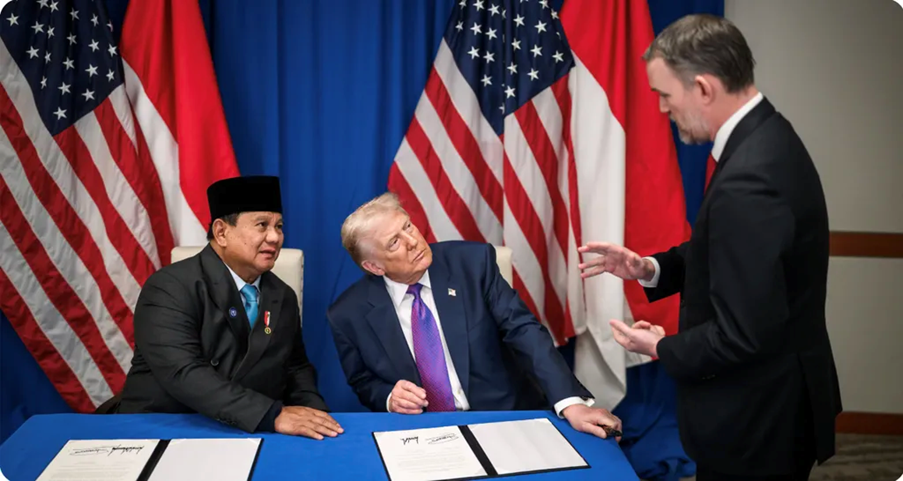
Under the Prabowo administration, mandatory downstreaming of minerals has transitioned into a more assertive phase of strategic asset consolidation. Credit: Google Gemini
Essay: Sensible Resource Nationalism?
Jackpot
If you want to understand modern Indonesia, you cannot ignore its natural resources. From nickel and coal to palm oil and gold, the country is sitting on a geological jackpot.
Over the past decade, Jakarta has made one thing pretty clear: these are not just commodities to flog to the highest bidder. They are instruments of sovereignty, levers of industrial policy and symbols of national pride.
Under former president Joko “Jokowi” Widodo, Indonesia leaned into what is often called resource nationalism. But this is not some old-school, heavy-handed version from the 1970s, nor is it free-market liberalism. It is more of a hybrid: assertive but practical, nationalist in tone yet technocratic in how it is actually carried out.
The big question now is whether that model is moving into a trickier phase.
Developmental State with Nationalist Twist
The groundwork was laid with Law Number 4 of 2009 on Mineral and Coal Mining (Minerba), which has since been updated to Law Number 2 of 2025. This latter instrument scraps the more liberal setup from the Soeharto era. Today, foreign mining firms are required to divest shares to Indonesian entities over time, and companies are expected to process raw minerals domestically.
The logic was straightforward: why export raw ore and let foreign refiners pocket the value? Why not build smelters at home, create jobs, strengthen industry and climb the value chain?
Nickel became the poster child. Indonesia has the world’s largest nickel reserves—crucial for stainless steel and, increasingly, electric vehicle batteries.
The impact was dramatic. Billions of dollars, much of it from China, poured into industrial parks in Sulawesi and beyond. Indonesia shifted from being a raw materials supplier to a dominant player in global nickel processing. From a development point of view, it looked like a bold win.
But resource nationalism has never just been about economics. It is political too.
A key moment came with the renegotiation of the Grasberg mine in Papua, previously majority-owned by Freeport-McMoRan. After long negotiations, Indonesia secured majority ownership through its state mining holding company.
Politically, this came across like a projection of power. It resonated with the people as a reclaiming of a key national asset and locking in revenue.
But it also showed how complex and expensive these deals can be.
State-owned enterprises (SOEs) sit at the heart of this model. Mining SOEs have been consolidated into holding structures meant to improve coordination and strengthen bargaining power.
In theory, this ensures that profits align more closely with national development goals and gives Jakarta greater leverage in negotiations with foreign partners.
In practice, however, concentrating control also concentrates risk. Without transparency, clear oversight and professional management, SOEs can drift into patronage networks and rent-seeking.
At first, the emphasis was squarely on downstreaming—pushing more processing and manufacturing at home. Now, there are signs the focus is broadening toward deeper strategic ownership and long-term control of assets themselves.
Gold is a good example. Unlike nickel, a country cannot build an industrial ecosystem around bullion. Gold is more about fiscal strength and financial resilience. That is why debates around initiatives like the state’s new sovereign wealth super-agency, Danantara, which floated the idea of consolidating state assets more aggressively, attracted attention.
Take, for example, the Martabe Gold Mine, operated by PT Agincourt Resources. It is one of Indonesia’s largest gold producers. Danantara’s attempt to take over the mine suggests that what was framed initially as swift environmental accountability after deadly floods in Sumatra has quickly become something much messier. Critics pointed out that key due process steps seemed to be skipped, and the intended transfer of the mine to a new SOE called Perminas looked more like a state-led seizure of private assets.
That sparked alarm in global markets, with institutions from Moody’s to MSCI flagging concerns about regulatory unpredictability and legal certainty in Indonesia’s resource sector. Investors began to reassess how they viewed Indonesia’s stability as a long-term destination.
The government has since somewhat backtracked, with President Prabowo Subianto directing a re-evaluation of the environmental claims and reviewing whether Agincourt Resources’ rights should be restored if no violations are found.
Even so, advocates warned that swooping in on assets without clear legal grounding could expose the state to lawsuits and cast long shadows over contract sanctity and land rights well beyond the tenure of a single administration.
All of this is happening against a shifting global backdrop. Demand for critical minerals is soaring as the world moves towards electric vehicles and renewables. Much of the nickel build-out has been financed with Chinese capital, even as Jakarta tries to diversify ties with the United States.
Resource nationalism becomes part of that balancing act: assert autonomy, engage multiple partners and avoid overdependence on any one power. It is a delicate calibration.
There are risks. Investor confidence depends heavily on predictability. Mining is capital-intensive and long-term. Even small hints of tighter ownership rules or licensing changes – especially in sectors like gold – can nudge up perceived risk.
There is also concentration risk. The strategy leans heavily on a handful of minerals, which has paid off during the current energy transition boom.
But commodity markets are volatile, and technology moves on. Battery chemistry could change. Demand cycles could soften. Tying an industrial strategy too tightly to one or two commodities inevitably brings exposure.
Then there is also geopolitics. The rise of nickel is closely linked to Chinese investment and technology, while engagement with the United States reflects a desire to diversify. Lean too far one way, and leverage turns into dependency; push sovereignty too aggressively, and partnerships may cool.
As highlighted in a recent discussion, the real story is about how commodity booms quietly reshape the relationship between the state and big business over time.
Downstreaming creates new industrial players whose fortunes hinge on continued protection and favourable regulation. That can deepen ties between political power and corporate interests in ways that are perfectly legal but not always transparent.
In the long run, the test is whether the government can do so without blurring the line between strategic direction and discretionary control.
Whose Interest?
Not everyone is convinced that resource nationalism automatically serves the broader public. Critics point to environmental damage, labour issues and uneven benefits in some downstream industrial parks. Local communities often end up dealing with the pollution and land disputes, while the money tends to land in corporate pockets—whether state-owned or private.
Looking back at Jokowi’s decade in office, resource nationalism stood out as a defining theme. It fit neatly with his wider development push: infrastructure, industrial upgrading and tangible economic gains. Still, Jokowi’s approach was often less ideological and more like strategic bargaining: the state set the terms, and investors decided if they could work with them.
Under Prabowo, the downstreaming doctrine has largely stayed in place. One clear signal from his administration is that the raw mineral export bans are not up for negotiation, even if major partners push for access. The finalised trade deal with the United States makes it pretty clear the focus is on processed goods and investment, not a return to shipping out raw ore.
Treating export bans as non-negotiable sends a strong signal at home too. It reduces uncertainty about the direction of policy and, simultaneously, raises the stakes around how licences, quotas and incentives are handed out—areas where rent-seeking risks can creep in.
Prabowo has also floated extending the nickel playbook to other commodities, including tin. Even suggesting a possible export ban shows that curbs remain a tool in the government’s kit when it sees strategic value in using them.
On top of that, the creation of Danantara helps push through big, capital-hungry downstream projects when private investors hesitate. But the trade-off is governance. Put that much money and influence in one place, and you either supercharge development or make it much easier for decisions to become politicised.
Energy security has entered the picture as well. Moves to restrict exports of palm oil by-products and adjust export levies tie resource nationalism to biodiesel and the broader fuel ambitions. The approach is more comprehensive: keep a tighter grip on raw inputs, support domestic processing and reduce reliance on imports.
There has also been tougher enforcement of land legality and forest operations, with hefty fines and land seizures aimed at companies operating without proper permits. That can be read as cleaning up governance or as expanding the state’s footprint in commodity supply chains. In reality, it is probably a bit of both.
Conclusion
Indonesia’s brand of resource nationalism is broadly sensible. The nickel strategy demonstrated that the state can change the country’s economic trajectory if it is willing to lean in. Indonesia has not slammed the door on foreign investors; it has simply made clear they enter on national terms.
Now, however, things get trickier. Moving up the value chain was the obvious first step. Tightening strategic control and pooling assets is a far more delicate business. It requires steady hands and institutions capable of carrying the weight.
Indonesia wants global capital, but on national terms, while hedging between Beijing and Washington. The minerals will still be there in 20 years. The real question is whether governance will be strong enough to manage them.
This article is published under a Creative Commons Licence. Republications minimally require 1) credit authors and their institutions, and 2) credit to STRAT.O.SPHERE CONSULTING PTE LTD and include a link back to either our home page or the article URL.